Despite Formula 1 producing a thrilling recent Championship battle, and all the current excitement leading into the 2026 season, I've mostly been away.
I’m still finding time to be a general nuisance at GrandPrix247 Headquarters on as much of a regular basis possible, making a lot of noise but contributing little, and it’s because I've been busy fielding my driver in a karting program designed for kids aged four to seven years old.
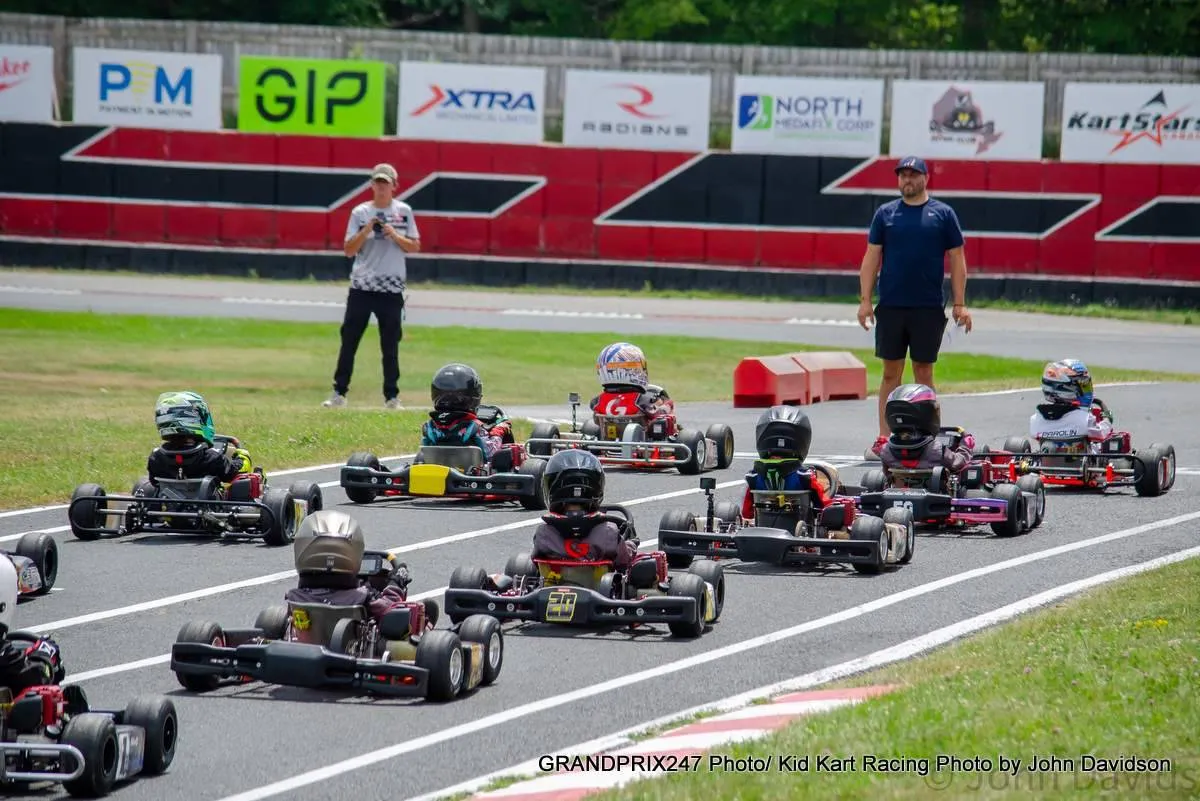
That is right, for the last two years I've been busy participating in “Introduction to Racing” Kid Kart Program, a karting program led by Daniel Di Leo for sub eight-year-old children at Goodwood Kartways near Uxbridge in Ontario, Canada.
Kids jumping into karts traditionally starts around the age of seven and while there is nothing particularly unusual about putting a four-year-old in a kart, it’s been more so reserved for the kids of die-hard racer parents that had the means to do so.
Now, for those lucky enough to have circuits available to them that allow it, it is open to anybody and everybody. What started as a fun learning experience for myself and my son Alvaro, it quickly turned into intense open practice schedule at various kart circuits trying to speed up the learning curve. Karting was something I was lucky enough to compete in as a teenager.
As a parent, I’m grateful to have completed the “Karter to Karter Dad” transition. Jump 25 years onwards from my own karting experiences as a driver, I find myself participating in something that many people have never seen or even heard of.
This new journey is interesting on paper: buy a kart, stuff a small child in, and send them out on track. In principle, the whole concept sounds maybe a little absurd, so here's what I've been up to in my last two years at the track.
The Kart and Driving Equipment

It begins four years ago at Innisfil Kart Club in Gilford, Ontario. This was my home circuit growing up. Having already modded my son’s e-bike to go faster, I decided to swing by and visit track owner Tony Launi to embark on a new challenge, I picked up a used CRG Puffo kart.
These karts have several names, a baby kart, a kid kart, a bambino kart, but basically, they are karts with a wheelbase that is shorter than 950mm. These karts are not recognized under FIA homologation, as they are shorter than Group 3 FIA dimension “Mini” or ‘Cadet” kart category, however all top karting manufacturers offer them.
These particular karts are sized such that even a four-year-old can be made to fit comfortably. The chassis are traditional to form, they're just smaller and much lighter in weight. Power is delivered from a genuine or cloned stock Honda GX35 motor, a whopping 1.3hp. It is capable of delivering a top speed of 60km/h.
Vega blue tires, no minimum weight requirements and a mandatory gearing ratio of 8. This is accomplished with a combination of an 8-tooth pinion, 64 gear rear sprocket, or 7-tooth pinion, 56 gear rear sprocket. Drivers are fitted with Snell approved racing helmet, wear rib protectors, gloves, neck protector and a racing suit designed specifically for karting.
First Run

It's 8:00 am, April, it is really, really, cold. Day One of Introduction to Racing, orientation is being led by Daniel Di Leo. Lesson One, after going over some basic rules and flags, the kids are tasked with a braking input and general control test.
It's amazing to see how quickly children adapt to the stress of showing up, among 50 or so other kids to begin lapping. Some kids learn slow, some learn fast. The young ladies seem to excel immediately.
Perhaps my very first observation the girls simply have a better stress coping mechanism in the kart at speed than boys at this young age. It’s a pattern which would continue to reveal itself throughout the program.
Community

It doesn't take long before kids begin bonding and having fun outside of the karts, it’s only natural. Parents begin to bond as everyone has something to contribute, and it’s the parents helping each other in some capacity that helps keep all the kids running on track.
Over time, all of these relationships intensify. Birthdays become a blend of school friends and karting friends. Parents begin grouping in messaging groups and information begins to flow.
Outside of the kid kart racing program, multiple kids are heading out to open practice lapping. It can be pretty boring to run all by yourself on track so every opportunity for five or six kids to be grouped together, they will run for hours and complete hundreds of laps together.
First Crash

This one’s taboo. Nobody wants to talk about it, nobody wants to believe it, nobody wants to accept it until it happens.
First crashes are brutal but inevitable, it is going to happen no matter how much effort is put into preventing it, it happens with 100% certainty. The normal cycle has been every kid starts fast, has an awful crash and then is reset to a pace that’s slower than where they first started to begin with.
First crash is core principle learning, something all race car drivers know well, and it is to understand the risks and keep themselves out of trouble. We do have the fearless though, like five-year-old Eleanor Irwin who flipped her kid kart and sampled a significantly faster Briggs Lo206 cadet kart for the first time all in the same afternoon.
Rebuilding and Development

Even at the age of five, every kid has specific needs. The most basic being their ability to adequately reach the pedals, comfortably grip the steering wheel, and be able to see above the bodywork and steering wheel.
Making sure these things are set correctly helps them get up to speed sooner, and it’s beneficial to them as they gel to their karts. This gelling takes a lot of time, and patience.
During practice days Dan would split the field into 2 or 3 groups based on pace with the goal of getting all kids to progress to their ultimate best and converge as one big pack. The kids would participate in drills teaching the line, braking, and crash avoidance, all done rain or shine.
Expectation and Roller Coast of Disappointment

If the first crash is the first major hurdle, parents managing expectation is the second. This is where I myself have to take a deep breath and slow down.
It’s so easy to get lost in the concept that improvement is made in a linear fashion, lap to lap, session to session. This is not how it works with five-year-olds.
There is intrepid joy when the kids deliver fast and consistent lap times only to be followed in so many instances with near insurmountable frustration when the kids lose an alarming amount of lap time out of the blue, for what us parents perceive as for no apparent reason.
The most frustrating moment in year one for me was a race day swap of steering wheels. Alvaro was in the mid pack; I swapped him to a larger wheel to help him have a better feel. The wheel we swapped to has a flat top. It is a great wheel that Alvy would eventually prefer exclusively and still uses today.
However, on this day, it cost him 10 seconds per lap due to a general discomfort and slightly less visibility than the stock steering wheel. Standing trackside while this went down, I was inconsolable, consumed in anger, ready to sell everything. Managing the roller coaster of disappointment is a constant. It is just part of the learning process and expected.
Becoming the team mechanical, hauler and driving coach

There is a bit of a blessing running a simplified package, with an almost maintenance free motor, easy access to parts through Honda, and a fixed gearing ratio.
The transition into this category is far simpler than jumping straight into cadet level karting. Parents from all walks of life get to jump in with both feet at a manageable stress level. There are of course instances of unbelievable poor luck resulting in almost inexplicable levels of damage and stress.
There is supplemental stress such as purchasing, storing and learning how to reverse a trailer. For those jumping in and all of a sudden finding themselves having to figure this out, it is perhaps more stressful than getting the kart on track to begin with. Wrenching on these karts can also be stressful for those who have never had the need to wrench on anything. These karts are traditional to design, so lessons learned at this level become repeated in subsequent divisions of karting.
By the end I managed to turn every bolt and nut on the kart many times over including those inside the engine. There are also the supreme leaders in this category like John Davidson who not only did all of the above, but also flooded the community with photographs, while “Dadmaxxing” like a pro.
There are several driving coaches already providing aide to these youngsters, believe it or not. Having a driving coach at these ages has been completely normalized through this program. The driving coach aspect at this point for my son is pretty much summed up by saying “go faster” over and over again. It didn’t make him go faster, but I felt obligated to say it anyways.
Solidification to keep fighting on

Getting towards the end of the season, the roller coaster of pace, despite being a sting for parents, has somewhat become expected. It truly becomes the spirit of the kids on a whole that transcends us parents to continue to push on.
The enthusiasm all parents feel when one kid overachieves sends a shockwave of positivity through the paddock of parents. Even when your own driver has had an off day, you just can't help but feel and embellish in the positivity for a driver that delivered more than expected that day.
That spirit resets the negativity and provides the strength to continue to try, continue to practice and find the will to be prepared for the next race.
Cost and time commitments

Year one costs 10,000 CAD (almost 7,500$) minimum, requires a lot of time and does not include the cost of a trailer. It isn't unusual for these four-year-olds to find themselves in a kart multiple times a week.
Between track practice passes, the program cost at Goodwood Kartways, securing a kart, purchasing driving equipment and transportation, it all boils down to a very simple and straightforward formula: more track time equals more cost. Some costs can be circumvented but those cost reduction measures are a trade for free labour.
I throw an insane amount of free labor at my program to keep the cost low although admittedly it results in significantly less available free time.
Finish strong

By the end of the year, not a single driver is on the track that shouldn't be. Every driver has made significant progress from where they started. The slow progress of the season has led to significant cumulative improvement for most.
Everybody has a hyper focus on their own son and daughter; we all want our kids to be the next Lando Norris.
The truth is, being in the moment, not forgetting the enjoyment of it all is of far greater value than the karting results at this stage.
The value of family time is supreme, but winter is arriving for us in Southwestern Ontario, the karts will go away, until part two anyways.
Latest News


Loading