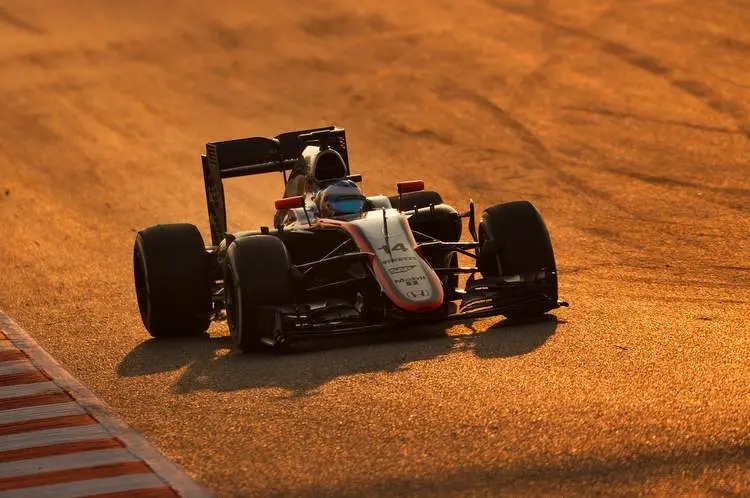
With all the current talk about the woeful performance of the reunification of the McLaren-Honda partnership, it is easy, especially in this social media age, for everyone to have an opinion and readily point out the shortcomings.
As an ex-McLaren man myself, it makes me sad and frustrated to see this once great team battling with the likes of Marussia, splendid team that they are on their limited resources. Ron Dennis once famously said to be second is to be the first of the losers, so no doubt it pains him deeply to be second to last!
So how did it get to this? At the start of the rekindled partnership there was so much hype based on history, including four consecutive drivers and constructors championship and during the first dominating year of 1988, taking 15 out of 16 Grand Prix wins, 15 out of 16 pole positions and 97% of laps led - see I can still recall all of the facts we proudly boasted. In fact, if it wasn’t for Ayrton tripping over Jean Louis Schlesser at Monza, there would have been a 100% record!
However, great as all these achievements were, you do have to bear in mind that when the McLaren Honda partnership commenced, Honda was a well established in Formula One as an successful engine manufacturer and was a much sought after partner - hence the raid by McLaren on Williams.
In addition 1988 was the last year of the turbo before switching back to normally aspirated engines. So while other turbo engines were being used for the last year, Honda built a brand new V6 engine specifically for that year and had found a specific loop hole in the regulations. As ex McLaren and subsequently Ferrari Technical Director John Barnard explained in the book ‘The Life of Senna’:

“Honda manipulated the regulations to accommodate the boost level and found a way to circumvent them that masked the boost level limit by putting cunning shapes within the manifold, which effectively put the head of the pop-off valve in a low pressure area. So although the boost limit was 2.5 bar the engine saw as much as 2.9 bar”.
It took Ferrari a whole six months to catch up and do the same thing!
Once on the track the performance was staggering, although I do remember that they had great problems initially getting the engine started, which led to the sight of the car being towed around the McLaren car park for some time in order to bump start it!
However, all of this success came towards the end of that particular era of Honda’s involvement in Formula One. Honda have participated in Formula One, as an entrant, constructor and engine supplier, for various periods since 1964.
Their first withdrawal in 1968 was precipitated by the death of Honda driver Jo Schlesser during the 1968 French Grand Prix. Honda returned in 1983 as an engine supplier to Spirit, Lotus and Williams, which cumulated with McLaren in 1992.
They again returned in 2000, providing engines for British American Racing (BAR) and by the end of 2005 they had bought out BAR and renamed the team Honda Racing and raced until 2008 due to the Global financial crisis. This led to the management buyout headed by team principal Ross Brawn and subsequently winning the World Championship in 2009 with Jenson Button.

However Honda never come close to repeating the success they shared with McLaren, so rejoining forces seemed perfectly logical. But the world of Formula One has changed. We now have ‘power units’. Not only is there a a V6 1.6 litre turbo charged engine, this is also supplemented by an Energy Recovery System (ERS) which converts mechanical and heat energy into electrical energy. Whilst the overall power output is in the region of 760 bhp, this is made up of 600 bhp from the engine, plus 160 bhp from ERS.
Therefore, it is a matter of getting the right combination between the two components. This the key which Mercedes has done so well. Whilst you may have a good engine, if you can’t generate sufficient power from ERS then you will be a sitting duck on the straights, as Fernando Alonso experienced in Suzuka and hence his comment about GP2 cars, which have 612 bhp!
From all that has been talked about, Honda’s main power problem is with the ERS. Okay they haven’t got it right yet and it must be remembered that they are effectively at least a year’s development behind Mercedes and Renault, who themselves have had problems which has led to the unsightly and acrimonious divorce from Red Bull.
But to my way of thinking, the biggest problem is the regulations and their politically correct overpowering micromanaged restrictions. Sure, so sometimes people, teams, constructors, engine makers, don’t always get things right … BUT they should have the ability to develop out of the problems. We used to say that a Formula One car could change by up to 95% throughout the course of the season. No more!
Recently McLaren CEO Ron Dennis said that Formula One's regulations are delaying his team's return to competitiveness with new engine supplier Honda.

"I think the frustrations I have with the regulations is that everything that has been designed to reduce costs has increased it and primarily because the cost of getting durability is endless evaluation on dynos and test cells," he said. "I would like to go testing, I would like to have freedom in wind tunnels, freedom in CFD. When you are uncompetitive you have to develop your way out of it and at the moment the regulations are extremely constraining in that area."
Under the current regulations, from the start of the season to the end of the calendar year, the teams are permitted to take part in two team tests of no more than two consecutive days at circuits where an event has just taken place. These tests must commence no less than 36 hours after the end of the event.
However if that wasn’t restrictive enough, two days of each in-season test must be allocated to young driver training, which is classified as someone who has competed two or fewer Grands Prix.
So effectively McLaren Honda are expected to put on a world class performance with the equivalent of fighting with one hand tied behind their back!
Back in the glory days, the team in a bid to progressively improve, ran not only a permanent test team in Europe, who an averaged test most weeks after a Grand Prix, but also kept a special team based in Japan running at Suzuka and Fuji, which kept Emanuele Pirro, Jonathan Palmer and Allan McNish gamefully employed at various stages.
I am not advocating that we go back to testing with that degree of intensity, but if you could stand back at look at the whole picture for a minute, which admittedly is not a Formula One natural forte, it does make sense to allow more freedom to test and allow the team’s to develop their cars in a natural racing environment, rather than in the artificial world of simulation!
Inside Line by Peter Burns
Latest News

Loading