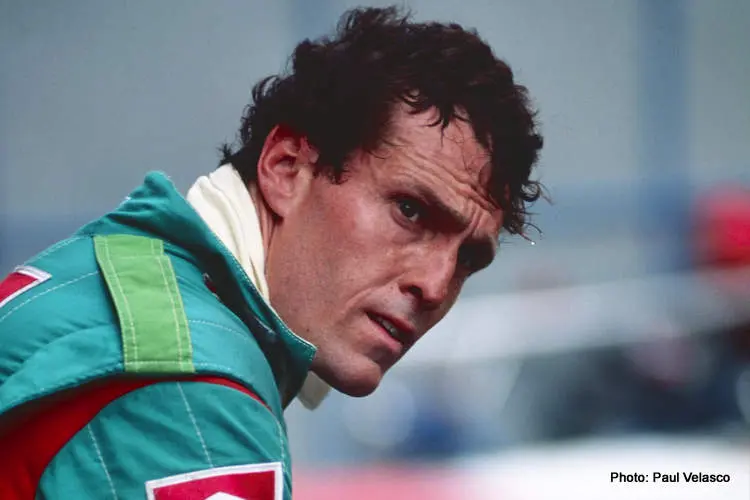
Double tragedy shook the world of Formula 1 on October 5, 2014, from Roma to Suzuka. Marussia driver Jules Bianchi suffered a serious accident at Suzuka in the rain. Unfortunately, without ever regaining consciousness, he would pass away in 2015.
On the same day of the tragedy at Suzuka, on the other side of the world in Italy, the Roman gladiator Andrea de Cesaris lost his life in a motorcycle accident. Closing a chapter in the life of a driver who took part in 208 Grand Prix races.
Early Days. De Cesaris had a successful karting career, the highlight of which, apart from winning the Italian and European championships, was victory in the 1976 World Karting Championship in the junior category held in Wohlen, Switzerland.
In 1979, he raced in the ultra-competitive British Formula 3 series and put in a robust performance, winning six races, one more than more consistent Brazilian Chico Serra, who outscored the Italian 103 to 90 points to take the title.
The Marlboro Man. De Cesaris’ father was in the tobacco business and had enjoyed a good relationship with Aleardo Buzzi, the man in charge of marketing dollars at Marlboro Italy. De Cesaris in the cockpit meant Marlboro on the sidepods of the racing car.
De Cesaris meets Ron Dennis

In 1980, de Cesaris moved up to Formula 2 and took his Marlboro sponsorship to Ron Dennis and his Project 4 Team. The one-time Brabham mechanic and now a Formula 2 team owner would take the Marlboro partnership to a different level and just eight years later would smoke the Formula 1 competition with his Marlboro McLaren and possibly best ever driver lineup of Alain Prost and Ayrton Senna.
Now back to the 1980 European Formula 2 Championship. De Cesaris started the season on a high note by taking third place in his first F2 race at Thruxton. After retiring from the next two rounds, he was back on the podium, one step higher in second place at Vallelunga. Retirement in Pau was followed by another second-place podium at Silverstone.
His first and only victory of the season came in the penultimate round at Misano. He was classified fifth in the championship with twenty-eight points. Brian Henton was the champion with sixty-one points.
The Piranha Pool. Alfa Romeo gave de Cesaris his Formula 1 debut in the penultimate round of the 1980 season in Montreal. He also took part in the season finale at Watkins Glen. He retired from both races. Sign of things to come.
First full F1 season with McLaren

His first full season in Formula 1 was in 1981 with Ron Dennis and Marlboro McLaren International. The season turned out to be very rocky for the 21-year-old Roman driver.
While his teammate John Watson finished sixth in the championship with twenty-seven points, including carbon fibre McLaren MP4/1’s maiden win at Silverstone, de Cesaris was eighteenth in the standings. His only point of the season came from sixth place in the San Marino Grand Prix at Imola.
He suffered eight retirements from fourteen starts. There were driver errors and accidents like at Silverstone, which he blamed on Gilles Villeneuve spinning, leaving him nowhere to go. De Cesaris was of the opinion he was not treated fairly by Dennis, pointing to roughly twenty laps of testing at Silverstone before the season opener in South Africa at Kyalami, a race later declared a non-championship event.
Much like today’s FIA President de Cesaris would blame the English press for the negative reputation bestowed upon him, especially the nickname “De Crasheris.”
De Cesaris moves to Alfa Romeo with Marlboro backing

In 1982, he joined the friendly and what he called “family atmosphere” at Alfa Romeo under the helm of Carlo Chiti. In only his third race for the Milan-based team, de Cesaris put the V12 Alfa on pole at the USGP West in the streets of Long Beach. He led for fourteen laps before crashing out.
In a season of sixteen races, he had ten retirements. He was within a lap of his maiden Grand Prix victory in Monaco when he ran out of fuel; he was still classified third in the race. This and sixth in Canada were his only points-scoring finishes during the season, leaving him seventeenth in the championship with only five points.
For the 1983 season, the Alfa Romeo team switched to a V8 turbo engine, and Mauro Baldi replaced Bruno Giacomelli as de Cesaris’ teammate. He led the Belgian Grand Prix at Spa-Francorchamps and set the only fastest lap of his F1 career before engine failure. He was second in both the German and season finale, the South African Grand Prix.
He was classified in the top ten in the 1981 F1 World Championship, earning fifteen points for P8 in the standings.
The next two seasons he experienced French flair and fear of team owner Guy Ligier. In 1984, it was more of the same. Nine retirements from sixteen starts. The three points he scored to finish eighteenth in the championship came in two of the first four races, fifth at Kyalami and sixth at Imola.
De Cesaris goes French with Ligier
In 1985, there were eight retirements from eleven starts with the French team. Fourth in Monaco was the only point of the (partial) season. High drama and wrath of Ligier came at the Austrian Grand Prix, where de Cesaris had a monumental barrel-roll crash from which he was lucky to escape serious injuries.
Contrary to the popular myth in which de Cesaris would allude to the press “bullshit,” he was not fired by Ligier, as proven by the fact he raced for the team in the next round at Zandvoort; this would turn out to be his last race of the season.
Before the Dutch Grand Prix de Cesaris had accepted an offer from Herbie Blash to join Brabham, based on this, he advised Ligier he would not renew for the 1986 season. The Brabham deal fell apart when the team was advised by their engine supplier BMW that they had to keep their driver, Marc Surer.
In 1986, de Cesaris would drive for fellow Italian Giancarlo Minardi. Chiti was back in the picture too, as he designed the Motori Moderni V6 turbo. The season was a complete disaster; the 16-race season saw one finish, eighth in Mexico City, a DNQ in Monaco, and fourteen retirements.
The Brabham stint

A seat would open at Brabham for the 1987 season, which allowed the thrill of 1,000 hp from the BMW turbo engine. Unreliability remained his constant companion. He never took the chequered flag in sixteen races; even in his third-place finish at Spa, he stopped on the penultimate lap of the 43-lap race after running out of fuel.
The next stop for the 1988 season was the Rial team owned by Günther Schmid, a German alloy wheel manufacturer and former owner of the ATS team. He was so eccentric he would make Günther Steiner look normal. Despite having talented Austrian Gustav Brunner as designer, Schmid ran the show and had a say in everything, from telling mechanics how to hold a screwdriver to advising his drivers how to drive.
De Cesaris delivered a fourth-place finish in the streets of Detroit, the only point finish of the season. As usual, there were more retirements than race finishes, and for the 1989 season, he moved on to his fourth team in as many years.
The high point of the 1989 season for him and his new team, Scuderia Italia Dallara, was the third step of the podium in Canada; again, this was the only point finish of the season. The following season, 1990, with the same team resulted in no points, and de Cesaris endured twelve retirements from fifteen starts.
New Jordan team signs De Cesaris

For the 1991 season, he joined the new Jordan team to drive the beautiful Gary Anderson-designed green Jordan 191. The driver was lucky to escape injuries after a serious crash at Silverstone. At Spa, de Cesaris was running second and had a good chance to win the race as Senna was experiencing gearbox issues, but then the engine expired. Ford had failed to inform the team the new piston rings would be using more oil.
Lady Luck was never willing to dance with de Cesaris.
But a bigger problem had arrived in the team making his debut that Spa weekend. That is a story for another day.
De Cesaris scored points in four races; his best result was fourth in Canada and Mexico, and he finished ninth in the championship with nine points.
The Tyrrell stint
![Andrea de Cesaris (Tyrrell 020B) & Érik Comas (Ligier JS37) - 1992 - Japanese GP (Suzuka) [1456x898] : r/F1Porn](https://external-preview.redd.it/CtatKX7NqI7AxHLoe6piuWBrRIZBT8V5gdvR43BOP3s.jpg?auto=webp&s=583eaaf22910ff036f898d1f9e17eaa88f939402)
Ken Tyrrell welcomed the Roman driver for the 1992 season to his lumber shed team in Surrey, England. The championship-winning days of his star driver “JYS” were by now distant memories, but “Uncle Ken” carried on with much enthusiasm and dedication.
De Cesaris’ best finish was fourth in the Japanese Grand Prix at Suzuka. Eight points put him ninth in the standings.
In 1993, the Tyrrell team had a Yamaha V10, and the season was a complete disaster for de Cesaris. Only one top-ten finish in Monaco and no points scored through the sixteen-race season.
The tragic 1994 season would be his last in Formula 1. He had two point-scoring finishes, fourth in Monaco with Jordan, while replacing Eddie Irvine, who was serving a three-race ban. And sixth in the French Grand Prix driving for Sauber in place of Karl Wendlinger, who was seriously injured in Monte Carlo.
In life after Formula 1, de Cesaris enjoyed the thrill of windsurfing, declaring Hawaii to be the best place for windsurfing. His other passion was dealing in currency exchange. He did well in both.
The Last Lap
A man who raced Grand Prix cars all over the world for over a decade was unfortunately unable to survive the crash of his Suzuki 600 on a Roman Sunday afternoon. According to the police report, he lost control of his bike, crashed into the guardrail, and was killed instantly. He was 55 years old. The day was, 5 October 2014.
Latest News


Loading