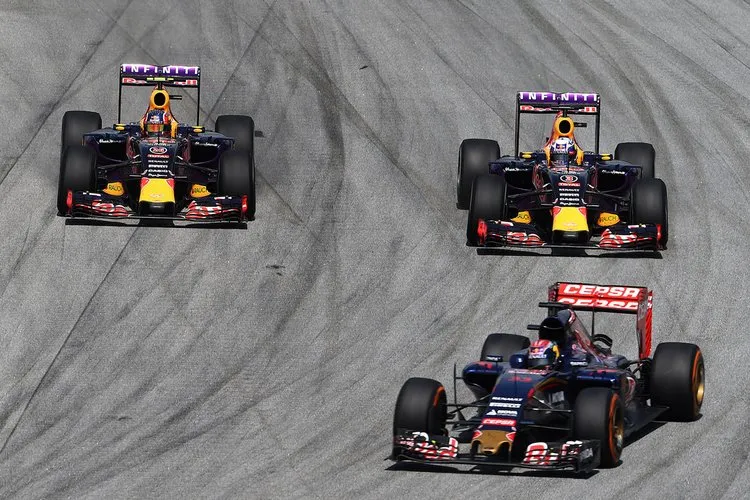
Renault, engine supplier to Red Bull and Toro Rosso, preview the Canadian Grand Prix - Round 7 of the 2015 Formula 1 world championship at Circuit Gilles Villeneuve, on the IleNotre Dame in Montreal.
Remi Taffin, director of operations, "Montreal is one of the circuits where accurate, smooth power delivery is crucial. The straights are long so the driver needs strong acceleration, ideally reaching top speed towards the end of the straight."
"The corners are tight and low speed, so the driver needs the power quickly to flick the car in and out of the chicanes, but smoothly through the hairpins."
"Giving the driver the power when he needs it is one of the key challenges of the weekend and we have worked particularly hard with the teams to develop engine maps and settings to this end."
"The Circuit Gilles-Villeneuve also puts the internals under intense pressure. Over half of the track is taken at full throttle, with two long straights, and the heavy braking points at the end of those straights put the ICE under extreme load."
"Even the energy recovery systems will feel the pressure in Canada with the numerous heavy braking points and straights, so overall it’s a very difficult race to get right.
"We are realistic ahead of this race. We’ve put in a great deal of work on reliability and have improved our record in the last two races, but we know that Montreal will be tough for us performance-wise."
"Knowing that power is critical, we have to try to repeat our Monaco approach, which was to optimize each sector individually. Unlike Monaco, however, we also need to assess the right drag/downforce compromise to allow good performance in qualifying and the race."
"We are getting there, and hope we can be closer yet again in Montreal."
Renault 2015 fast facts:
- Montreal has the shortest overall lap time of the season. It takes just 75 seconds on average for the cars to round the track, making it the quickest single lap time of the year.
- The Circuit Gilles-Villeneuve has the highest fuel consumption rate per lap due to the heavy braking points and periods of acceleration. It is predicted that consumption will be some 7% over the permitted maximum, so energy recovery and fuel saving becomes critical to be able to finish the race.
- The track is flat and exposed, on an island, thus wind strength and direction can have a large influence. Engineers play careful attention to wind direction during sessions as fuel consumption rates will be affected if the wind is very strong. If the car is running into the wind, the time spent at full throttle along the straight is higher, meaning fuel consumption is higher.
- The Renault Energy F1 Power Unit scored its first victory at the Canadian Grand Prix last year. Daniel Ricciardo won the race by just over four seconds from Nico Rosberg. It was the Australian’s first career win in F1 and the first win for the Red Bull-Renault partnership that season.
- Montreal was also the scene for the first Renault V10 win in 1989. Thierry Boutsen raced the Williams FW12C to victory, the first-ever race win for the Williams-Renault partnership.
Focus on Montreal 2014
The 2014 Canadian Grand Prix was a highlight of the year for the Renault team, with Daniel Ricciardo sealing the first victory for the all-new turbocharged V6 Power Unit. It may have been an opportunistic win, but as Ricciardo’s engine engineer, David Mart, explains, nothing comes by luck alone.
‘We had qualified in sixth position, which we thought was reasonable, but weren’t expecting too much from there, especially given the advantage that the Mercedes’ seemed to have at the start of the weekend. It was looking like a typical race, maybe going for a podium if circumstances allowed, as we had done in the two previous races with Daniel. We just started aiming to get the best out of the car and the strategy.
‘The race got underway and Daniel did a reasonable start, keeping the same position and from there we got stuck in. The Mercs were ahead and managed to carve out a gap to the rest, and Sebastian [Vettel] was also ahead. But then we heard on the radio and saw on the screens that the two Mercedes had started to have some issues and lost some speed.
‘At this point the strategy didn’t change, but we knew that in the previous races we had managed to get ourselves into a good position and this could be an opportunity. It definitely gave us hope, especially the driver. We gave some extra push and performance from the engine where we could, particularly around the pit stops to get an advantage.
‘The last few laps were interesting as Daniel was getting closer and closer to the front. We were behind Perez for a few laps, so to get him past we gave Daniel a bit more power on track, turning the engine up in the DRS zones. Daniel managed to overtake and at this point we really thought there was the chance of the win as Rosberg was a slightly easier target. The message went out to Daniel that the guy in front had problems; he heard it and it pushed him to go faster, to dig deep.
‘He got past, but then there was a big crash between Perez and Massa and the race finished under the safety car. We took the chequered flag and that was it – the first win. Daniel’s first comment was about the other drivers, though, he wanted to know if they were OK.
‘We all knew that there was some luck involved, but the win had come after a run of a few races where we had been edging closer. The podium in Barcelona had given us momentum and everyone was pushing to go better and better.
‘We had had a good race weekend with Daniel, and everyone at the track and factory had contributed to put us in that position. It was not something we had stolen; we had worked hard to be there. But more than that, it spurred us to more. Once Daniel got the win under his belt he knew what he was capable of and he just got better and better over the year.’
Latest News
Loading