Predicting Race Winners: Can Data Really Beat Instinct in Formula 1?
F1 NewsTuesday, 31 March 2026 at 05:00

Data can often beat instinct in F1 because it converts race uncertainty into repeatable probabilities built from lap times, telemetry, tire degradation, pit-stop variables, and weather context.
Where intuition once relied on track feel and recent
form, modern teams and analysts use statistical learning, simulations, and
uncertainty-aware ensembles to forecast pace, strategy windows, and safety-car
risk.
Models still struggle with sparse data and rule
changes, but they provide auditable decision support that gut feel cannot. More
details follow.
The Evolution of F1 Race Prediction
Although Formula One has always been shaped by
engineering insight and driver skill, race prediction has evolved from
intuition-driven forecasts to data-centric modeling as the sport’s telemetry
and historical records expanded.
Early punditry leaned on track feel and recent form.
Modern approaches formalize assumptions, testing them with statistical learning
and simulation.
This shift reframes uncertainty, making f1 race outcome
prediction a repeatable, auditable process rather than opinion.
Key Data Sources for Predicting F1 Winners
Reliable winner predictions in F1 start with granular
lap times and telemetry streams that quantify pace, efficiency, and on-track
behavior in real time.
They also depend on tire degradation signals and pit
stop strategy variables that reshape stint performance and position changes
across a Grand Prix.
Finally, weather and track conditions provide critical
context, as shifts in temperature, rainfall, and grip can alter both car setup
effectiveness and strategic choices.
The Role of Lap Times and Telemetry Data in F1 Predictions
Few data sources capture race performance as directly
as lap times and telemetry, making them central inputs for predicting F1
winners from historical evidence. lap time analysis highlights pace
consistency, sector strengths, and traffic loss; telemetry data formula 1 adds
throttle, brake, and speed traces to infer setup efficiency and driver
execution.
| Signal | What it shows | Predictive use |
| Sectors | Corner balance | Pace ceiling |
| Throttle | Traction | Overtake odds |
The Impact of Tire Degradation and Pit Stop Strategy on Race Outcomes
Because tire grip decays nonlinearly with temperature,
compound choice, and stint length, tire degradation and pit stop strategy often
decide whether raw pace converts into a race win.
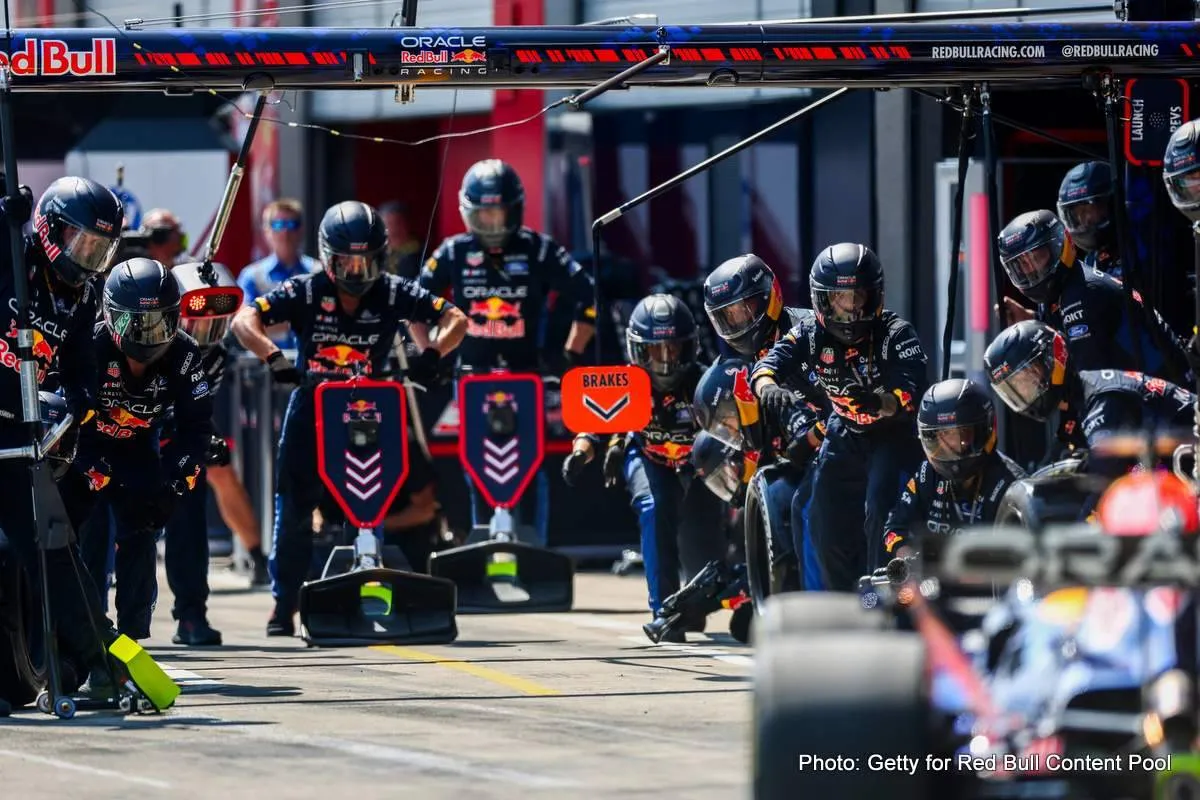
Analysts combine tire degradation data f1 with
lap-by-lap stint deltas, pit lane loss, and undercut/overcut success rates.
Modeling ideal stop windows and expected tire drop-off helps forecast who can
defend track position or gain it through strategy.
The Influence of Weather and Track Conditions on F1 Predictions
While car performance is often modeled as a stable
baseline, weather and track conditions can quickly invert the expected order by
changing grip, tire operating windows, and the value of track position.
Predictive models consequently ingest forecasts, radar
feeds, and on-site telemetry for track temperature, rainfall intensity, wind,
and humidity.
They also track evolving rubbering, standing water, and
Safety Car likelihood to quantify weather impact f1 races.
The Use of Machine Learning and AI to Predict F1 Race Outcomes
Machine learning systems for F1 outcome prediction
commonly use models such as decision trees, random forests, and neural networks
trained on historical variables like pit-stop patterns, finishing times,
points, and circuit context.
Similar data-driven forecasting approaches are widely
used beyond motorsport in domains such as finance, logistics, and healthcare,
reinforcing the general value of predictive analytics while highlighting
domain-specific feature needs.
However, F1 predictions remain constrained by sparse
and shifting data, regulation and car-performance changes, weather variability,
safety cars, and strategic decisions that can rapidly invalidate model
assumptions.
Common Prediction Models Used in F1
As Formula One generates vast streams of timing,
telemetry, and event data, predictive modeling has become a practical way to
estimate likely race winners from historical patterns.
In f1 race prediction, common prediction models used in
f1 include decision trees and random forests for nonlinear feature
interactions, gradient boosting for calibrated probabilities, and neural
networks for high-dimensional telemetry.
Bayesian models also quantify uncertainty
across circuits, weather, and strategy variables.
Data-Driven Prediction Systems Beyond Motorsport
Because high-frequency operational data now underpins
decision-making across industries, the same machine-learning principles used to
forecast Formula One race winners—feature engineering from historical records,
probabilistic classification, and model evaluation under shifting
conditions—also power data-driven prediction systems in domains such as
finance, healthcare, logistics, and cybersecurity.
Similar approaches inform data-driven betting and
predictive systems across industries.
Comparative insights into how these models are
structured and applied in real-world environments can be found in resources
such as this analysis
on bestaucasinolist, which explores how predictive frameworks are
used to optimize decision-making, user behavior modeling, and engagement.
●
credit-risk scoring
●
triage and readmission prediction
●
fleet ETA and demand forecasting
●
anomaly detection for threats
Challenges and Limitations of AI in F1 Race Prediction
While AI models can extract meaningful patterns from
historical lap times, pit-stop data, and driver–constructor performance,
predicting an F1 race winner remains constrained by limits in data quality,
shifting regulations, and the sport’s inherent randomness.
f1 performance data can be sparse, noisy, or
inconsistently labeled across eras. Weather, safety cars, upgrades, and
reliability failures create nonstationary dynamics that degrade model
generalization. Limited transparency in team strategies further reduces
predictive confidence.
The Application of Data Analytics by F1 Teams for Strategy
Harnessing telemetry, timing, and historical race
databases, Formula One teams apply data analytics to convert raw sensor streams
into strategic decisions during a Grand Prix. This f1 strategy analysis
supports:
●
optimizing pit windows using undercut/overcut
simulations
●
selecting tyre compounds via degradation and pace
models
●
adjusting fuel, ERS, and engine modes to target lap
time
●
coordinating track position with safety-car and VSC
probabilities
Unique Factors That Influence F1 Race Predictions
Although race outcomes can be modeled from historical
pace and finishing results, F1 race predictions are uniquely sensitive to
variables that are sparse, nonlinear, and often revealed only on race weekend.
Sudden weather shifts, Safety Car timing, track
evolution, and tire degradation interact with setup choices and traffic.
Reliability risks and penalties alter grids. Even with formula 1 data
analytics, limited samples make these effects hard to generalize.
The Future of Predictive Analytics in Formula 1
The same sparse, nonlinear race-weekend variables that
complicate today’s F1 race predictions are shaping where predictive analytics
is headed next.
Teams will fuse historical results with streaming
telemetry, simulator outputs, and strategy constraints, pushing predictive
analytics in motorsport toward probabilistic decision-support rather than
single-winner forecasts. Likely advances include:
●
real-time feature engineering
●
causal models for pit timing
●
uncertainty-aware ensembles
●
privacy-preserving data sharing
Latest News




Loading