Suzuka returns as one of Formula 1’s most demanding circuits, with tyre behaviour set to play a decisive role as Pirelli introduces its hardest compound selection of the season so far.
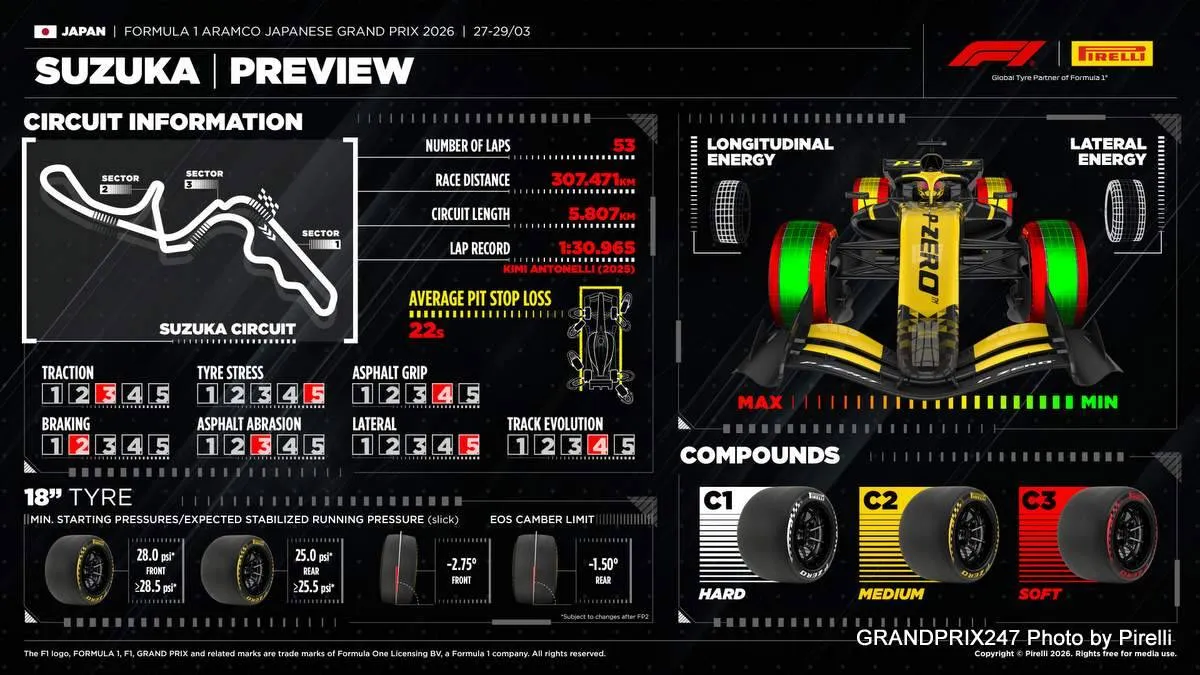
The 5.807 kilometre figure of eight layout, featuring 18 corners and relentless direction changes, places extreme loads on tyres. High speed sections combined with lateral forces make the Japanese Grand Prix one of the toughest tests on the calendar.
For this weekend, Pirelli has selected the C1 as Hard, C2 as Medium, and C3 as Soft, marking the debut of the C1 compound in 2026 after it was not used in the opening two rounds.
The Suzuka circuit has undergone extensive resurfacing work across the past two years. After the first sector was completed ahead of the 2025 race, further work now extends through sectors 2 and 3 up to Turn 17.
The result is a smoother but still green track surface, expected to offer low grip early in the weekend. That combination typically leads to graining, particularly on the softer compounds.
Pirelli underlined the expected behaviour: “In these conditions it is normal to expect some graining, particularly with the softest compound.”
Last year, graining appeared mainly on the front axle but reduced significantly as the track evolved. This time, with a larger portion of the circuit resurfaced, the phenomenon could be more pronounced and requires close monitoring from the outset.
The performance of both ends of the compound range will be critical in shaping race strategy. If the hardest C1 delivers sufficient grip and the C3 maintains consistency similar to Shanghai, teams could have multiple viable strategic options.
Pirelli explained the potential spread: “It will be particularly interesting to observe the behaviour of both the hardest and the softest compounds in the selection.”
Temperature will also influence tyre performance. The race takes place earlier in the year compared to 2025, when ambient conditions hovered around 15°C.
If similar temperatures persist, thermal degradation is expected to remain limited. That scenario opens the door to a one stop race, although the extent of graining will ultimately dictate whether that becomes realistic.
Beyond race strategy, tyre preparation in qualifying is expected to be a key challenge. With low grip conditions likely on a freshly resurfaced track, bringing the tyres into the correct operating window will be essential for performance.
Pirelli stressed the importance of execution: “Certainly, the teams will need to pay close attention to qualifying preparation, when it will be essential to bring the tyres up to the correct temperature.”
By the end of Friday running, teams should have a clearer understanding of degradation trends and whether Suzuka delivers a strategic puzzle or a more straightforward race.
Latest News



Loading