Mattia Binotto on Audi problems: It's not only power, it's energy efficiency, deployment and drivability of the engine
F1 NewsSaturday, 11 April 2026 at 16:10
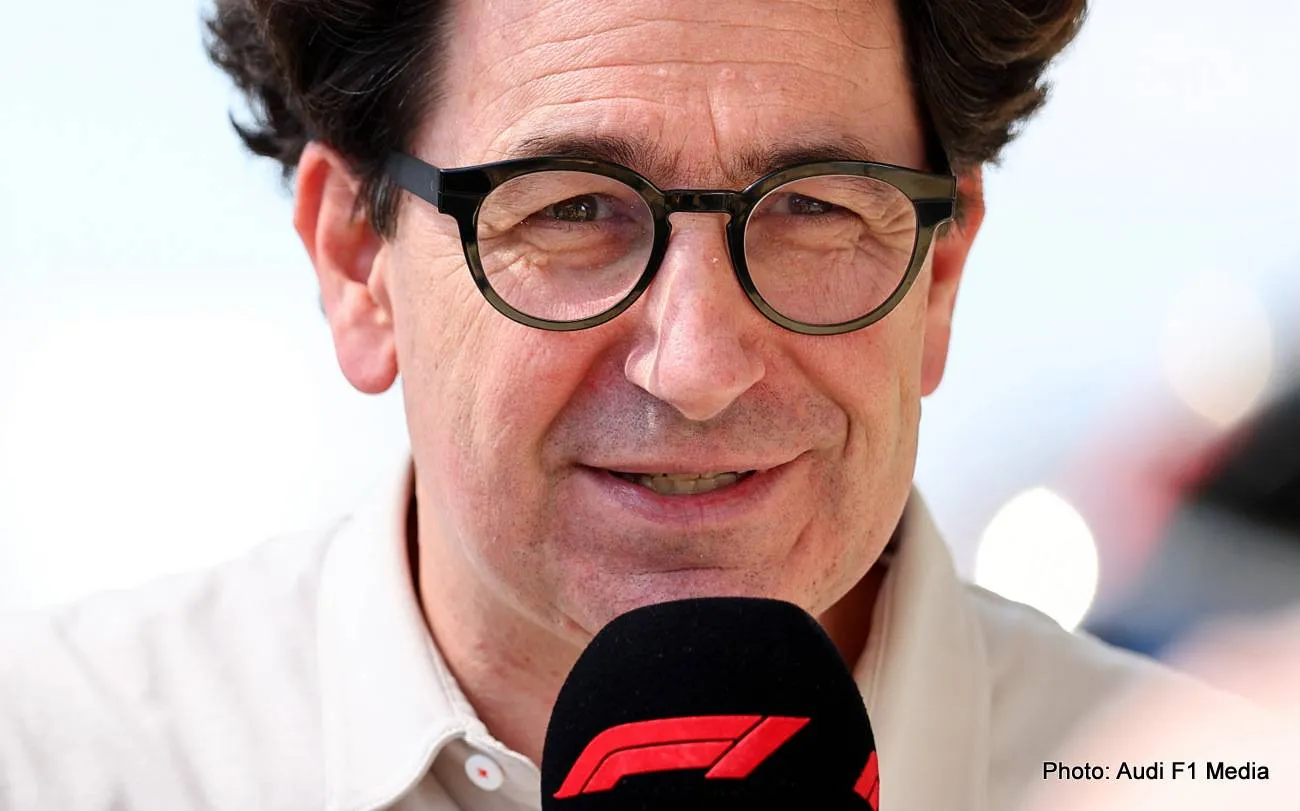
Mattia Binotto has delivered a clear verdict on Audi’s early Formula 1 struggles, insisting the gap to the front is far more complex than outright engine power.
The Audi project, built on the foundations of Sauber, is still in its infancy as a full works operation, with the German manufacturer targeting a title challenge by 2030.
Early signs have not been encouraging, but the limitations of a brand-new Formula 1 power unit are already shaping the team’s trajectory, which is downwards. Adding to the team's first-season woes is the unexpected departure of Jonathan Wheatley.
Binotto, who previously spent more than three decades at Ferrari and oversaw championship winning eras, is under no illusions about the scale of the task ahead.
Speaking to F1.com after Suzuka, he said: “It’s not only power. It’s energy efficiency, energy deployment, but as well, it’s about the drivability of the engine itself. When you come to drivability, it’s also with the gear change, which are very harsh for us at the moment.”
Audi’s R26 chassis has emerged as a solid platform, with points already on the board and consistent midfield competitiveness across China and Japan. However, Binotto made it clear that the majority of the performance deficit sits within the power unit.
He explained: “We are aware as well that if I look at the overall performance and the gap to the best, where the biggest performance to gain is on the power unit itself, so most of our gap in performance is in the power unit.
"This is not a surprise. We would have expected it. We know how difficult it is to build a brand new power unit, so it’s not something which surprised us. It’s not something which disappoints us. No, it’s a matter of fact," he added.
Drivability issues compounding performance loss

Despite the deficit, Binotto stressed there are no fundamental flaws in the overall concept, a critical distinction for a team still building its long-term structure: “There is nothing fundamentally wrong with our car and our project, which is the most important because once you’ve got something which is fundamentally wrong, then you need to catch up and address it.
“You are spending a lot of energy, time, capacity and budget from the budget cap to address fundamentals. While I think we do not have fundamental issues, we can concentrate really on our projects to move forward on the next steps," explained Binotto.
Beyond outright power, Binotto highlighted drivability as a major weakness, with the interaction between engine, gearbox and energy systems creating instability under braking and acceleration: “The car is unstable in braking, unstable in acceleration because of the harshness of the gear change. Maybe the ratio arrangements are not right.
"There is so much on drivability, as much as on pure performance. I think if you make the sum of the two, between performance and drivability, it can be up to a second per lap just by then," Binotto revealed.
That figure underlines the scale of the challenge Audi faces, particularly in an era where energy deployment and harvesting strategies define competitiveness as much as raw horsepower.
Binotto added: “We knew that would have been the biggest challenge. We knew that it’s where there is the most to gain in performance, because I think the gap is significant, mainly on the power unit, but we’ve got plans to develop it.”
The unexpected five-week gap in April, following the cancellation of the Bahrain and Saudi Arabian Grands Prix, arrives at a crucial moment for Audi’s development programme.
Miami upgrade set to define next phase

With early races dominated by reliability fixes and race preparation, both Nico Hulkenberg and Gabriele Bortoleto were plagued by issues, technical and operational, that kept them out of contention in Melbourne and Shanghai.
Binotto admitted the team has not yet been able to fully focus on structured development: “I think it’s really a chance for us because, since the winter testing, we have been focused so much on addressing all the problems we had, making sure that for the following event or race we were prepared and had solved them.
“That race preparation has been very time-consuming for us. Once you are absorbed completely by race preparation, you can’t develop as you wish so I think that April off, which is not an off obviously, will be very important for us to rejoin, refocus on what the next developments are, and make sure that we are not only fixing problems but developing properly.”
Like much of the grid, Audi is preparing a significant upgrade package for Miami, where the compressed development window is expected to produce major performance gains across the field.
Binotto said: “I hear a lot of teams will bring performance packages there. I think it will be the same for us at the wind tunnel. I think the rate of development of these new regulations is still very high. So yes, certainly we will bring a package, which is a significant one for what we have used in the past.”
“It’s a relative competition, how big will be ours to the others, I don’t know. But I think I’m happy with what we have done and developed. I’m confident that with the packages we are bringing, we can at least keep fighting for where we are today," concluded Binotto.
With Audi targeting the long game to 2030, the next phase of development in Miami will offer the clearest indication yet of whether the project can close the gap on Formula 1’s established powerhouses. But the journey will be tough.

Latest News







Loading