How Cadillac, Las Vegas and Apple TV are redrawing Formula 1's American map
F1 Teams NewsWednesday, 20 May 2026 at 04:43
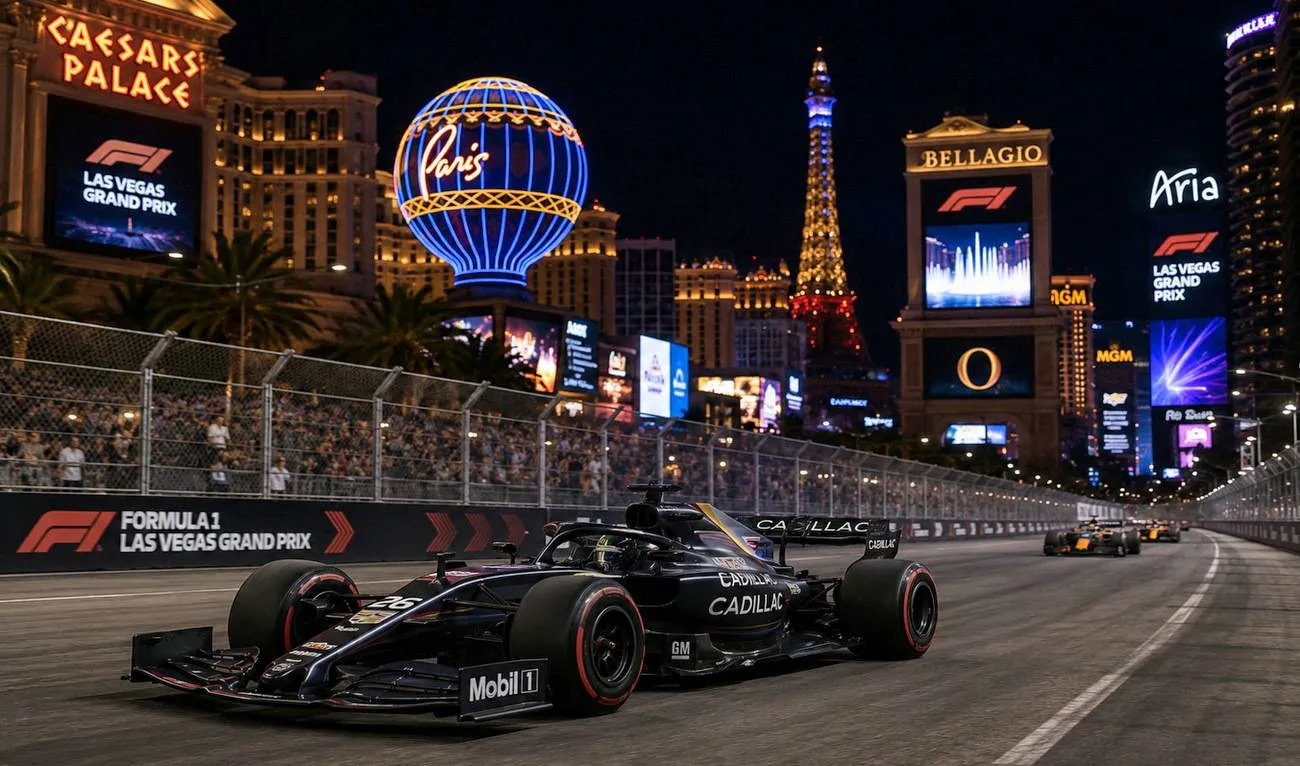
Three U.S. Grands Prix, an eleventh team flying the American flag, and a 750-million-dollar broadcast deal: 2026 is the season Formula 1 stops courting America and starts owning it.
A US-flagged team finally on the grid: Cadillac's debut season in numbers
Cadillac's arrival as Formula 1's
eleventh team in 2026 was never going to be a quiet affair. Built from scratch
with a dual base - race operations at Silverstone, performance and power unit
development at the new Fishers, Indiana facility - the American outfit hit the
grid in Australia in March before tackling China and Japan.
An unprecedented
five-week gap followed: the Bahrain and Saudi Arabian Grands Prix, originally
scheduled for April, were cancelled by F1 and the FIA over safety concerns
linked to the conflict in the Middle East, reducing the 2026 calendar from 24
rounds to 22. Cadillac resumed in early May at Miami, its first home race.
Engines are supplied by Ferrari through 2028, with General Motors' in-house
power unit targeted for a 2029 debut.
CEO Dan Towriss has consistently framed
the early months as a foundation-building exercise. "When you think about
short-, medium-, and long-term goals, I think we're on track," he told
Formula 1's official website.
Yet the stopwatch tells a more sobering story:
both cars have been routinely lapped, sitting roughly three to four seconds off
the pace despite a Miami upgrade package that delivered the team's most visible
step forward to date. Team Principal Graeme Lowdon and the GM leadership
remain focused on trajectory rather than timing sheets — a learning curve they
openly describe as ruthless.
Three races, one strategy: how Miami, Austin and Las Vegas anchor F1 in the United States

The United States is now the only country
on the 2026 calendar to host three Grands Prix, and the geography of those
rounds is no accident. Miami, Austin and Las Vegas each target a different
slice of the American audience - coastal entertainment, motorsport heartland,
and prime-time spectacle - while collectively building the most ambitious
territorial footprint Formula 1 has ever attempted outside Europe.
Long-term
contracts confirm the commitment: both the Miami Grand Prix and the United
States Grand Prix at Circuit of The Americas have been extended through 2041,
while the Las Vegas Strip Circuit remains under a multi-year deal anchoring the
back end of the calendar.
Miami, held over the first weekend of May
2026, served as Cadillac's first home race and showcased the team's largest
upgrade package of the season to date. Austin, scheduled for late October at
Circuit of The Americas, remains the most racing-pure of the three venues, with
a fanbase built over more than a decade of continuous presence.
Las Vegas
closes the American trilogy in November — and increasingly defines what F1's
U.S. ambitions actually mean in commercial terms.
The Las Vegas effect: when Formula 1 meets the world's entertainment capital

The Las Vegas Strip Circuit, christened
in 2023, runs directly past the doorsteps of Caesars Palace, Bellagio, Wynn and
the MGM properties. The 2025 edition drew more than 300,000 attendees across
the weekend, and hospitality packages built around the Strip's casino-resorts
continue to account for a significant share of the event's commercial revenue.
Stefano Domenicali, F1's CEO, has openly described the race as a showcase for
the sport's appeal in the United States.
That ecosystem extends well beyond the
racetrack itself. North American audiences who follow F1 also engage heavily
with adjacent forms of entertainment, including online gaming platforms
regulated province by province in Canada.
For Canadian fans looking to navigate
that landscape, on this site
offers independent reviews of online casinos available to Canadian players. The
Las Vegas Grand Prix has effectively turned a Saturday-night race into a
multi-day entertainment property where motorsport, hospitality and gaming
converge under one address.
Austin and Miami: the two pillars supporting the American trilogy

While Las Vegas captures the headlines,
Austin remains the sport's longest-standing American foothold. Circuit of The
Americas has hosted the United States Grand Prix continuously since 2012 and
consistently ranks among the highest-attended events on the calendar, with the
2023 edition drawing roughly 432,000 spectators across the weekend. Its layout,
modelled in part on Silverstone and Suzuka, is widely regarded by drivers as
one of the most rewarding circuits of the season.
Miami, by contrast, has built its
identity around spectacle and celebrity. The Miami International Autodrome,
laid out around Hard Rock Stadium, attracted record television audiences during
its early editions.
It remains the launchpad for F1's North American swing each
spring. Together, Austin and Miami provide the steady commercial and sporting
foundation that allows Las Vegas to operate at the scale it does.
Apple TV, Drive to Survive and the digital pipeline behind America's F1 boom

The 2026 season also marks a broadcast
shift that has been years in the making. Apple TV is now the exclusive home of
Formula 1 in the United States under a five-year deal worth approximately 750
million dollars, ending ESPN's run as the sport's American broadcaster. The
agreement, announced in October 2025, formalises what years of streaming data
had already made obvious: F1's growth in North America is fundamentally
digital.
The groundwork was laid by Netflix's
Drive to Survive, now in its eighth season, and reinforced in 2025 by the
release of F1 The Movie starring Brad Pitt. The numbers tell a clear story:
Formula 1 reached 827 million fans globally in 2025, U.S. interest grew by 11
per cent year-on-year.
43 per cent of the fanbase is under 35, and 42 per cent
identifies as female - with the United States now F1's largest audience on both
YouTube and TikTok. The Apple TV deal is, in that sense, less a starting
point than a confirmation of a transformation already underway.
The road ahead: what Cadillac's first full season says about F1's American future

Three indicators will define the rest of
2026: Cadillac's rate of progression on the timing sheets, the attendance and
television figures generated by the Las Vegas Grand Prix in November, and Apple
TV's opening audience numbers under its new exclusive deal.
Together, they
will measure whether the American expansion is converting commercial momentum
into sporting and broadcast substance.
Dan Towriss has already set the
longer horizon: "Regardless of the funding, I think it's important that we
see a Cadillac power unit on the grid as soon as possible," he told
reporters, with GM's in-house engine targeted for 2029.

Latest News
Loading