Haas F1 Team emerged from crisis by rejecting blame culture within the organisation
F1 Teams NewsWednesday, 20 May 2026 at 08:00
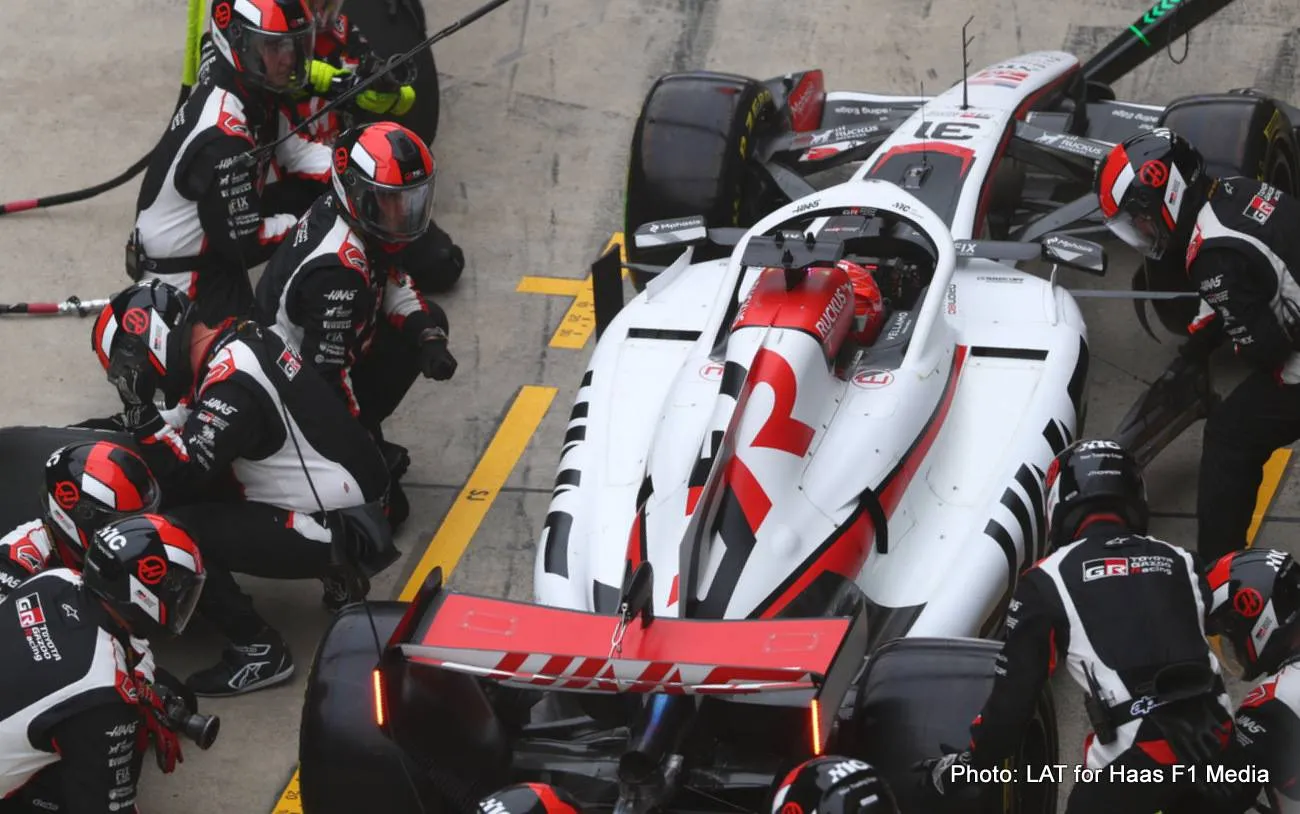
Ayao Komatsu says Haas emerged stronger from a major technical crisis after the team refused to fall into a “blame culture” when a serious flaw appeared on its Formula 1 car before the start of the 2025 season.
Speaking on the Inside the NYSE ICE House podcast, the Haas Team Principal detailed how the American outfit discovered a critical weakness during the opening round in Australia after initially believing winter testing had gone smoothly.
Komatsu recalled the 2025 pre-season: “We did pre-season testing in Bahrain and everything was good. We were confident. We went to Australia for our first race. The minute we started running, we saw just in front of our eyes: wow, this car's got a really big issue. The driver couldn't drive through the high-speed corners.”
The Japanese engineer admitted the first challenge was accepting the severity of the situation rather than denying it existed: “The first step is accepting that we got a big issue. If you're in denial over that, you cannot find a solution.”
“We shared the problem openly and asked: what’s the root cause? Is it an aerodynamic problem? Is it a drivability problem? Mechanical problem?” revealed the Haas F1 boss.
Rather than slowing development or searching for individuals to blame," Komatsu said Haas deliberately accelerated decision-making and accepted greater technical risk in an attempt to solve the issue.
Tackling the biggest challenge

“To make things happen within such a short time window, we had to cut our normal process,” Komatsu revealed. “That means higher risk. But I said: I’ll take that risk as a leader. I trust your engineering judgement.”
He explained that his biggest challenge was resisting the temptation to directly intervene as an engineer himself: “I really wanted to go into it saying: look at this, look at this, look at that, jump in. But you have to hold back.
"I really tried hard to hold back and I’m so happy I did that because then they came up with the solution. Even if we got it wrong in two weeks' time, at least we know that's not the direction we should go. If we get it right, great. But if we don't do anything, we don't learn anything," radded Komatsu.
The gamble ultimately transformed the season. Haas recovered from its early struggles and finished 2025 with one of the strongest development curves on the grid.
Komatsu declared: “By the end of 2025 they managed to have an amazing development. We finished the season with the fifth-fastest car. Those are the moments where your culture is truly tested.
"We behaved correctly. We behaved in a collaborative manner, inclusive manner, no blame culture," insisted Komatsu, who believes the crisis ultimately strengthened the entire organisation because the team remained collaborative and avoided internal conflict during its most difficult period:
What doesn't break you makes you stronger

The Haas boss argued that empowering people to make decisions without fear of punishment remains critical inside Formula 1, where split-second calls often determine success or failure: “You have to make a decision. The worst thing is freezing and making no decision.”
“I try to send the message that even in a high-pressure situation, it's a safe environment. Don't be afraid of failure. What doesn't break you makes you stronger. That's exactly what happened.”
Despite those limitations, Haas has emerged as one of the surprise packages of the 2026 Formula 1 season. The VF-26 has proven competitive under the new regulations, with strong tyre management, reliable Ferrari power and an efficient operational structure helping the American outfit consistently fight in the midfield points battle.
Oliver Bearman has impressed with several standout performances, while Esteban Ocon has added valuable experience as Haas climbed to sixth in the Constructors’ Championship by mid-May.
For Komatsu, the progress only reinforced his belief that trust, collaboration and rejecting blame culture were the foundations behind the team’s resurgence. Ahead of the forthcoming Canadian Grand Prix, Haas F1 Team are P6 in the 2026 F1 World Championship.
Latest News
Loading