Many Formula 1 Ferraris were great. But one car in particular stands head and shoulders above the rest.
As we wait with bated breath to see how many upgrades Ferrari chucks at the SF-26 to bewilder the Scuderia even more in the lead up to the Canadian Grand Pris, Even more so to Formula 1’s pursuant ADUO engine performance upgrade handouts. So its’ probably a good time to pose this question.
What was Ferrari’s best-ever Formula 1 car? A difficult question indeed. Most ‘modern’ F1 fans wouldn’t even compute what Ascari’s 500 F2 was, never mind that the D50 was actually a Lancia that Fangio drove to his Ferrari title. Or even Hawthorn’s 246 F1, Phil Hill’s sharknose 156 and Surtees’ 158.
Maybe they have an inkling what Niki’s 312 T1 and T2 were. Or Jody’s T4. What all of them were, were Ferrari’s world championship winners. It took a terrible 21 years for the next title to come along.
Even today’s fans should know what Michael’s F2000, 2001, 2, 3 and 4 were. And Kimi’s F2007, of course. Everything since is rubbish. Just as most of the previous 21 year drought’s cars were.
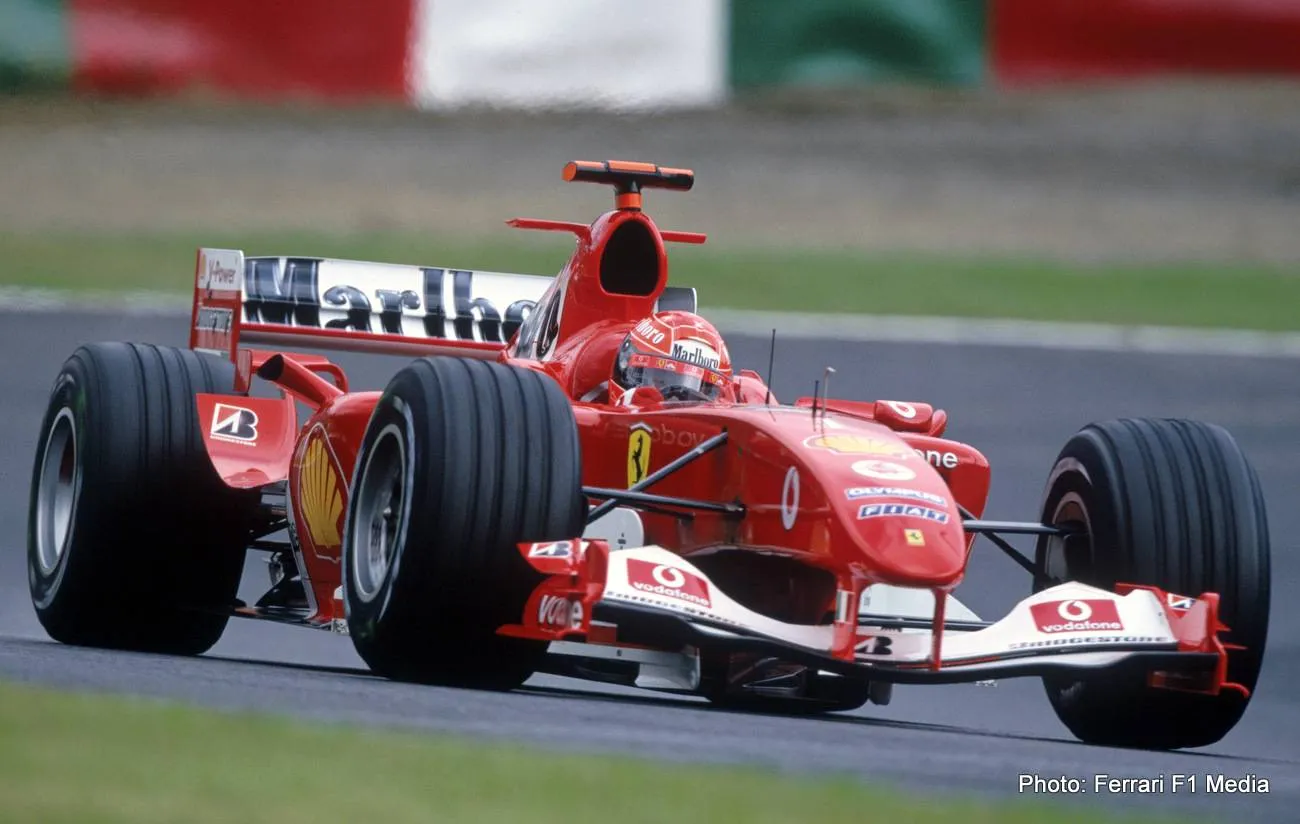
There is however one car that stands head and shoulders above. And for many a great reason, too. Michael Scumacher’s Ferrari F2004 is widely considered the best Formula 1 Ferrari ever built.
It marks the pinnacle of the Dream Team's dominance as much as it represents Formula 1’s greatest era. An even more important factor in these troubled times as F1 attempts to re-invent itself.
The numbers speak for themselves. The F2004 won 15 races, eight of those as 1-2s, and scored 30 podiums in the 18 races it started in 2004. Add 12 pole positions, 14 fastest laps and breaking the lap records in most of those cases, In fact, Michael Schumacher’s 1 minute 32.238 second Shanghai lap record still stands.22 years later.
Tipo 053 V10 was better in every possible way

Of course, the bulletproof reliable F2004 never broke once as it took Michael Schumacher to his seventh and final World Driver’s title. And brought Ferrari another emphatic Manufacturer’s crown. Its sixth on the trot for that era, too. And best of all? it was a 3-litre V10. Oh, the joys!
An engineering masterclass penned by a legendary Rory Byrne and Ross Brawn -led technical group under Jean Todt’s metronomic management and reporting to then capo, former Enzo Ferrari consigliere Luca di Montezemelo, the F2004 evolved out of the previous year's F2003.
Its naturally aspirated Tipo 053 3-litre V10 designed in a cabal under Paolo Martinelli, Gilles Simon and Mattia Binotto, produced 865 horsepower at a staggering 18,300 rpm. In race trim. It made closer to 940 horsepower at 19,100 rpm for quali.
Revolutionary compressed nitrogen pneumatics replaced traditional metal springs to overcome valve float at extreme engine speeds. Its sophisticated Magneti Marelli electronics integrated engine mapping and traction control.
Designed to meet the FIA’s new one engine per weekend rule, the lighter, lower centre of gravity 053 was more powerful. It also delivered double the previous engine's lifespan.
F2004’s ultra-light carbonfibre honeycomb composite chassis brought the car in well under the 605 kg minimum to allow the team to minutely tweak its weight distribution. And Bridgestone designed its tyre casings and rubber compounds around the F2004’s unique geometry and behaviour in the grip of the Formula 1 tyre war.
The real secret? It was in the testing…

And then the testing. Unlike today when it’s all but banned, Ferrari tested relentlessly. From shakedown through a round-the-clock program simultaneously running multiple chassis across different tracks throughout the season.
Even when Schumacher and Barrichello were away racing, full-time test drivers Luca Baddor and Marc Gené hammered the F2004 through thousands of kilometres of at Mugello, Monza, and Fiorano. Every single change was meticulously proven, on its own before the next began its own rigorous test regime.
Clearly that race engineering principle of proving every upgrade on its own merits is now forgotten at Maranello? We hear they chucked twenty new features onto the cars in Miami. Little wonder Ferrari is still lost in 2026…
Getting back to the F2004, that’s how you win races. It’s also how you win championships.
The evolution of a decade of incredible graft and dedication under the auspices of a brilliant general, managed meticulously and run by a conglomerate if genii who checked, re-checked and again checked every plausible aspect of the F2004, and the team, to perfection. It could not lose.
Now, what’s missing today? Makes you think, doesn’t it?
Latest News
Loading