It’s sad and telling sign of the times that Formula 1 has inked a deal with the Miami Grand Prix until 2041, like a whore chasing a trick, while our real Temples of Speed that have stood the test of time - such as Imola - are falling by the wayside.
Formula 1 heads to Imola next. But is this the last time? Or the second last? How many more times will Autodromo Internazionale Enzo e Dino Ferrari be on the calendar as the sport shifts towards fakery and temporary circuits like the one in Miami?
It is with great sadness that Formula 1 has chosen this path of disrespect, turning its back on the grand slam venues that are part and parcel of its history and legacy. The very circuits where the graves of many drivers lie. Circuits like Imola, Monza, and Spa, where legends were born.
Thus, it is fitting, ahead of Round 7 of the 2025 Formula 1 World Championship, to look back on the history of Imola as a Grand Prix host.
Autodromo Internazionale Enzo e Dino Ferrari

Imola Circuit, has long held a special place in the heart of Formula 1 and is among the legendary venues that have graced our sport.
Though officially bearing the names of Ferrari’s legendary founder and his son, the Imola Circuit near Maranello, Ferrari's home, is forever associated with memorable Grand Prix racing, winter testing, triumph, tragedy, and the soul of Italian motorsport.
From its early years as a proving ground to its current status as a modern F1 venue, Imola’s connection with Formula 1 has evolved through decades of shifting eras, regulatory upheaval, and emotional moments that have defined the sport.
The story of the venue's deep-rooted history with Formula 1, not just on race weekends, but also as one of its most significant testing venues. The 1980 Italian Grand Prix was held at Imola, not Monza, marking the first-ever Formula 1 World Championship race at the circuit.
This one-off switch happened because Monza was undergoing safety upgrades at the time. Imola stepped in as a temporary host and did such a good job that it later secured its own race on the F1 calendar — the San Marino Grand Prix, which debuted in 1981.
1950s–1970s Origins and early Formula 1 appearances
The circuit was inaugurated in 1953, originally designed as a semi-permanent road course weaving through the Emilia-Romagna hills near Bologna. Although it was not immediately part of the Formula 1 World Championship, it quickly drew interest from top drivers and teams as a venue for sportscar races and unofficial single-seater testing.

Throughout the 1960s and 70s, Formula 1 teams used Imola as a private testing ground, especially Ferrari, given the circuit’s proximity to Maranello. It was a natural fit — a technical, flowing track with high-speed corners that provided meaningful data across aerodynamics, suspension, and powertrain configurations.
The circuit’s reputation grew, and in 1979, Imola hosted its first non-championship Formula 1 race, the Dino Ferrari Grand Prix, won by Niki Lauda in a Brabham-Alfa Romeo. The success of that event paved the way for its formal inclusion into the championship calendar.
1981–2006: The San Marino Grand Prix era begins

In 1981, Imola officially entered the Formula 1 World Championship calendar under the title of the Gran Premio di San Marino. The name was chosen because Italy already had a Grand Prix at Monza, and the nearby microstate of San Marino allowed the organisers to title the event separately while keeping it in Italy.
The inaugural San Marino Grand Prix was held in April 1981 and was won by Nelson Piquet in a Brabham-Ford. From then on, Imola became a permanent fixture on the calendar for over two decades, hosting some of the most iconic and politically charged races in F1 history.
The turbo era of the 1980s saw titanic battles at Imola — Prost vs Piquet, Mansell vs Senna — while Ferrari often found themselves in the spotlight, either through heroics or heartbreak. The Tifosi embraced the circuit as their second home Grand Prix, and the Ferrari team made Imola an annual testing hotspot, often running behind closed doors in the winter and between flyaway races.
Testing sessions at Imola were fiercely guarded affairs. Teams like Williams, McLaren, Benetton and Jordan frequently joined Ferrari in utilising the circuit’s challenging layout to fine-tune aerodynamics, suspension geometry, and brake cooling performance — data that often translated to improved European performances.
1994: A tragic turning point

No discussion of Imola in Formula 1 is complete without confronting the events of the 1994 San Marino Grand Prix — one of the darkest weekends in the sport’s history.
The race weekend claimed the lives of Austrian rookie Roland Ratzenberger (during qualifying) and three-time World Champion Ayrton Senna (during the race), with a third major incident involving Rubens Barrichello in Friday practice. The Tamburello and Villeneuve corners — fast, blind left-handers with minimal runoff — were central to both fatal crashes.
The Grand Prix community was shaken to its core. The FIA responded with sweeping safety reforms that forever altered the layout of Imola and redefined Formula 1’s approach to circuit design. Tamburello was reprofiled into a chicane, and the Villeneuve curve was also modified. Testing, too, was restructured in the years that followed, with mandatory crash testing, impact data recording, and stricter driver medical protocols enforced.
Imola’s reputation never fully recovered from the 1994 weekend, but it remained on the calendar for 12 more years. The circuit continued to play host to title-deciding moments, including Fernando Alonso’s gripping defensive drive against Michael Schumacher in 2005 — a race often cited as one of the Spaniard’s best.
The last San Marino Grand Prix took place in 2006, won by Schumacher in a Ferrari. By that point, the paddock had shifted focus to newer venues, and the facilities at Imola were beginning to show their age. It was dropped from the calendar ahead of the 2007 season.
2007–2019 F1 testing at Imola: The post-Grand Prix years

Even after losing its place on the calendar, Imola retained a critical role as a test circuit, particularly for Ferrari. In the late 2000s and 2010s, when in-season testing was banned or tightly limited, Imola remained a preferred private testing facility — especially for non-F1 car development, junior programmes, and demonstration runs.
Ferrari often ran their F1 Clienti programme at Imola, giving historic Grand Prix machinery a chance to stretch their legs. The circuit also hosted young driver evaluations and private filming days, keeping its asphalt relevant in the F1 ecosystem.
Technical updates, especially involving brake duct revisions, mechanical grip, and thermal efficiency systems, were often shaken down here by customer teams and occasional wildcard outings. Though it no longer served as the backdrop for major tyre or aerodynamic tests, Imola remained on the radar due to its proximity to multiple Italian engineering suppliers and its history as a data-rich, driver-challenging track.
2020–2025 Return to the calendar during COVID and beyond

In 2020, the COVID-19 pandemic forced Formula 1 to rewrite its calendar on the fly. With multiple flyaway races cancelled and travel restrictions in place, Formula 1 turned to European classics to rebuild its schedule. Imola was brought back under a new banner: the Emilia Romagna Grand Prix.
Held as a two-day event, the 2020 Emilia Romagna GP marked Imola’s return to the World Championship. It was won by Lewis Hamilton, who praised the circuit for its old-school feel and technical demands.
The successful reintroduction of Imola led to its inclusion in the 2021, 2022 and 2023 calendars — though the 2023 event was cancelled just days before the race due to catastrophic flooding in the Emilia-Romagna region. The Santerno River burst its banks, flooding areas of the circuit, and F1 leadership cancelled the weekend to avoid burdening emergency services.
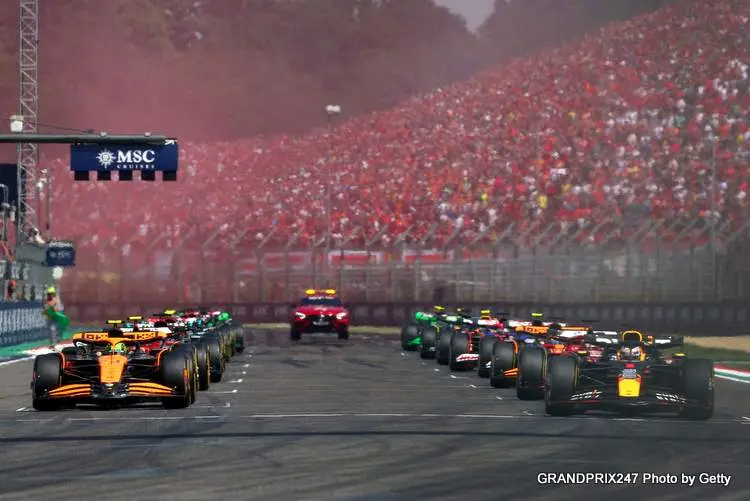
The race returned in 2024, where Max Verstappen fended off Lando Norris by under a second to secure his third Imola win.
As of 2025, Imola remains on the calendar and continues to challenge drivers with its undulating terrain, unforgiving run-offs, and rich racing history.
1981–2024 Grand Prix winners at Imola

Not included is Nelson Piquet's victory for Brabham at the 1980 Italian Grand Prix, when Imola replaced Monza as the country's GP host circuit. The table below includes San Marino GP from 1981 to 2006 and Emilia Romagna GP from 2020 to present.
(Source: StatsF1)
| Year | Grand Prix | Winner | Team |
|---|---|---|---|
| 1981 | San Marino GP | Nelson Piquet | Brabham-Ford |
| 1982 | San Marino GP | Didier Pironi | Ferrari |
| 1983 | San Marino GP | Patrick Tambay | Ferrari |
| 1984 | San Marino GP | Alain Prost | McLaren-TAG |
| 1985 | San Marino GP | Elio de Angelis | Lotus-Renault |
| 1986 | San Marino GP | Alain Prost | McLaren-TAG |
| 1987 | San Marino GP | Nigel Mansell | Williams-Honda |
| 1988 | San Marino GP | Ayrton Senna | McLaren-Honda |
| 1989 | San Marino GP | Ayrton Senna | McLaren-Honda |
| 1990 | San Marino GP | Riccardo Patrese | Williams-Renault |
| 1991 | San Marino GP | Ayrton Senna | McLaren-Honda |
| 1992 | San Marino GP | Nigel Mansell | Williams-Renault |
| 1993 | San Marino GP | Alain Prost | Williams-Renault |
| 1994 | San Marino GP | Michael Schumacher | Benetton-Ford |
| 1995 | San Marino GP | Damon Hill | Williams-Renault |
| 1996 | San Marino GP | Damon Hill | Williams-Renault |
| 1997 | San Marino GP | Heinz-Harald Frentzen | Williams-Renault |
| 1998 | San Marino GP | David Coulthard | McLaren-Mercedes |
| 1999 | San Marino GP | Michael Schumacher | Ferrari |
| 2000 | San Marino GP | Michael Schumacher | Ferrari |
| 2001 | San Marino GP | Ralf Schumacher | Williams-BMW |
| 2002 | San Marino GP | Michael Schumacher | Ferrari |
| 2003 | San Marino GP | Michael Schumacher | Ferrari |
| 2004 | San Marino GP | Michael Schumacher | Ferrari |
| 2005 | San Marino GP | Fernando Alonso | Renault |
| 2006 | San Marino GP | Michael Schumacher | Ferrari |
| 2020 | Emilia Romagna GP | Lewis Hamilton | Mercedes |
| 2021 | Emilia Romagna GP | Max Verstappen | Red Bull-Honda |
| 2022 | Emilia Romagna GP | Max Verstappen | Red Bull-RBPT |
| 2023 | Emilia Romagna GP | Cancelled (Flooding) | — |
| 2024 | Emilia Romagna GP | Max Verstappen | Red Bull-RBPT |
Latest News

Loading