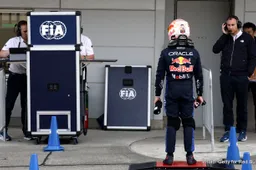
Lewis Hamilton: Closing the gap to Mercedes is going to take a mighty push from everybody at Ferrari
F1 Grand PrixSaturday, 28 March 2026 at 09:41

Ferrari driver Lewis Hamilton admitted his team are short of the pace required to challenge at the front after qualifying P6 for the Japanese Grand Prix, with teammate Charles Leclerc securing P4 on a day dominated by Mercedes and a resurgent McLaren.
Hamilton pointed directly to a lack of outright speed as the defining factor behind Ferrari’s deficit at Suzuka, where the circuit's demands exposed both aerodynamic inefficiencies and power-deployment limitations.
The seven-time Formula 1 world champion said: “I was feeling pretty decent, it’s just we’re not very quick, I mean, compared to the Mercedes and a little bit the McLaren.”
That blunt assessment came despite a lap that, at one stage, looked capable of putting him closer to the sharp end. Instead, a critical moment on the straights cost him heavily and underlined Ferrari’s current weaknesses.
Hamilton reflected on his session on Saturday: “My first lap I was up and then I lost two and a half tenths just on the straights, just from, I had a snap and then it changed the deployment and then that was it. And at that point I was up, so if we didn’t have that problem, I probably would have had fourth. But other than that, it’s just the way this deployment situation is.”
Hamilton’s reference to deployment adds another layer to Scuderia’s challenge in this new era of Formula 1 machinery, where energy management is increasingly dictating qualifying outcomes. At Suzuka, even a minor disruption proved costly, instantly wiping out any gains built through the technical first sector.
The issue is not isolated. It reflects a broader trend across the weekend, with Ferrari struggling to match the efficiency and consistency shown by Mercedes and McLaren, particularly on the straights where deployment and power unit performance play a decisive role.
Ferrari race pace offers some hope

A five-time Japanese Grand Prix winner, Hamilton acknowledged the scale of the challenge facing the team, suggesting that even clean execution would not yet be enough to bridge the gap.
Despite the setback, Hamilton pointed to encouraging signs over longer runs, although he remained cautious about what that could realistically deliver on Sunday: “I don’t know whether we can turn it into a podium, but our race pace has been pretty decent. It looks like McLaren have taken a step forward, naturally because they’ve got the Mercedes engine which is a long way ahead of us at the moment.”
That comparison will not go unnoticed inside Ferrari. With McLaren now clearly in the fight at the front and Mercedes locking out the top positions in qualifying, Ferrari find themselves chasing on multiple fronts.
Hamilton’s closing assessment left little room for optimism in the short term. The gap, he suggested, is structural rather than situational: “We’ve got a huge amount of work to do.
"To be seven to eight-tenths off, even if you bring an upgrade of two, three, or four-tenths, it’s still a long way off. So, to close that gap is going to take a mighty push from everybody," concluded the Briton.
For Ferrari, Suzuka has laid bare the scale of the task ahead. With Leclerc closer to the front but still off the ultimate pace, and Hamilton unable to convert potential into position, the Scuderia head into Sunday needing both a clean race and external opportunities to challenge for the podium.
Beyond that, the bigger concern is clear. On pure performance, Ferrari are not yet in the same fight as Mercedes and McLaren, and closing that gap will demand more than incremental gains as the season unfolds.
Latest News





Loading