Rookie Barrier: Why is it becoming increasingly difficult for F2 talents to secure an F1 seat?
F1 NewsTuesday, 05 May 2026 at 01:58
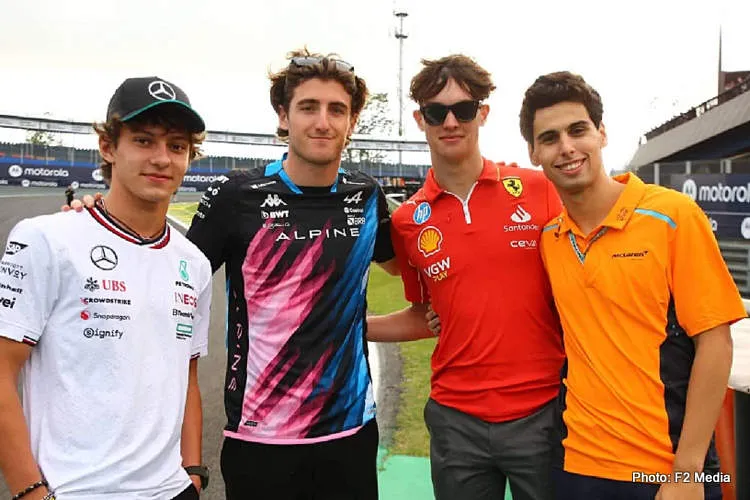
The dream of every young racing driver is to stand on the Formula 1 podium, spray the champagne, and etch their name into the history books alongside legends like Senna, Schumacher, and Hamilton.
For decades, the path to this summit was clear: dominate in karting, climb through the junior formulae, and finally, prove your worth in the FIA Formula 2 Championship. F2 was designed to be the ultimate filter – the final proving ground where the world’s twenty best young prospects battle in identical machinery to determine who is truly ready for the "Great Circus."
However, as we move through the mid–2020s, a troubling trend has emerged. The bridge between F2 and F1, once a direct highway for talent, has become a narrow, crumbling ledge.
We are witnessing a historic "rookie logjam" where championship–winning talents are being left on the sidelines, forced into reserve driver roles or exported to other series like IndyCar or Super Formula. For the first time in the history of the sport, the 2024 season began with the exact same grid that finished the 2023 season – not a single rookie was given a seat.
This phenomenon raises a critical question for the sport’s ecosystem: why has it become nearly impossible for the next generation to break through the barrier?
The Stagnation of the "Old Guard" and Increased Longevity

One of the most immediate reasons for the rookie barrier is the unprecedented longevity of the current F1 grid. In previous eras, a driver’s career typically wound down by their mid–30s as physical fatigue and a loss of "ultimate edge" set in. Today, advancements in sports science, physiotherapy, and data–driven training have allowed veterans to maintain peak performance well into their 40s.
The presence of the "Old Guard" creates a static market:
- Fernando Alonso: Still performing at an elite level in his 40s, proving that age is no longer a barrier to speed.
- Lewis Hamilton: Moving to Ferrari in 2025, occupying a top–tier seat that might otherwise have been part of a larger shuffle.
- Nico Hulkenberg and Kevin Magnussen: Experienced "safe pairs of hands" who provide stability for midfield teams.
- Daniel Ricciardo and Sergio Perez: Established names who retain high commercial and developmental value despite pressure from younger talents.
When the veterans do not retire, the musical chairs stop. In the past, a team might take a gamble on a rookie because an older driver was clearly fading. Now, with drivers like Alonso and Hamilton showing no signs of slowing down, teams are choosing the certainty of experience over the potential of youth. This creates a psychological barrier where a "good" veteran is considered more valuable than a "potentially great" rookie.
The Financial Risk of the Budget Cap Era

The introduction of the Financial Regulations (the Budget Cap) in 2021 changed the fundamental DNA of F1 team management. While the cap was intended to level the playing field, it has inadvertently made teams more risk–averse when it comes to driver selection. In a world where every dollar spent on a crash is a dollar taken away from aerodynamic development, a rookie is a financial liability.
The economic reality for a modern F1 principal is harsh:
- The Cost of "Binning It": A major crash in practice or a race can cost a team anywhere from $500,000 to $2 million. For a team operating at the limit of the cap, three big rookie mistakes can end their development program for the year.
- The Points–Per–Dollar Ratio: In the tight midfield battle, the difference between P6 and P7 in the Constructors' Championship is worth tens of millions of dollars. Teams believe that an experienced driver will consistently bring the car home in the points, even if they lack the raw, unpolished speed of an F2 champion.
- Limited Testing Opportunities: Current regulations strictly limit "Testing of Previous Cars" (TPC) and pre–season testing. A rookie now gets only 1.5 days of testing before their first race, which is simply not enough time to acclimate to the complexities of a modern hybrid power unit.
This risk–aversion has created a culture of "safe" hiring. Teams like Haas, Sauber, and Williams have historically been the entry points for rookies, but even they have pivoted toward experienced lineups to protect their technical budgets and championship standing. The "rookie tax" is currently too high for the smaller teams to pay, and the top teams are too focused on the championship to blood a newcomer.
The Simulation Gap and the "All or Nothing" Mentality

The transition from an F2 car to an F1 car is no longer just about speed; it is about managing a "computer on wheels." Modern F1 cars require precise management of energy recovery systems, tire thermal degradation, and complex differential settings – all while traveling at 320 km/h. While F2 provides the raw racing skills, it cannot replicate the technical workload of F1.
This creates a paradox where a driver can only become "F1 ready" by being in F1. The stakes are so high that the pressure on a young driver is comparable to the most intense, high–stakes digital environments in the world. Whether it is a high–level eSports tournament or the calculated risk–taking found at an online casino Wincraft, the psychological toll of making an "all or nothing" decision under the eyes of millions is immense. Drivers know that if they fail in their first six months, their career is effectively over. There are no second chances in the modern era, which forces rookies to drive with a level of caution that often masks their true potential.
Because the simulation technology is so advanced, teams often feel they can get 90% of the value of a young driver just by having them in the simulator. They can use the talent for development without ever having to risk a race seat. This "Simulator Trap" has claimed the careers of several F2 standouts who spent years "developing" the car for others while their own racing instincts went dull on the sidelines.
The Super License Point System: A Double–Edged Sword

The FIA Super License system was introduced to prevent "pay drivers" from jumping straight into F1 without merit. On paper, requiring 40 points earned through junior categories is a logical safety and quality control measure. However, in practice, it has become a bureaucratic hurdle that often ignores context and raw talent.
Consider the following impacts of the points system:
- The "IndyCar Disrespect": Elite talents from the US IndyCar series often struggle to get enough points because the FIA devalues the series compared to F2, preventing F1 from accessing a huge pool of ready–made talent.
- The One–Year Peak: An F2 champion cannot return to the series. If they win the title but there are no F1 seats available, they are forced into a "gap year." By the time a seat opens up a year later, they are "old news," and the hype has moved to the newest F2 winner.
- Point Decay: Points expire after three years. If a talent like Oscar Piastri (who eventually broke through) or Theo Pourchaire has to wait too long, they actually lose their eligibility to drive, despite being more experienced than when they won their titles.
This system has turned F2 into a high–pressure "one–shot" lottery. If you don't win in your first or second year, and if a seat doesn't open up exactly during your championship window, you are essentially discarded by the system. The rigidity of the Super License makes it difficult for teams to be flexible or opportunistic with their talent pools.
The Academy Logjam: Too Many Drivers, Too Few Seats

The rise of Driver Academies (Red Bull, Mercedes, Ferrari, Alpine, McLaren) was supposed to secure the future of the sport. Every team wanted to find the "next Max Verstappen." However, this has led to a market saturation where each academy has 3–5 elite drivers competing for zero vacant seats.
This leads to several systemic failures:
- Brand Loyalty Restrictions: A Mercedes–backed driver like Esteban Ocon or George Russell was historically difficult to place in a non–Mercedes team. Competitors are hesitant to train a driver only to have them recalled by their parent team a year later.
- The "Vasseur" and "Wolff" Dilemma: Team principals are under such pressure to deliver immediate results to their corporate boards that they cannot justify the 12–month learning curve that a rookie requires.
- The Pay–Driver 2.0: While the era of the "pure" pay–driver is fading, we now see "funded academy drivers." These are talents who are genuinely fast but also bring massive regional sponsorship (e.g., from China or the Middle East). A talented but unfunded F2 driver from a traditional market has almost zero chance against a funded talent of similar speed.
The result is a bottleneck where drivers like Felipe Drugovich (the 2022 champion) or Liam Lawson are forced to sit in the back of a garage wearing headsets for years. They are "overqualified" for F2 but "under–experienced" for F1, leaving them in a professional purgatory that benefits no one.
The Solution: Expanding the Grid or Mandatory Sprints?

If the rookie barrier is not addressed, the junior ladder will eventually collapse. Parents and sponsors will stop investing millions into a path that leads to a dead end. Several solutions have been proposed to break the stalemate.
The most obvious is expanding the grid to 11 or 12 teams, adding 2–4 extra seats. However, existing teams are fiercely protective of their prize money and have fought against new entries like Andretti Global.
Another proposal involves mandatory "Rookie Sprint Races" or increasing the number of mandatory FP1 sessions. If every team were required to run a rookie in 50% of the Friday sessions, the "experience gap" would shrink. Furthermore, some have suggested a "Rookie Subsidy," where a portion of a rookie’s crash damage would not count against the budget cap. This would remove the primary financial fear that keeps team principals awake at night.
The "Rookie Barrier" is not the result of a lack of talent. The current crop of F2 drivers is arguably the most prepared and professional in history. Instead, the barrier is a construction of economics, regulation, and corporate risk–aversion.
Formula 1 is currently enjoying a golden era of popularity, but it is a sport that lives on the "new" – new technology, new tracks, and crucially, new heroes.
By failing to blood the next generation, F1 risks becoming a stagnant "legacy league" rather than a true pinnacle of world sport. Securing a seat should be difficult, but it should not be impossible. It will take courage from team owners and a rethink of the regulations from the FIA to ensure that the bridge between F2 and F1 is restored.
Until then, the world’s best young drivers will continue to look at the F1 grid as a private club with a "No Vacancy" sign permanently hanging on the door.
Latest News


Loading