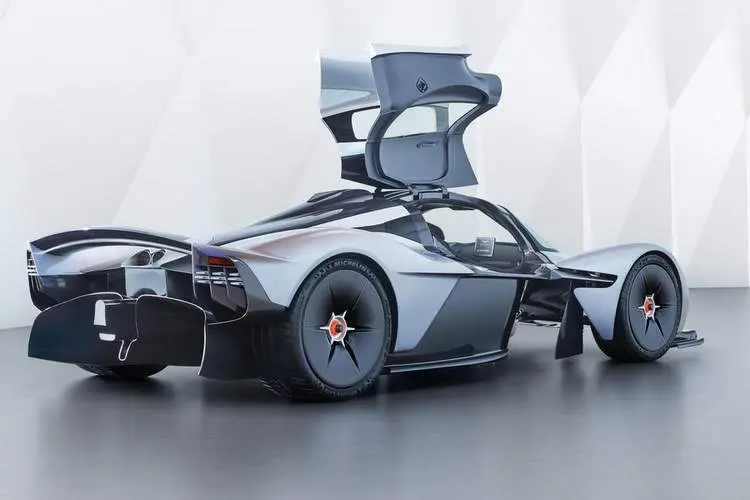
This week Aston Martin tweeted the sound of the Valkyrie, the +1,100 bhp, $3.2-million hypercar that has been built in conjunction with Red Bull and their guru designer Adrian Newey.
In March this year we reported: "The hybrid Valkyrie is a collaborative project designed under the leadership of Adrian Newey by Red Bull Advanced Technologies and Aston Martin. Created as a genre-defining road-legal hypercar, it already exists at the extreme edge of the performance envelope – now, evolved into track-only form as the AMR Pro, it redefines the envelope."
The new car was uncovered at the Geneva Motor Show by Newey and team chief Christian Horner, together with Marek Reichman, Aston Martin’s Chief Creative Officer. It formed the centerpiece of the Aston Martin stand, flanked by our show car and Aston Martin Racing’s new WEC challenger, the Vantage GTE.
Not long after Newey gave an intriguing interview regarding his interest in car design and the Valkyrie project in general:
Why design road cars?
Adrian Newey: Obviously, my career has been in motor racing since I graduated. But my dad was a great car enthusiast and he used to tinker around with Lotus Elans and E-Types and so on. I’ve always been interested in and enjoyed road cars, so it has been a background ambition through my career to at some point have a go at designing one.
Adrian Newey: Obviously, my career has been in motor racing since I graduated. But my dad was a great car enthusiast and he used to tinker around with Lotus Elans and E-Types and so on. I’ve always been interested in and enjoyed road cars, so it has been a background ambition through my career to at some point have a go at designing one.
The Valkyrie began as an evening and weekend hobby almost, but I started thinking about it a bit more seriously in the summer of 2014 when I was on holiday. The first thing you think is ‘Okay, what’s the angle, what should it be?’ and with my background, it seemed sensible to make it a high-performance sports car. Then you have to decide what you want the car to achieve.
The obvious target was a car that if you took it on track it would be capable of very quick lap times – significantly quicker than any other road-legal car. But at the same time, it would be a comfortable car, one that if you’re driving on the road it’s not a horrible place to be. I also wanted it to be something that you could look at as hopefully a piece of art and I wanted it to be like a modern superbike where, unless you’re completely stupid, there’s a slight air of trepidation before you get on it, because you need to have your wits about you when you ride it. I wanted it to be something that would make your heart race.
Once you were sure you wanted to proceed with the project, how did you go about getting it from holiday daydream to drawing board and production?
AN: When I got back to the UK I started to do some very early layout drawings, beginning with the seating position and the broad mechanical layout. To suit the aerodynamics I wanted to keep the chassis as narrow as possible, so the first thing was the seating position – raised legs and feet, just as we do on a race car. I thought about the engine quite a lot and from a technical point of view, there seemed to be two possibilities.
AN: When I got back to the UK I started to do some very early layout drawings, beginning with the seating position and the broad mechanical layout. To suit the aerodynamics I wanted to keep the chassis as narrow as possible, so the first thing was the seating position – raised legs and feet, just as we do on a race car. I thought about the engine quite a lot and from a technical point of view, there seemed to be two possibilities.
One was to go for a turbocharged V6, the other a normally aspirated V12. Looking at it from a purely technical standpoint there wasn’t a lot of difference, but with the V12 I was more confident that we could mount it solidly, without vibration being an issue. And as soon as you have to go to a rubber-mounted engine, then that means the engine and gearbox are non-structural.
You need to have this big framework around it and that gets heavy and clumsy. Plus a turbocharged engine needs intercoolers. And I also felt that the V12, being a smoother engine, would allow us to do some tricks with the gearbox that we wouldn’t be able to do as easily with a V6, and that would actually make for a much lighter gearbox. Also, from an emotional point of view and with regard to noise, then, of course, the V12 has some advantages!
You were doing all this in isolation, so when did it become a wider project?
AN: With Red Bull Racing we assembled a small team consisting of a mechanical design engineer, Ben Butler, simulation engineer Giles Wood, a CFD engineer and two surface designers. From there we were able to start doing some performance simulations and it appeared to achieve its targets in the simulation world.
AN: With Red Bull Racing we assembled a small team consisting of a mechanical design engineer, Ben Butler, simulation engineer Giles Wood, a CFD engineer and two surface designers. From there we were able to start doing some performance simulations and it appeared to achieve its targets in the simulation world.
We did that for nine months and the following summer it was a question of ‘How do we take it forwards?’ There were two choices: you either go with a private investor and we had somebody lined up as a possibility, or go with an OEM, a manufacturer. Christian [Horner, Red Bull Racing team principal] and I felt that for various reasons the OEM route was better, simply because of the experience it would have in the automotive sector with dealerships and warranties etc, and knowledge of the legal side would be useful.
Then it was a simple choice to approach Aston Martin. It’s a British brand, it’s geographically just 30 miles or so down the road from our factory, and we knew some of the Aston personnel – in particular, Andy Palmer – from our previous Infiniti relationship. So there was a natural synergy. It’s been a very good choice. There have been cultural clashes, as you might expect because as an F1 team we’re used to doing things quickly. We take quite large amounts of risk and don’t concern ourselves too much about what it costs to make something, whereas it’s almost the opposite in the automotive world. But we’re learning from each other.
You talk about it being a hypercar that is comfortable in traffic. Can you really do the supermarket run in it?
AN: For the kind of low-speed tractability and comfort you need if you’re stuck in traffic, then the downside of any high-revving, highly-tuned engine is that its low-speed tractability might be poor. We, therefore, put an electric motor in for low-speed work, which obviously boosts the power as well, and performs various other functions. Also, if you have an electric motor you don’t need a starter motor, you don’t need an alternator. You don’t need a reverse gear; you can reverse using the e-motor. Those elements went a long way to cancelling out the weight of the electric motor because we could leave other bits off.
AN: For the kind of low-speed tractability and comfort you need if you’re stuck in traffic, then the downside of any high-revving, highly-tuned engine is that its low-speed tractability might be poor. We, therefore, put an electric motor in for low-speed work, which obviously boosts the power as well, and performs various other functions. Also, if you have an electric motor you don’t need a starter motor, you don’t need an alternator. You don’t need a reverse gear; you can reverse using the e-motor. Those elements went a long way to cancelling out the weight of the electric motor because we could leave other bits off.
What about the Pro version, the track-only car that was launched at the Geneva Motor Show last month?
AN: The 002 has the same mechanical underpinnings in terms of chassis, engine and suspension, but with anything needed for road legislation or road comfort taken away – such as a lot of the emission stuff, which is one of the reasons that cars have got so heavy. Because ride is less of a consideration you can go stiffer on the suspension, which means it can take even higher area loads, so more downforce. Basically, it’s about taking away the limitations of making a comfortable road car. If you take those away the 002 is what you’re left with.
AN: The 002 has the same mechanical underpinnings in terms of chassis, engine and suspension, but with anything needed for road legislation or road comfort taken away – such as a lot of the emission stuff, which is one of the reasons that cars have got so heavy. Because ride is less of a consideration you can go stiffer on the suspension, which means it can take even higher area loads, so more downforce. Basically, it’s about taking away the limitations of making a comfortable road car. If you take those away the 002 is what you’re left with.
And what is that? What does a Valkyrie Pro driver get?
AN: You get a car that – not on top speed, because other manufacturers such as Bugatti have chased that one – but on track, you get a car that is uncharted territory for a two-seater, outside perhaps LMP1.
But with the road version, you also get a car that’s comfortable and something that hopefully looks and sounds great, a car you feel pride and joy in owning.
That’s the real target.
AN: You get a car that – not on top speed, because other manufacturers such as Bugatti have chased that one – but on track, you get a car that is uncharted territory for a two-seater, outside perhaps LMP1.
But with the road version, you also get a car that’s comfortable and something that hopefully looks and sounds great, a car you feel pride and joy in owning.
That’s the real target.
So who buys the track version? Are the customers all F1 drivers?
AN: There are a few current and ex-F1 drivers buying them. I don’t want to name any names. That would be indiscreet, but yes, there are a few grand prix drivers on the list.
AN: There are a few current and ex-F1 drivers buying them. I don’t want to name any names. That would be indiscreet, but yes, there are a few grand prix drivers on the list.
Are you satisfied with the end product?
AN: As long as it works out as we hope it should then yes, I think so. It will hopefully be looked upon as being a landmark car.
AN: As long as it works out as we hope it should then yes, I think so. It will hopefully be looked upon as being a landmark car.
What about the next step? Lots of sports car designers often bemoan that fact that they’re only ever asked to design supercars when they’d like to take on other challenges. Do you fancy drawing a suburban runabout?
A road car production of 150 units is planned, at a unit price of US$3.2 million. There will be a track version, called the Valkyrie AMR Pro, with only 25 units to be produced, apparently all sold already!
https://www.grandprix247.com/2018/03/06/red-bulls-mighty-aston-martin-valkyrie-amr-pro-unveiled/
loading
Latest News
Loading