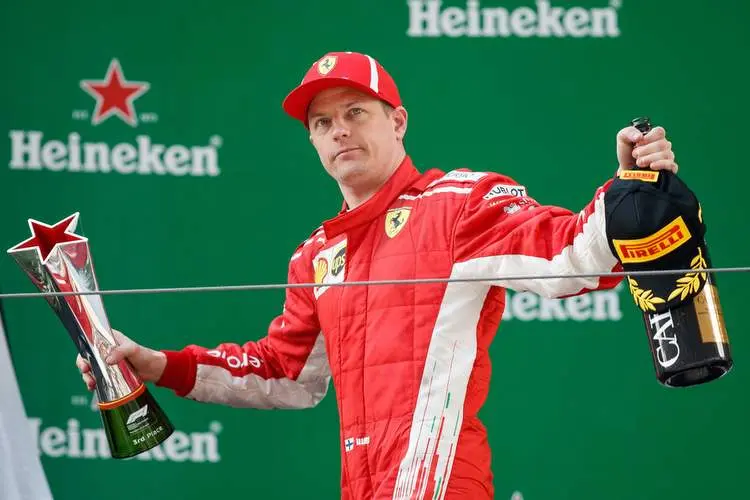
Finland has a population smaller than metropolitan London, yet it has produced more Formula 1 world champions than Germany’s grid-filling motor industry has managed on its own soil.
Keke Rosberg opened the account in
1982, driving for Williams in a season so brutal it claimed two drivers’ lives.
Since then, Mika Häkkinen, Kimi Räikkönen, and Keke’s own son Nico have added
three more titles between them, and Valtteri Bottas has quietly become one of
the most statistically productive non-champions the sport has seen.
For a
country better known for ice hockey and saunas, that record is hard to explain
by population size alone — something in Finnish racing culture, from karting
tracks to rally roads, keeps producing drivers who are unnervingly calm under
pressure.
Häkkinen vs. Schumacher: A Rivalry Settled at 300 km/h

Mika Häkkinen won back-to-back titles in 1998 and 1999, but
the moment most people associate with him didn’t come during either
championship run. It came at Spa-Francorchamps in August 2000, on lap 41 of the
Belgian Grand Prix, when he passed both Michael Schumacher and backmarker
Ricardo Zonta in a single move on the run up to Les Combes.
The context mattered as much as the move itself. A lap
earlier, Schumacher had forced Häkkinen onto the gravel at close to 300 km/h —
a situation Häkkinen called out directly as dangerous at the drivers' weigh-in.
Rather than retaliate, he waited.
As both cars closed in on Zonta's slower BAR,
Schumacher chose to pass on the left; Häkkinen went right, slipping through a
gap that was open for perhaps a second, and held the lead through the corner.
The win itself was comfortable, and it stretched Häkkinen's championship lead
to six points with four races left in the season.
Title fights like this one have always drawn bettors who
follow the series closely — sites like Maltalaisetkasinot.net are now
where Finns can compare odds on upcoming races, much the way fans followed the
tension of a Spa weekend back in the early 2000s.
McLaren's Ron Dennis called
the pass one of the best in the sport's history at the time, and more than
sixty F1 historians later voted it the standout moment of the entire 2000
season.
The move has aged well: two decades on, drivers like Esteban Ocon have
openly modelled similar overtakes on it, and it still gets replayed whenever
broadcasts need an example of top-level wheel-to-wheel racing.
Räikkönen’s 2007 Title: The Iceman Arrives Last and Wins First
No Finnish story in Formula 1 is more improbable than Kimi
Räikkönen’s 2007 championship. He’d just joined Ferrari after a winless final
season at McLaren, and by the time the field reached Japan for the penultimate
round, he was 17 points behind Lewis Hamilton with only 20 left on the table.
Statistically, the title race looked over.
It wasn’t. Wins in China and then Brazil — combined with
late-season misfortune for both McLaren drivers, including a gearbox issue that
derailed Hamilton’s run at Interlagos — pulled Räikkönen level going into the
final laps. He crossed the line in Brazil to win the race and, with it, the
drivers’ championship by a single point over both Hamilton and Fernando Alonso.
It was the first time in F1 history that three drivers had scored over 100
points in the same season, and only the second time a driver sitting third
before the finale had gone on to take the title, the first being Giuseppe
Farina back in 1950.
What makes the result stick in memory isn’t just the
arithmetic. Räikkönen had entered the season as Ferrari’s replacement for the
retiring Schumacher, an outsider stepping into an intense, tightly run team
mid-rivalry between two McLaren stars who barely spoke to each other by
season’s end. He let the drama play out around him and simply kept finishing
races. It remains, to date, the last drivers’ title Ferrari has won.
Rosberg 2016: A Championship, Then a Goodbye
Nico Rosberg’s story sits slightly apart from the others —
born in Germany, racing under the German flag, but the son of 1982 champion
Keke Rosberg and holder of Finnish citizenship through his father. His own
title, in 2016, closed a three-year rivalry with Mercedes teammate Lewis
Hamilton that had turned genuinely personal by the end.
The numbers tell part of it: Rosberg won 10 races to
Hamilton’s 10 across the season, but consistency in the races neither driver
won gave him a five-point cushion heading into the Abu Dhabi finale. He
finished second behind Hamilton that day — enough to clinch the title on
points. What happened next is the part people remember.
Five days later, at the
FIA prize-giving ceremony in Vienna, Rosberg announced his immediate
retirement. He was 31, freshly crowned, and walking away at the peak of the
sport — the first reigning champion to retire since Alain Prost in 1993.
He later said the decision had crystallised the moment he
crossed the finish line in Abu Dhabi: having spent the season stripping grams
off his helmet and gloves and working with a sports psychologist to close the
gap on Hamilton, he simply didn’t want to do it again. It’s one of the few
championships in F1 history where the ending felt more consequential than the
win itself.
Bottas: Ten Wins in the Shadow of a Champion
Valtteri Bottas never won a world title, and he’s
occasionally been remembered for Toto Wolff’s offhand description of him as a
“sensational wingman” during a 2018 team-orders controversy. But the five years
he spent at Mercedes between 2017 and 2021 deserve a cleaner look.
He arrived as Rosberg’s replacement, immediately took pole
in Bahrain, and won his first race at that year’s Russian Grand Prix — one of
three victories in his debut Mercedes season.
Runner-up finishes to Hamilton
followed in 2019 and 2020, years where Bottas was frequently fast enough to
lead races outright but rarely got the run of strategy calls that a genuine
title challenge required. His final win, at the 2021 Turkish Grand Prix,
brought his Mercedes tally to ten victories and closed out a stretch in which
the team took five consecutive constructors’ championships.
By the numbers, he remains the highest points-scorer in F1
history never to win a drivers’ title — a statistic that says as much about the
strength of his teammate as it does about Bottas himself.
A Small Country’s Outsized Footprint
Four drivers, four very different stories — a legendary
overtake, an against-the-odds title, a championship-and-retirement in the space
of a week, and a quietly excellent supporting act.
None of it reads as
coincidence once you notice how many of Finland’s fastest exports have shared
the same traits: patience under pressure, minimal fuss, and a habit of
delivering the result before saying much about it. Whatever the next generation
of Finnish drivers brings, they’ll be racing against a standard that’s already
unusually high for a country of five and a half million people.

Latest News

Loading