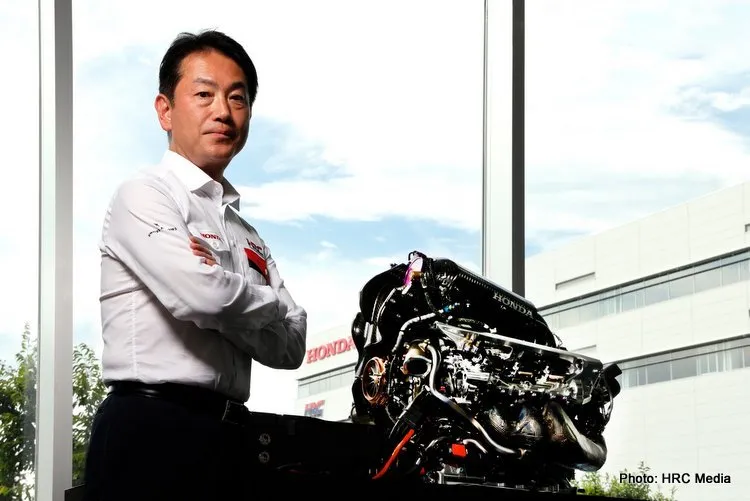
Koji Watanabe’s appointment as President of Honda Racing Corporation (HRC) in 2022 marked a decisive new chapter in the company’s global motorsport strategy.
A Honda veteran since 1987, Watanabe brought decades of international experience across automotive operations, motorsport PR, and brand communications to the role. His leadership oversaw the unification of Honda’s two- and four-wheel racing efforts under the HRC banner, streamlining operations and sharpening Honda’s competitive focus.
In an exclusive interview with GRANDPRIX247 and Kyodo News Agency, Watanabe reflected on the end of Honda’s dominant partnership with Red Bull in Formula 1, the company's full-scale return with Aston Martin in 2026, and the deepening alignment between F1’s hybrid future and Honda’s wider electrification roadmap.
He reaffirmed Honda’s commitment to racing as a proving ground for both technology and talent, and outlined a clear ambition: to convert F1 success into long-term value for the Honda brand, its engineers, and a new generation of global fans.
Q: First of all, is your long-standing partnership with Red Bull ending successfully? Looking back, how would you evaluate it?
Koji Watanabe: Yes, Honda has been in partnership with Red Bull for eight years. For us, it was one of the most successful partnerships in F1 history.
In 2019, we won our first race in Austria during our fourth term. That year, we also finished first and second in Brazil, and in 2020, AlphaTauri took their first win. In 2023, we achieved 21 wins out of 22 races, a record-breaking winning rate. Max’s drivers' championships - four in a row - were all won with Honda and HRC power units. I believe we made a significant contribution. It was a great partnership overall. That’s the summary.
In 2019, we won our first race in Austria during our fourth term. That year, we also finished first and second in Brazil, and in 2020, AlphaTauri took their first win. In 2023, we achieved 21 wins out of 22 races, a record-breaking winning rate. Max’s drivers' championships - four in a row - were all won with Honda and HRC power units. I believe we made a significant contribution. It was a great partnership overall. That’s the summary.
Q: You’ve been struggling this season. What do you think is the reason?
KW: That’s competition. Red Bull and Honda haven’t become complacent, but other teams have made remarkable progress. In any case, we haven’t given up on the drivers’ championship yet. Max is still giving it everything.
Speaking of Red Bull, it’s about Mateschitz - his leadership and great vision. He was obsessed with winning and loved racing. I think he led the entire team to victory. You need someone with strong leadership in racing, and that was Red Bull’s strength. There’s no doubt that Christian and Helmut are now leading the team with that same energy. Mateschitz was truly great.
Speaking of Red Bull, it’s about Mateschitz - his leadership and great vision. He was obsessed with winning and loved racing. I think he led the entire team to victory. You need someone with strong leadership in racing, and that was Red Bull’s strength. There’s no doubt that Christian and Helmut are now leading the team with that same energy. Mateschitz was truly great.
Q: Looking ahead to next season, you withdrew from F1 in 2021 but have returned. How does this align with Honda’s EV strategy through 2040?
KW: The withdrawal by Honda Motor Co., Ltd. was a major shift toward electrification, and that’s not a small change. F1 used to require many top engineers, but we felt those people needed to be reallocated to EV development. It was necessary to reassign people, resources, and funding. I believe it was the right decision.
Then, as the new F1 regulations were finalised, especially with a larger emphasis on electrification and carbon neutrality, it became clear that some of the technologies could be applied to our commercial operations - 3D mobility, eVTOL and so on. That’s when we decided to re-enter in 2026.
Then, as the new F1 regulations were finalised, especially with a larger emphasis on electrification and carbon neutrality, it became clear that some of the technologies could be applied to our commercial operations - 3D mobility, eVTOL and so on. That’s when we decided to re-enter in 2026.
Q: Some people say the 2021 withdrawal was a waste of time. Do you agree?
KW: Well, yes. At the time, we didn’t expect to return so soon, so in that sense, it could be seen that way. But in 2022, Honda’s F1 operations were integrated into HRC, originally a two-wheel racing company, and we continued to support Red Bull. We also continued developing elemental technologies. So in that sense, we didn’t start from zero. When we return in 2026, we won’t be starting from scratch in terms of staff or budget.
Q: Can you tell us how the partnership with Aston Martin came about?
KW: To participate in 2026, we had to register as a manufacturer by November 2023. At that time, we weren’t planning to re-enter, but as a racing company, we wanted to stay involved with the direction of F1. Once we registered, various teams approached us, and that’s how the talks with Aston Martin began.
We were in contact with almost all of the major teams - not Ferrari or Mercedes - but others. What stood out with Aston Martin, much like with Mateschitz, was their leadership. We saw Stroll’s commitment to winning, his love of racing, and his respect for Honda. From their side, they really wanted to work with us. That’s where serious discussions began.
We were in contact with almost all of the major teams - not Ferrari or Mercedes - but others. What stood out with Aston Martin, much like with Mateschitz, was their leadership. We saw Stroll’s commitment to winning, his love of racing, and his respect for Honda. From their side, they really wanted to work with us. That’s where serious discussions began.
Q: What are you focusing on in preparation for next season?
KW: As a works team - not a customer - we also work on engine packaging and integration with the chassis. Aston Martin is currently producing the gearbox and integrating it with our power unit. We’re also testing several configurations.
With Adrian Newey involved, we’re looking at how to match the engine to his aerodynamic concepts. Fuel development is also critical. This is the first time we’re working with Aramco. We have some fuel expertise and are now co-developing. We’re also developing engine oil with Valvoline. We’re doing everything that’s needed to win.
With Adrian Newey involved, we’re looking at how to match the engine to his aerodynamic concepts. Fuel development is also critical. This is the first time we’re working with Aramco. We have some fuel expertise and are now co-developing. We’re also developing engine oil with Valvoline. We’re doing everything that’s needed to win.
Q: Would you say preparations are going well?
KW: It’s a completely new regulation, so we don’t know exactly what the others are doing. We’ve set ambitious but reasonable targets - several steps above our previous standards - and are working toward them. We won’t be able to assess our position until we’re running, but our mindset is always on winning.
Q: What is the key to success, as you achieved with Red Bull?
KW: It comes down to taking on new technical challenges. You can’t win by simply extending existing technology. We have to set higher goals and adopt new ideas. That’s what we’re doing.
Q: How does this connect to mass production and EVs?
KW: Not everything translates directly. F1 is cutting-edge, and most of the tech doesn’t apply to mass production. But engineers who have experienced F1 can bring value to hybrid and eHEV development. They can also contribute to new fields like 3D mobility. Training people and developing technology - that’s why we race. The end goal is for engineers to turn their knowledge into real products for customers.
Q: How has the external reaction been?
KW: There’s a strong expectation for Honda to be in F1. When people think of the Honda brand, motorsport is part of that identity. Our customers are watching, and we must be aware of that. I can’t promise anything definitive about the future, but as president of Honda Racing, I believe we must build a system that allows us to keep racing.
Q: Is the sustainability approach different now than before?
KW: It’s no longer just a project that disappears once it ends. Know-how is now being retained within the company. If we can work more closely with Honda’s business side, and create a direct pipeline from HRC and F1 into mass production - like what GR has done - we can increase the value of our racing activities. That’s one of our goals.
Q: F1 is growing globally, especially in the US. Is that helping Honda’s marketing?
KW: The US is now a very important market for Honda. The growth of F1 there is a major reason for our return. Our brand image in the US had become a bit dull - known only for durability and quality. Honda America wants to use F1 to appeal to younger customers again. They’re using F1 in their advertising now. Marketing and motorsport are more connected than ever, and that helps with continuity.
Q: In Japan, the fan base is aging. What needs to change?
KW: That’s true, though we’re seeing younger fans emerge. We’re working with F1 and FOM to attract new fans. For example, we hosted an event in Odaiba this year to help bring F1 closer to people who can’t make it to Suzuka. There are fewer fans in Tokyo, and we want to change that. Kansai still has a strong, loyal fanbase, but Tokyo needs more engagement.
Q: Let’s talk about Tsunoda. He began driving for Red Bull mid-season. You supported that decision, didn’t you?
KW: Yes. I’ve always told Christian Horner that Honda wants a driver who can win. We’ve believed in Tsunoda’s ability from the start, though he hasn’t always had the success we hoped. At Suzuka, I spoke with Christian and asked him to seriously evaluate Yuki. That’s how the promotion happened. People ask me how long he’ll drive, but we agreed they would give him a fair chance. I’m not worried. I’ll check in with Christian again soon, but I don’t expect changes.
Q: How do you think Tsunoda is doing since the promotion?
KW: I spoke to him recently. He’s staying positive and believes in his potential. The car is still lacking competitiveness, but Red Bull is a top team. I think they’ll improve in the second half of the season. I believe Yuki will seize this chance and deliver strong results.
Q: Aston Martin has renewed their driver lineup, but Tsunoda is a former Honda driver. What do you want his future to look like?
KW: I don’t intend to tie him to Honda just because of the past. He’s a capable F1 driver. What matters is his own will. From what I hear, he wants to stay with Red Bull. I support that. Wherever he goes, he will always be a Honda alumnus, and I’ll continue to support him.
Q: Is it important for Honda to have a Japanese driver involved?
KW: Now that we’re partnering with Aston Martin, we need a driver lineup that can win. If there’s a Japanese driver who fits that role, I’d push for him. I hope we can create opportunities for the next generation of Japanese drivers following in Yuki’s footsteps.
Q: What do you think of the current presence of Japanese drivers?
KW: Tsunoda has now done 100 races, and we’re proud to have a Japanese driver performing at this level. I believe there are others in Japan with similar potential. We want to strengthen our training programmes and provide proper support to help bring them up. Our goal is to produce a second or third Tsunoda.
Q: What is the current status of HRC’s UK base?
KW: It was originally closed after our work with Red Bull, but we’ve since re-established our UK base. I am currently serving as its president, and Mr Yamazaki is vice president.
Who is Koji Watanabe

Koji Watanabe assumed the presidency of Honda Racing Corporation (HRC) in 2022, marking a bold pivot in a storied motorsport legacy. A Honda veteran since 1987, Watanabe’s ascent through European automobile operations, motorsport PR, and brand communication uniquely positioned him to unify Honda’s two- and four-wheel racing programmes under a single umbrella.
Born into a generation inspired by Formula 1, Watanabe was drawn to Honda’s motorsport spirit early on. His career saw postings overseas for 18 years in motorsport PR, followed by executive roles in brand management, culminating in the presidency of HRC. He reflects that his personal mission was to blend motorsport passion, global reach, and communication strategy, and that the HRC role has allowed him to achieve all three.
Under Watanabe’s direction, HRC’s 2022 restructuring brought motorcycle and automobile racing together under one global entity. This included absorbing HRD Sakura to establish HRC Sakura in Tochigi and launching subsidiaries in the UK and the US. The goal was not just to enhance race performance, but also to build brand value through cross-discipline synergy. Watanabe prioritised brand elevation, carbon neutrality, and talent development across MotoGP, Super Formula, Super GT, Rally, Trial, and the upcoming F1 entry.
Red Bull Phase Boosts Honda Reputation

The 2022 to 2025 partnership saw HRC supply power units to Red Bull Powertrains and AlphaTauri. This era contributed to Red Bull Racing’s domination, with 21 wins in 22 races in 2023 and continued Drivers’ Championships for Max Verstappen.
Watanabe viewed Formula 1 as a laboratory on wheels, helping Honda refine hybrid efficiency, energy deployment and real-time telemetry systems, all of which contribute to future road car technology.
At the 2025 Japanese Grand Prix at Suzuka, Watanabe praised Verstappen’s emotional fourth win at the venue and acknowledged the impact the Red Bull partnership had on Honda’s motorsport identity.
In May 2023, Honda confirmed a full-scale return to F1 in 2026, this time with Aston Martin as a full works partner. Watanabe described this as a pivotal move, one that allowed HRC to step beyond engine supply and into a more strategic, commercially driven role.
Alongside this, HRC plans to expand brand equity through merchandising, services, and a greater emphasis on sustainable profitability in motorsport.
2026 and Beyond: Watanabe’s Technical and Global Vision

With Formula 1’s 2026 rules set to increase electrical output and mandate carbon-neutral fuels, Watanabe acknowledges the engineering challenge. The new rules call for a 50/50 split between internal combustion and electric power, alongside cost controls.
Still, Watanabe believes this direction aligns perfectly with Honda’s long-term environmental goals and says the learnings from F1 will feed into Honda’s next-generation cars and mobility platforms.
He remains realistic about the difficulty of the task. “We are struggling. Now we are trying,” he admitted, as development intensifies behind closed doors.
Watanabe is clear about HRC’s broader mission. Domestic series like Super GT and Super Formula are being used to develop young talent such as Ayumu Iwasa and Igor Fraga. HRC is also investing in e-motorsports, using virtual racing to connect with new fans and identify future drivers and engineers.
He sees F1’s growing audience, particularly among younger fans, as vital to energising Honda’s brand in Japan and North America. The resurgence of business engagement around the Japanese Grand Prix reflects the momentum HRC is building under his leadership
Watanabe is guiding HRC through a crucial transformation, from a race-focused engine supplier into a global motorsport and innovation platform. His approach combines Honda’s founding racing spirit with strategic commercial thinking, positioning HRC to thrive in the next era of Formula 1 and beyond.
As the sport enters a new phase of technological evolution, it is Watanabe’s leadership that will define Honda’s competitive future.
Latest News

Loading