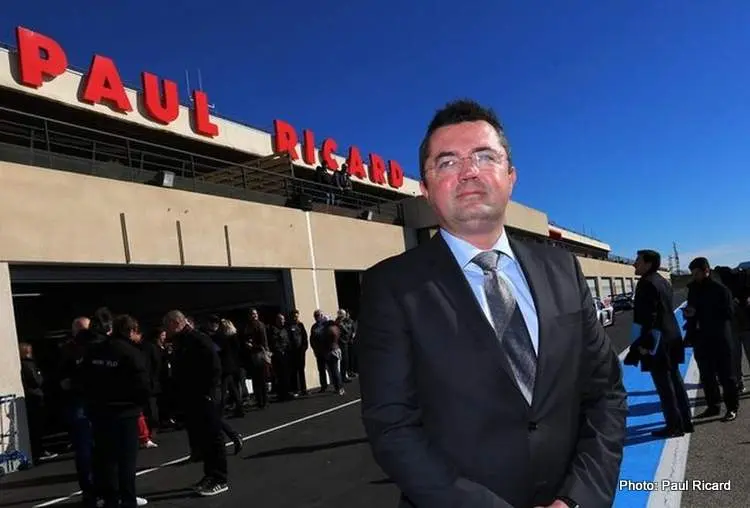
After being unceremoniously ditched by McLaren when the Zak Brown era got into full swing at Woking, Eric Boullier has emerged as a strategic advisor and race ambassador to the French Grand Prix.
Once in the hurly-burly of the Formula 1 contest, with senior management roles at Renault, Lotus and McLaren by, the Frenchman now finds himself on another side of the fence as he goes in to bat for the organisers of this weekend's race at Paul Ricard, having already played an instrumental role in returning the Grand Prix to France after a decade absence.
One of the biggest gripes, and indeed turn-offs, regarding last year's race at Paul Ricard, in Le Castellet were the exorbitant hotel and accommodation prices in the surrounding area during race week, while traffic jams which seriously hampered fans, teams and media from getting in and out of the circuit tarnished the weekend for many.
Ahead of this weekend's race at the venue in southern France, F1 Media released an interview with Boullier, who addresses these issues and sheds light on others, ahead of his home race where he will once again be in the paddock limelight.
You were instrumental in bringing the French Grand Prix back to the calendar and since February you’ve been working with the organisers. What needed to be done and how has your role developed over the past months?
EB: The main thing for me to understand was where the team were at in terms of capability and development of this year’s race.
Despite a few glitches, they had a successful first edition and for me, it was about building on that and establishing the identity of the grand prix for the medium and long term – making sure we are building something Formula 1 views as a valuable Grand Prix for the future and also that fans value.
Last year was very successful in terms of attendance, but it was mainly French people and locals coming. We are now targeting a much wider audience across Europe and beyond.
EB: The main thing for me to understand was where the team were at in terms of capability and development of this year’s race.
Despite a few glitches, they had a successful first edition and for me, it was about building on that and establishing the identity of the grand prix for the medium and long term – making sure we are building something Formula 1 views as a valuable Grand Prix for the future and also that fans value.
Last year was very successful in terms of attendance, but it was mainly French people and locals coming. We are now targeting a much wider audience across Europe and beyond.
Is that the key for the future success of the race – more consistent marketing and building a strong identity?
EB: Absolutely. You need the product and you need to keep developing it but you also need to find the right partners to establish the right marketing and you need to deliver the right message.
Reaching people is good, but you need to make sure your message is understood, and for us, that message is focused on our location. Our race date is just before the summer holidays, so what we want to do is to give people an experience of the French Riviera and I think we have really brought that experience to the track and to the paddock.
We want to maintain that French touch and the cultural experience. We want people coming to the race enjoy the Riviera experience, the food, the wine, the music. It’s a taste of summer before the holidays really kick into gear.
EB: Absolutely. You need the product and you need to keep developing it but you also need to find the right partners to establish the right marketing and you need to deliver the right message.
Reaching people is good, but you need to make sure your message is understood, and for us, that message is focused on our location. Our race date is just before the summer holidays, so what we want to do is to give people an experience of the French Riviera and I think we have really brought that experience to the track and to the paddock.
We want to maintain that French touch and the cultural experience. We want people coming to the race enjoy the Riviera experience, the food, the wine, the music. It’s a taste of summer before the holidays really kick into gear.
The event has to meet a great number of demands in terms of local employment, boosting tourism numbers but also remaining economically viable. How difficult is it to balance all of those aspects?
EB: I think the balance is between investing for the future and covering the costs of operating the Grand Prix itself, which are substantial.
We are lucky enough to be, in simple terms, a state company, which means that we are under no obligation to make a profit. Obviously, we can’t have any losses but we have the ability to spend what we have. It means that every cent we accrue in revenue can be put back into the race to make sure the experience is as great as it possibly can.
EB: I think the balance is between investing for the future and covering the costs of operating the Grand Prix itself, which are substantial.
We are lucky enough to be, in simple terms, a state company, which means that we are under no obligation to make a profit. Obviously, we can’t have any losses but we have the ability to spend what we have. It means that every cent we accrue in revenue can be put back into the race to make sure the experience is as great as it possibly can.
Is there any measure yet of the economic impact of the race on the region?
EB: Yes, we commissioned a survey with Deloitte before and after last year’s Grand Prix and it generated detailed numbers. In terms of job creation, we have created around 600 full-time jobs and the economic impact amounts to €78-million into the "Region Sud". So it is around €14-million spent for a return of more than €70-million. When you have government and public subsidies involved you need to be transparent and prove that the model works. So far we have shown that it is a good model and now we need to make sure that we keep that model sustainable over the long-term.
EB: Yes, we commissioned a survey with Deloitte before and after last year’s Grand Prix and it generated detailed numbers. In terms of job creation, we have created around 600 full-time jobs and the economic impact amounts to €78-million into the "Region Sud". So it is around €14-million spent for a return of more than €70-million. When you have government and public subsidies involved you need to be transparent and prove that the model works. So far we have shown that it is a good model and now we need to make sure that we keep that model sustainable over the long-term.
The major concern last year was, of course, the traffic. Are you happy with the solutions put in place for this year’s Grand Prix?
EB: The plan we have is good. It has been dictated by data. We partnered with a company called Citec in Switzerland, which has world-class expertise in mobility plans for large events. They looked after the Ryder Cup in France last year, the 2016 UEFA European Championship and they are working with the Olympics for the 2024 Games in Paris.
They took all of the data we had from last year and with that knowledge of how the traffic flowed, and where and when it was at its heaviest, they built simulations and came back with a plan.
We have a new traffic management plan and we are working closely with the local authorities through a steering committee. We have additional access points to the circuit without crossing streams of traffic, we will have 170 shuttles available to the general public with 4,000 Parking & Ride places and we have partnered with traffic app Waze who will dedicate some engineers to the grand prix so that we have real-time traffic information that can be accessed by everyone.
We have to fix the issues we had last year – that’s a given. And if solve those problems and if we pass the second edition without mobility issues it will be forgotten.
EB: The plan we have is good. It has been dictated by data. We partnered with a company called Citec in Switzerland, which has world-class expertise in mobility plans for large events. They looked after the Ryder Cup in France last year, the 2016 UEFA European Championship and they are working with the Olympics for the 2024 Games in Paris.
They took all of the data we had from last year and with that knowledge of how the traffic flowed, and where and when it was at its heaviest, they built simulations and came back with a plan.
We have a new traffic management plan and we are working closely with the local authorities through a steering committee. We have additional access points to the circuit without crossing streams of traffic, we will have 170 shuttles available to the general public with 4,000 Parking & Ride places and we have partnered with traffic app Waze who will dedicate some engineers to the grand prix so that we have real-time traffic information that can be accessed by everyone.
We have to fix the issues we had last year – that’s a given. And if solve those problems and if we pass the second edition without mobility issues it will be forgotten.
The first year of a race is always something of an easy sell, as there’s inevitably a buzz around a new or returning race. The second year can be a lot trickier. Are you happy with ticket sales this year and with the programmes you have put in place to drive numbers?
https://www.grandprix247.com/2018/07/04/boullier-resigns-in-mclaren-f1-team-restructuring/
loading
Latest News

Loading