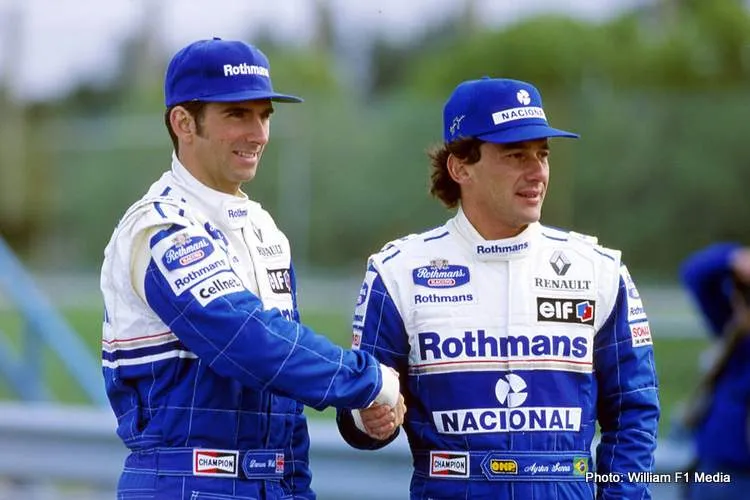
1996 Formula 1 World Champion Damon Hill has offered his most personal reflections yet on Ayrton Senna’s death and its lifelong impact, ahead of the release of his new documentary 'Hill'.
Speaking candidly in support of the film, Hill revisited the horrors of Imola 1994 and revealed how his time with Senna as a teammate—though brief—left a lasting emotional and spiritual imprint.
“I think Ayrton got in the car because that’s who he was,” Hill said. “He was a racer, and you give him a racing car, he’s going to go and try and win a race. Without that, we would never have heard of him. He wouldn’t have been Senna.”
Hill recalled the dread that engulfed the paddock following the death of Roland Ratzenberger, and how Senna himself made the fateful decision to race the next day. “If we all walked away, we would not be true to ourselves,” Hill reflected. “Senna got in the car knowing the risks. That was who he was.”
The shock came later. “What took my breath away was understanding that after he died, the race continued,” said Hill, who drove the restarted Grand Prix without power steering. “I was dehydrated and in the medical centre when Dicky Stanford came in and told me. That was the first time I heard he had died.”
Ayrton, if you’re up there, I could do with a hand

Hill, who shared a garage with Senna for just three races at Williams, spoke movingly about the Brazilian’s character: “He was kind. He had a very big heart and he was determined to do good for the world if he could. He understood he carried the hopes of a nation.”
Senna’s presence lingered long after his death. In a remarkable moment, Hill recalled asking Senna for help from beyond during a high-pressure lap in the 1994 Japanese Grand Prix: “I was under pressure and thought, ‘Ayrton, if you’re up there, I could do with a hand.’ I suddenly felt like a passenger in my own car—like I was being driven by something beyond myself. It was extraordinary.”
Despite being offered the chance to step back amid safety doubts, Hill chose to carry on. “I trusted the team. What else can I do? You can’t keep going back asking, ‘Did you tighten that bolt?’ You go racing like that and accept that things can go wrong.”
He added: “Up until they died, Roland and Ayrton loved racing. That’s why they were there. If you didn’t understand the risks before, you shouldn’t really be doing it.”
Hill vs Schumacher

The documentary also charts Hill’s rivalry with Michael Schumacher, which reached its most controversial moment at the 1994 season finale in Adelaide. Hill reflected on the mental toll it took: “I fell for it. I got suckered in. He was able to put pressure on every little part of your life.”
Hill admitted that Schumacher’s tactics, from cold press conference interruptions to psychological distance, wore him down: “He didn’t show you any humanity. That’s something I struggled with. I need some human connection, and he was able to cut himself off completely.”
Yet Hill sees the rivalry as a defining challenge. “If it wasn’t for Michael, I would never have found out how far I could go as a racing driver. I eventually beat him fair and square in races, and I won a world title.”
The film Hill offers a deeply human look at a driver who lived through one of F1’s darkest weekends, faced its most ruthless competitor, and ultimately emerged as a world champion.
Damon Hill's F1 Stats show he competed in 115 GPs, winning 22 times, 20 times from pole position. He was the 1996 Formula 1 World Champion before quitting the sport in 1999.
Latest News
Loading