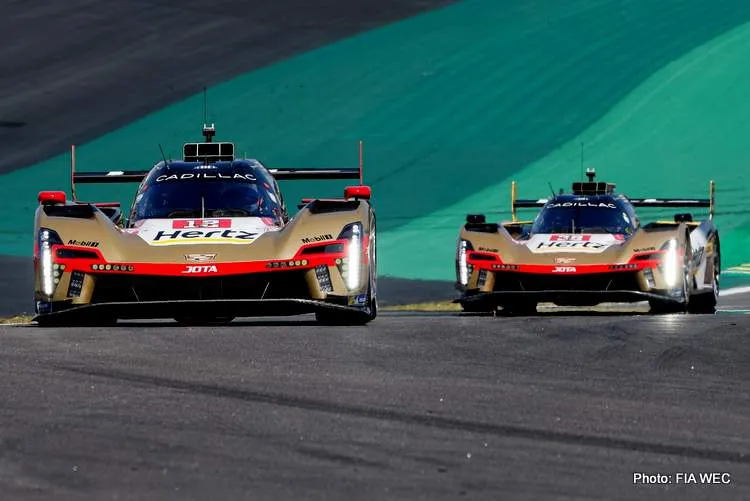
Cadillac dominated the FIA World Endurance Championship 6 Hours of Interlagos on Sunday, as Will Stevens, Alex Lynn, and Norman Nato powered to a maiden WEC victory for the brand.
They led home Cadillac teammates Earl Bamber, Jenson Button, and Sébastien Bourdais in a commanding V-Series.R LMDh 1-2 finish. It was also a first LMGT3 class win for Lexus, as José María López, Clemens Schmid, and Razvan Umbrarescu stormed to a similarly emphatic GT triumph.
The two factory Penske Porsche 963s finished third and fourth, while Sheldon van der Linde snatched fifth for BMW from the two Peugeot 9X8s in the dying laps.
In a race likely to be remembered as much for Cadillac’s breakthrough win as for the WEC’s increasingly controversial Balance of Performance (BoP) system, the Le Mans-winning yellow Ferrari 499P limped home eighth. The red factory Ferraris and both Gazoo Racing Toyotas finished well outside the points.
Cadillac Breaks Through with Historic 1-2

Cadillac locked out the front row in qualifying for the second race in a row, following Le Mans. However, a penalty on the #3 car promoted the #5 Porsche to the front row.
That Porsche snatched the lead on the opening lap and quickly pulled a five-second gap. But the Cadillacs fought back, applying pressure until Lynn flat-spotted his tyres and pitted early to replace them.
That strategy left the #12 Cadillac out of sequence, which may have helped it navigate traffic more effectively. As the race unfolded, Stevens, Lynn, and Nato emerged with a healthy lead over Bourdais in the #38, who, alongside Button and Bamber, was under pressure from Julien Andlauer in the #99 Porsche he shared with Michael Christensen.
Cadillac held firm to secure a historic 1-2 ahead of the Porsche, with Laurens Vanthoor and Kevin Estre a distant fourth and a lap down in the second 963. Van der Linde’s inspired stint in the BMW M Hybrid V8, alongside Marco Wittmann, earned them fifth ahead of the Peugeot crews Duval/Jakobsen and di Resta/Jensen.
Ferrari and Toyota off the pace

Behind them, Ferrari endured a nightmare weekend. The team arrived unbeaten in 2025 and fresh off a third straight Le Mans victory. The winning crew of Phil Hanson, Robert Kubica, and Yifei Ye were the quickest of the 499Ps, but all three factory Ferraris were uncompetitive.
The collapse in performance, mirrored by Toyota Gazoo Racing’s lack of pace, points squarely to dramatic BoP adjustments that continue to undermine the credibility of the championship’s technical regulations.
Behind the yellow Ferrari, the Alpine crew of Mick Schumacher, Frédéric Makowiecki, and Jules Gounon edged out the Proton Competition Porsche trio of Nico Pino, Neel Jani, and Nicolás Varrone to round out the points-paying positions.
All finished ahead of the two red factory Ferraris (Calado/Pier Guidi/Giovinazzi and Nielsen/Fuoco/Molina) and the promising Riberas/Sørensen Aston Martin Valkyrie.
Like Ferrari, Toyota struggled badly. Both cars finished out of the points for the first time since the Hypercar era began in 2021. The #8 of Conway, de Vries, and Kobayashi finished 14th, just ahead of the #7 of Hartley and Hirakawa. They were trailed by the second Aston Martin, the delayed second BMW, and the Alpine.
Lexus delivers in LMGT3

The Akkodis Lexus squad celebrated a maiden LMGT3 win. López, Schmid, and Umbrarescu led convincingly, and Lexus appeared on course for a 1-2 finish until a penalty dropped their second car down the order. That opened the door for Michelle Gatting to run second in the Iron Dames Porsche she shared with Célia Martin and Rahel Frey.
Late-race drama reshuffled the LMGT3 podium. A combination of bad traffic and a charging Charlie Eastwood in the Corvette Z06 GT3.R, shared with Lorens Vanthoor and Andrade, knocked the Iron Dames to fourth. Brazilian home hero Eduardo Barrichello, driving the Heart of Racing Aston Martin alongside McIntosh and Hasse-Clot, also got by to claim third.
As Cadillac celebrated its first WEC victory—timed perfectly ahead of the brand's upcoming entry into Formula 1—the weekend also reignited concerns over the WEC’s BoP system. While it is designed to level the playing field, critics argue it has now overstepped, leaving dominant contenders like Ferrari and Toyota unable to compete.
The WEC is arguably the crown jewel of the FIA’s global racing portfolio. It is more competitive and more attractive than ever, with major manufacturers queuing to join. But for that growth to be sustainable, consistency and fairness must be prioritised. Otherwise, the series risks falling back into the obscurity that endurance racing has faced too often in its past.
Latest News
Loading