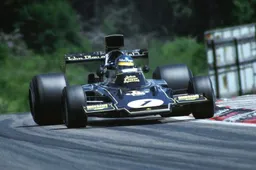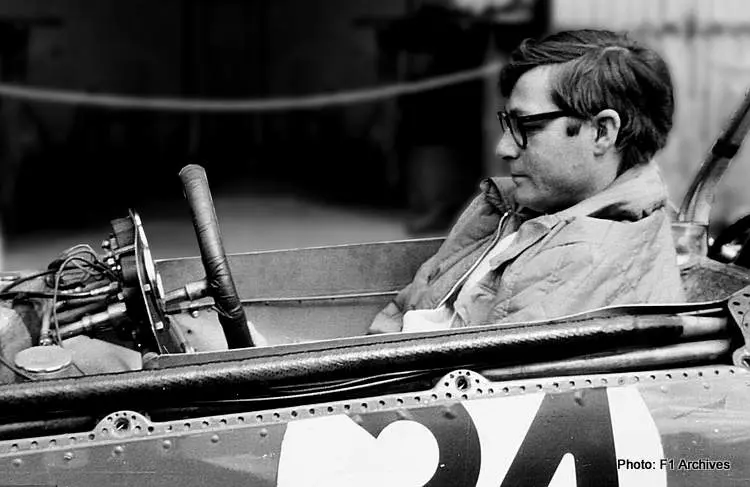
While names like Phil Hill, Dan Gurney, Peter Revson, and Mario Andretti are synonymous with American success in Formula 1, there have been more drivers from the other side of the pond who did their best and left their mark on Grand Prix racing.
The Early Years. Masten Gregory, known as the “Kansas City Flash,” was one of them. He was the youngest of three children.
Modern media may loathe Lance Stroll, but motor racing has always been powered by mucho pesos. How many in post-war Britain could afford to buy a Maserati 250F from the factory like Alfred Moss did for his son? Gregory was no different.
His father was the founder of Postal Life and Casualty Insurance Company, who died when Gregory was three years old. As soon as he turned eighteen, got married, and got his inheritance, he went motor racing.
He started with local events in a 1933 Ford coupe and served on the pit crew of a team owned by his brother-in-law, Dale Duncan.
Overseas Exposure
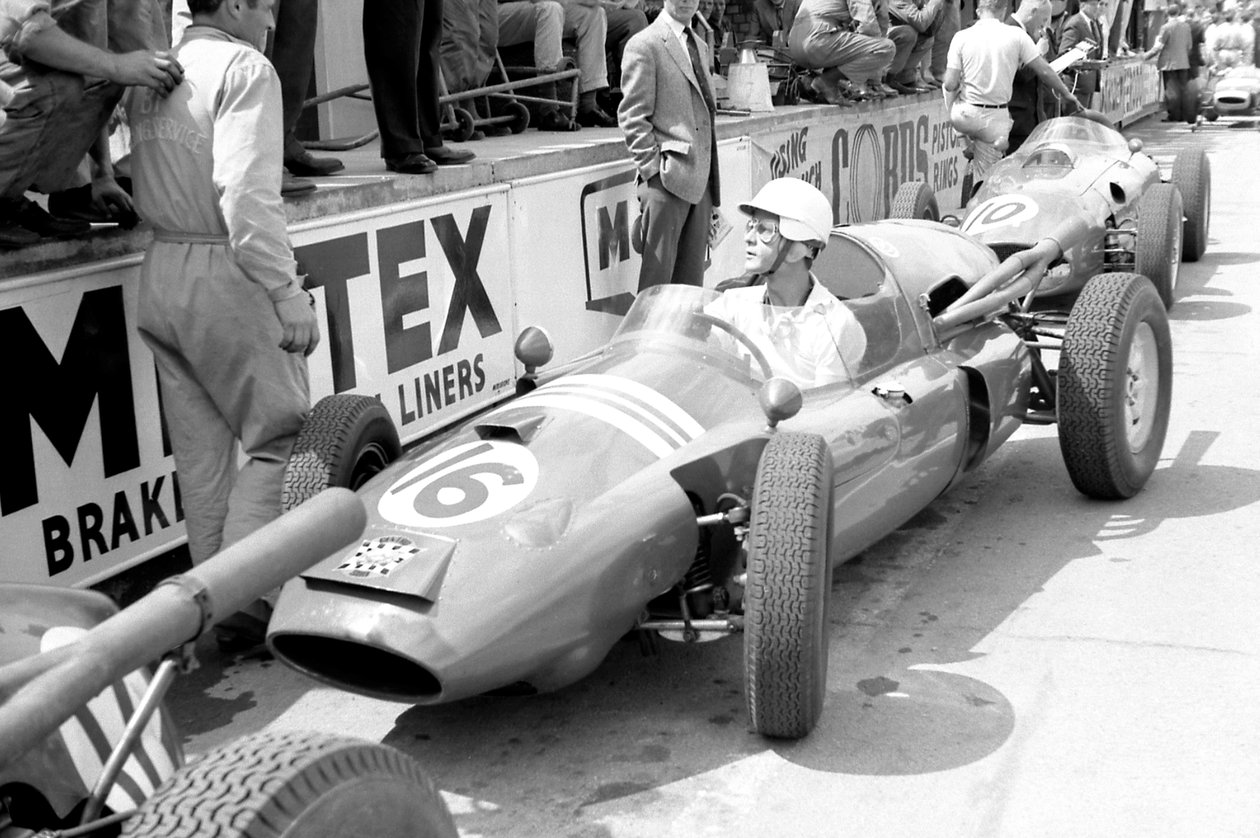
After winning races in Oklahoma, San Francisco at the Golden Gate Park, and Nebraska, Gregory got his first taste of international competition when he took part in the 1954 Buenos Aires 1000 km. He was classified fourteenth after encountering technical difficulties with his Jaguar C-Type.
The 1954 season also saw his first foray on the European continent, competing in events like the Tourist Trophy in Dundrod in Northern Ireland and the French endurance classic at Le Mans.
The highlight of the season was the overall victory in the Nassau Trophy. He and Clemente Biondetti finished fourth in the Reims 12 Hour, again at the wheel of a Ferrari 375MM.
The return to Argentina in 1957 was successful. Gregory—with Eugenio Castellotti and Luigi Musso as teammates—won the Buenos Aires 1000km in their Ferrari 290MM.
By this time Masten had mastered the art of bailing out, jumping from his sports car shortly before they crashed.
The “Flash” in Formula 1

Gregory made his Formula 1 debut in grand style in the 1957 Monaco Grand Prix. Driving a Scuderia Centro Sud Maserati 250F, he qualified tenth. In a race won by Fangio, Gregory became the first American driver to appear on the podium thanks to his third-place finish.
His next race was the epic 1957 German Grand Prix at the Nürburgring—again won by Fangio—where Gregory finished eighth. He competed in two more races and finished fourth in both, the one-and-only Pescara Grand Prix and at Monza.
He was classified sixth in the championship with ten points despite missing five of the nine championship races, which back then included the Indy 500.
In 1958, he raced again in four events at the wheel of a Maserati 250F. He retired from the Dutch and the Belgian Grands Prix, finished fourth at Monza, and sixth in the season finale in Casablanca, the only Moroccan F1 Championship Grand Prix to date.
For the 1959 season he switched to a rear-engine Cooper T51. His teammates would go on to become Grand Prix legends, Jack Brabham and Bruce McLaren. Quite the company.
In the season opener in Monaco, gearbox gremlins resulted in DNF, but he bounced back to the third step of the podium in his next race at Zandvoort.
Two more DNFs would follow in the French and German Grands Prix; in between these two races, he finished seventh in the British Grand Prix at the Aintree Racecourse near Liverpool.
Gregory failed to score any points from his four starts in 1960

The best result of the season came in the Portuguese Grand Prix at Monsanto Park, where he qualified third and finished second to Stirling Moss in a Cooper-Climax.
In the Argentine season opener, he drove a Camoradi International-entered Behra-Porsche and finished 12th. In the remaining three races, he drove a Maserati-powered Cooper for his old team, Scuderia Centro Sud. Results were ninth in France, fourteenth in Britain, and DNF in Portugal.
Pointless season continued in 1961. Three races were run in a Cooper, while at Monza and Watkins Glen, he drove a Lotus 18/21.
The 1962 season, again at the wheel of Lotus, resulted in three DNFs in the Netherlands, Belgium, and France. In the British Grand Prix at Aintree, he was seventh. His only point of the season came from sixth place in his home Grand Prix at Watkins Glen.
In 1963, he raced for Reg/Tim Parnell Racing in five races; the only finish of the season in seventh came in the British Grand Prix at Silverstone on board a BRM-powered Lotus.
His final races in Formula 1 came during the 1965 season. He finished eighth at the Nürburgring and was twelfth at Silverstone. His BRM P75 failed to reach the finish line at Spa and Monza.
Back to Sports Car & Success at Sarthe

The high point of his sports car career was victory in the 1965 Le Mans with Jochen Rindt driving a Luigi Chinetti-entered North American Racing Team Ferrari 250LM.
This would remain the last victory at the Sarthe circuit for the prancing horse till the centenary edition of the Le Mans last year.
Gregory and teammate John Whitmore drove their Ford GT40 to a second-place finish behind the race-winning Ferrari 330 of John Surtees and Mike Parkes in the 1966 Monza 1000 km race.
In the 1970 Sebring 12 Hour in Florida, Gregory and his Dutch teammate, Toine Hezemans, took third place in their Alfa Romeo T33.
The Last Lap

His final race was the tragic 1972 Le Mans 24 Hour. He and teammate Luigi Chinetti Jr. retired their Ferrari Daytona 365/GTB4 with only four hours remaining in the race due to engine issues.
It was the death of his friend Jo Bonnier during the race—the first Swedish Grand Prix winner had collided with the Ferrari Daytona of Swiss driver Florian Vetsch—that led to Gregory hanging up his racing helmet.
In life after racing, this gem of American racing became a jewellery trader based in Amsterdam.
The man who cheated death and jumped out of racing cars for survival during an extremely dangerous period of motor racing passed away at the age of fifty-three in his sleep from a heart attack on 8 November, 1985, in Porto Ercole, Tuscany, Italy.
Masten Gregory, gone but never to be forgotten.
Latest News

Loading