Many unique cars know the history of motorsport. Today we will remember the most legendary Formula 1 racing cars before 1990.
By the way, the site https://wbetznl.com/ will tell you how to make a profitable bet on Formula 1 racing. You can do this with bonuses and increase your chances of winning.
Alfa Romeo 158/159 (1950-1951)

Created by Gioachino Colombo in 1937, the famous Alfetta won its first victories even before the outbreak of war. In the post-war years, she also had no equal. When the World Championship was organized, a team of three "Fa" drivers—Farina, Fangio, and Fagioli—practically won all the races on the Alphettes in the first two seasons.
Ferrari 500 (1952-1953)

In 1952-1953, when the World Championship was held in the framework of Formula 2, simplicity and reliability became key success factors. The designer of the "five hundred" Aurelio Lampredi followed these principles, successfully combining them with a powerful 2-liter four-cylinder engine. Alberto Ascari, driving a Ferrari 500, won the first two Formula 1 world championship titles for Scuderia. The "Five Hundred" turned out to be an outstanding car, as it finished first 14 times out of 15 starts in the World Championship.
Maserati 250F (1954-1960)

The achievements of this car are much less impressive than those of the Alfetta. It has only 8 Grand Prix to its credit. Nevertheless, it is rightly considered the most elegant racing car of the 50s. The 250F is also renowned for its outstanding longevity — it has raced for as many as 7 seasons and has become the most common model in the racing peloton, relied on by many small teams and private riders.
Lotus 25 (1962-1966)

The Lotus 25, in which Colin Chapman introduced a monocoque body instead of the traditional tubular frame, has become a real revolution in the technology of production of racing cars. The duralumin "cocoon" turned out to be much lighter and stronger than the tubular chassis. Lotus 25 and its immediate successor Lotus 33 contributed to the fact that the "flying Scotsman" Jim Clark twice won the world title.
Lotus 72 (1970-1975)

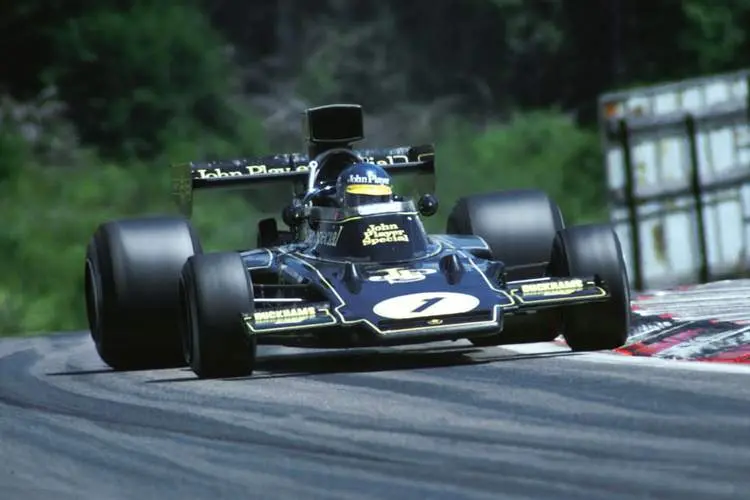
In the early 70s, when engine power and speed on the tracks increased significantly, aerodynamics became a key success factor. The Lotus 72 was the team's response to Colin Chapman and Maurice Phillippe's "aerodynamic challenge". Its wedge-shaped body shape and side radiator air intakes attracted attention and became an object of imitation for designers of other teams. Jochen Rindt won the championship title in 1970, and Emerson Fittipaldi repeated this success in 1972, driving this car. In total, over the six years of participation in the championship, the cars of the "72" series have won 20 Grand Prix.
Ferrari 312T/312T2 (1975-1978)

With the Ferrari 312T, the Maranello team returned to the top of the championship. One of the most unique features of the design developed by Mauro Forgieri was the transverse arrangement of the gearbox, which was the reason for the appearance of the letter "T" in the model name (from the Italian "transversale"). Niki Lauda won the world title on the 312T in 1975, and on its next version, the 312T2 — he became champion again two years later. It was on this car that Lauda was involved in the famous accident at the Nurburgring in 1976, which cost him not only the championship title but also caused serious injuries to his face.
Tyrrell P34 (1976-1977)

The six-wheeled Tyrrell P34 is one of the most unique cars in the history of Formula 1. Two pairs of small steerable front wheels were designed to achieve the dual purpose of increasing traction and reducing drag. Although this car has only one Grand Prix victory, the Tyrrell P34 deservedly takes its place in the history of Formula 1.
Lotus 78/79 (1977-1979)

The Lotus 78, known as the "wing car," was another revolutionary development by Colin Chapman that changed the landscape of Formula 1. The aerodynamics of the side pontoons, the shape of the bottom, and the flexible "skirt" along the edges of the body created an effect of pressing against the track, known as the "ground effect", which allowed cornering at significantly higher speeds. In 1977, Mario Andretti and Gunnar Nilsson brought the Lotus team five wins, and the following season Andretti added six more Big Prizes to the team's success and won the world title.
McLaren MP4/2 (1984-1986)

In the mid-80s, Formula 1 experienced a new revolution with the transition to composite bodies and the use of turbo engines. Designers John Barnard and Steve Nicholls were the first in the history of the F-1 to create a fully carbon fiber monocoque, based on the experience of the aerospace industry. The powerful turbocharged TAG-Porsche engine combined with a lightweight and durable chassis made the MP4/2 an outstanding representative of its time. Niki Lauda in 1984 and Alain Prost in 1985 confirmed the status of this car by winning two championship titles.
McLaren MP4/4 (1988)

In the last year of the turbo engine era, in 1988, McLaren achieved a colossal advantage. Ayrton Senna and Alain Prost won 15 of the 16 championship Grand Prix, repeating the Ferrari record with 500 wins. The car of the MP4/4 model became the instrument by which this star pair of pilots dominated their rivals. This car was a logical continuation of the engineering solutions laid down by John Barnard and developed by his successor as chief designer of the team, Steve Nicholls.
Latest News
Loading