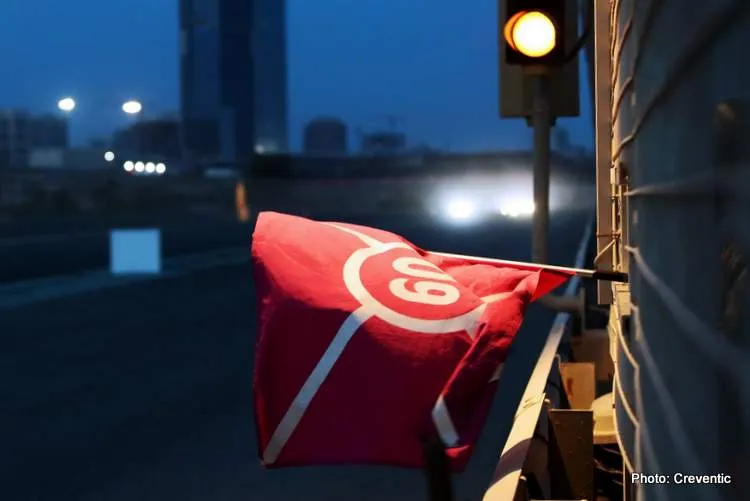
Code 60 is a very simple rule that endurance racing organisers of the 24H Series designed to slow down cars when a major incident took place on the circuit. Under this system, the field would slow to 60km/h while the 'mess' is cleared up.
This was an important innovation and a rule I believe has been embraced in other series too. And one the FIA and F1 should look at tweaking for F1 as it may have been the correct solution on a day of many wrong ones.
The reason for Code 60 came about when Creventic hosted fields of over 90 cars at the now-iconic Dubai Autodrome 24 Hours for GT and Touring cars.
Over 24 hours, with rain common in Dubai these days during January, there were and are always many incidents that require marshals on track and even recovery vehicles. Thus, instead of hauling out a safety car or stopping the race each time, they throw out a Code 60 to manage the clearing up operations.
Purple lights flash around the circuit and all cars - tracked by GPS to monitor speed limit - are obliged to run at 60 km/h or below. Once the track is declared safe by the race director, he releases them to race again. All very orderly and well-controlled.
How might that have factored into Sunday's Belgian Grand Prix and prevented the fiasco?
Simple. At 3pm they would have started the race behind the safety car rolling start style and thus release the field, with the Code 60 in place with rules of engagement, under those conditions, defined for drivers to adhere to.
One could argue 60 km/h in an F1 car would be called 'underkill' and if so, then make it a Code 100 or Code 120, or whatever speed is deemed fit for the purpose for an F1 race. Maybe pit lane speed limit?
Thus in the race, the safety car could have pulled off, and allowed 'racing' to resume under the designated Code speed limit. Perhaps even have a Code 60 for torrential conditions which can be upped at the race director's discretion to a Code 100, or Code 150 or whatever Code, as conditions improve.
Of course, if the weather clears during this period, it's race on!
But if the rain persists as it did on the day, and they cannot get beyond a Code 60 after, say, an hour or 25% of the race then award half points. At least the mileage was done, unlike Sunday when the four laps were declared a race and they even had the audacity to stage a podium ceremony.
A Code 60, or derivative thereof, might have spared F1 the blushes suffered after the farce at Spa and it would be very simple to implement in F1 according to my clerking mates.
Suggestion for F1: While in Holland, it would not harm Michael Masi, Stefano Domenicali and the rule-makers to tap up Creventic for advice on their handy regulation. They are cool Dutch people, always eager to help. And say Howzit from me!
In closing, there also has to be a point, in case of force majeure - be it rain, earthquake, bombs or whatever - that a race can be declared null and void which, in hindsight, is what should have happened with this edition of the Belgian Grand Prix.
Latest News

Loading