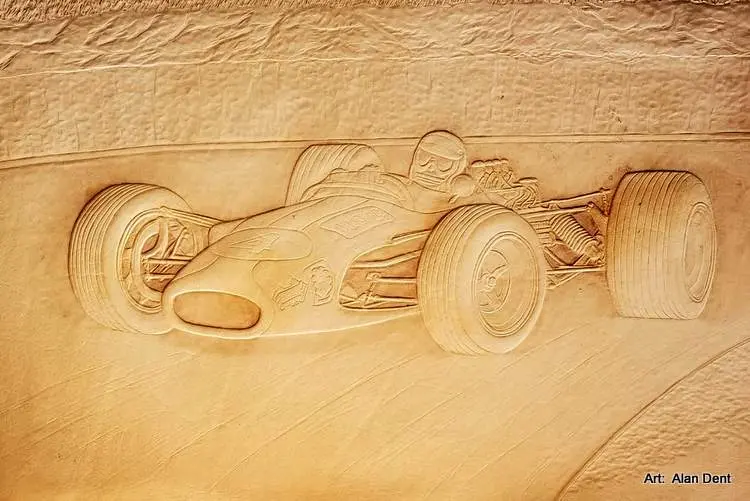
We caught up with motorsport specialist artist Alan Dent this week and he gave us an update on a Jim Clark Artwork Project he is undertaking
The South African has a unique art on leather style and technique that etches history into each of his extraordinary works, with a focus on his lifelong passion: Motorsport, and a special love for all things Formula 1.
Alan's art is appreciated by motor racing fans, drivers, teams and the like, who not only buy his art but also commission him for corporate projects through to exhibitions, while also embarking on flashes of inspiration which triggers a labour of love, which this Jim Clark artwork he is currently creating indeed is.
As is a friend of GRANDPRIX247 we have featured Alan on the site before, he is always open to catch-up and to discuss projects, as well as share the latest gossip on F1, which we did this week. Here is what he had to say about his latest adventure in his art:
Why Jim Clark in the Lotus?
Jim Clark was widely recognised as one of the greatest ever - by no less an authority than multiple championship winner Fangio himself.
I was very young when I was invited to go and watch the South African Grand Prix at Kyalami as I was a firm fan of Jim Clark. Little did we know that Clark’s win in the Grand Prix would turn out to be his last win - which coincidentally also surpassed Fangio’s record of 24 Grand Prix wins.
Jim Clark established an amazing record 25 wins from just 72 starts along with 33 pole positions. In addition he was only the second foreigner to win the Indianapolis 500 in 1965.
During his Grand Prix career the shy Scottish sheep farmer raced only for Colin Chapman, the legendary builder of the famous Lotus Team Chapman often remarked on his high intellect, unbelievable finesse and the ability to extract the utmost from his car even when it was experiencing problems.
Later on Jim Clark came to be recognised as ‘the Senna of the Sixties.’ Perhaps Senna could be regarded as the ‘Jim Clark of the Nineties’.
Jim Clark’s success in the Lotus 25 when he won the championship in 1963 was the beginning of the Lotus story and the Team went on to win 7 championships and notched up 79 Grand Prix wins.
Drivers who raced for Lotus included Graham Hill, who along with Clark and Stewart where regarded as the Three Musketeers of the Grand Prix circuit. Others who raced for Lotus were Mario Andretti, Emerson Fittipaldi, Stirling Moss, Ayrton Senna, Nigel Mansell, Ronnie Peterson and Jochen Rindt.
Jim Clark was tragically killed in a somewhat insignificant Formula 2 race at Hockenheim on 7th April 1968. I still clearly recall the shock of the radio broadcast announcing the loss of the racing world’s most talented driver - much like the shock of the John Kennedy assassination. Racing personalities came from all over the world to attend his funeral and pay homage to ‘their leader’ as one driver called him.
An interesting fact: Ayrton Senna visited the Jim Clark museum and he bought all the Jim Clark pencils to take home to Brazil for his friends - a superb gesture!

Why this particular picture?
When I decided to start producing my car art on leather works one of the works I always intended to produce was one of Jim Clark at Kyalami. Later this year a few of my art colleagues and I will be hosting a Grand Prix art day for petrol heads and so I believe the right time has arrived to produce this work for showing at the event.
1968 South African Grand Prix won by Jim Clark was simply spectacular. Consider these facts:
- The engines; among the fantastic sounding Grand Prix engines were the Cosworth Ford V8’s, the BRM V-16 and the screaming Ferrari and Honda V12’s. The noise levels were truly insane!
- The drivers; competing with Clark were the likes of Graham Hill, Jackie Stewart, Jackie Ickx, Jo Bonnier, Jack Brabham, Jochen Rindt, John Surtees, Dan Gurney, Denny Hulme. A who’s who of current and future legends in that group.
- Adding to the local flavour were the Rhodesian/South African drivers such as John Love, Dave Charlton, Jim Redman and Basil van Rooyen.
The piece will show Jim Clark at opposite lock as he came around Clubhouse bend where I was sitting - an interesting corner, more than 90-degree bend. In those days there were no run-off areas and no wings or ground effects so we witnessed some impressive spins as well as overtaking opportunities.
As the cars were only about 3 metres away from the (low) embankment we were sitting on the spectators were pretty much up-close-and-personal with the racing which was somewhat raw knuckle stuff at times.
And of course, the Lotus 49 in its British racing green and yellow livery was the class of the field.

Tell us about the Process of producing this artwork?
The "canvas" that I produce the artworks on is tanned leather whereby the subject of the work is carved and modelled into the hide to provide a permanent three-dimensional aspect to the subject.
All my works are produced on the finest quality cowhide leather which is specially imported from Argentina.
To achieve as authentic a result as possible I specifically concentrate on the composition of the picture, the specific details of the subject motor car and finally the colouring of the piece with acrylic paint.
The Process starts with the subject of the work being drawn onto damp leather. Then the background area around it is bevelled down to create the sense of depth between the subject and the background - the same effect that is created on a medallion where the background is pressed down in a machine press.
In a method that is similar to that used by a sculptor, the details of the subject are then modelled into the still damp leather using specially designed tools.
The final step at this stage is my signature being carved into the work along with the Genuine Leather logo being stamped into the corner.
The painting stage: I utilise the finest quality fade-free artist acrylic paints for this stage. The layers of paint are slowly built up to provide a more realistic look to the work, probably about 10 - 15 coats with this particular work.
Once this stage is completed, the colouring is protected with a final coat of a clear matt varnish ensuring a lifetime of trouble-free enjoyment.
Why use expensive leather as the base medium of choice?
The high-quality leather is considerably more expensive than canvas but these high costs are offset by the fact that once the leather has been carved and modelled it provides the considerable pleasure of engaging the additional human sense of touch.
So these works are indeed rare in the art world today - especially so with regard to reproducing motor vehicles where the fine details require considerable experience and a serious commitment to detail and accuracy.
The fact that all the details of the subject can actually be touched and felt by the viewer is a unique and very specific aspect of each of my works. This means that the pleasure obtained by the viewer is literally doubled and in the process, the work also becomes a wonderful conversation piece.
Where are you with this project?
I am about to begin the painting process and am fervently trusting that I will do justice to a great man, an amazing Grand Prix driver and one of the most successful teams in Formula One history. He brought so much dignity to a sport that was and still is overloaded with too much glitz.
More about Alan Dent:
Latest News

Loading