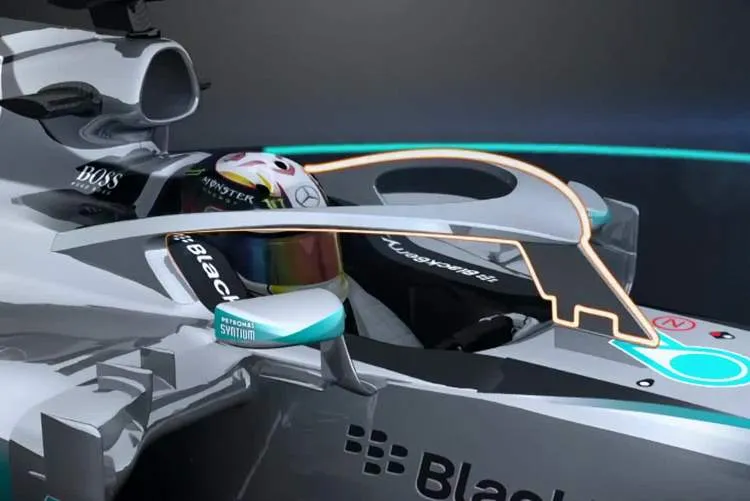
IndyCar and Formula 1 are investigating the use of enclosed cockpits to improve driver safety following the recent death of Briton Justin Wilson, and could take a leaf out of the National Hot Rod Association's book.
Former F1 driver Wilson suffered severe head injuries from flying debris during a wreck in the closing laps of an IndyCar race in Pennsylvania last month and died in hospital the following day.
While none of the prototypes in IndyCar or Formula One has yet shown the benefits to clearly outweigh the disadvantages, the National Hot Rod Association's premier division, Top Fuel, has been racing successfully with canopies since 2012.
Don Schumacher Racing, which fields cars for series champions Tony Schumacher and Antron Brown, developed some of the original cockpit designs which are still in use today.
The fragile-looking but monstrously powerful Top Fuel racers develop around 10,000 hp as they rocket down a 1,000-foot strip in under four seconds, reaching top speeds in excess of 320mph. They require parachutes to help them stop.

At those speeds a strike from anything -- like the bouncing spring that struck Brazil's Felipe Massa's head at the Hungarian Grand Prix in 2009 -- could be fatal to one of the NHRA drivers.
The canopy used by the drag racers closes over the existing car, and eight-time NHRA champion Schumacher would now never contemplate competing without one.
"I've hit three birds in my life in a top fuel," Schumacher (pictured above) told Reuters. "You hit one with (just) your helmet it will kill you. I don't care what helmet you have on. It will blind you at 300mph ... and you're going to put it (the car) upside down."
Aside from the safety aspect, there is another benefit according to Schumacher, "The turbulence is taken away and the sound is so much better. I can hear the engine so much better because I'm in a capsule."
According to Don Schumacher Racing, the cockpit protects the driver with "a hydraulic, fighter jet-type canopy that includes sides and a rear made of a combination of Kevlar and carbon fiber" that slips over of an existing chassis.

"The canopy can be quickly released inside by the driver or at the rear by crew or safety workers. The canopy also carries a fire suppression system and fresh-air breathing system."
There has not been a fatality in over 80 events in the NHRA's Top Fuel since canopies were adopted in August 2012 and Brown is a firm believer after surviving a fiery wreck in May last year without suffering an injury.
"My car hit the wall, it knocked off the front wing which hit right in the top center of the cockpit where my head was," 2012 national champion Brown told Reuters about his crash in qualifying for the NHRA Summer Nationals at Atlanta Dragway.
"If we only had a windshield, it would have hit me in the helmet and I wouldn't be here telling you about it."
Meanwhile, IndyCar safety measures have benefited from the work of Dr. Stephen Olvey, a founding fellow of the FIA Institute for Motor Sports Safety, and Dr. Terry Trammell.
Massa's injury in 2009, followed by the death of Henry Surtees, son of Formula 1 world champion driver John Surtees, in a Formula 2 car, accelerated the search for answers, Olvey told Reuters.

"(But) this led to more questions than answers, really," said Olvey, who pointed out that the jet canopy solution could create more problems if debris ricocheted off the canopy into grandstands following an accident. "It would be catastrophic."
Olvey also underscored the fact that IndyCars and Formula One cars race over long distances, and sometimes in driving rain, rather than in the short sprint of Top Fuel, "So other issues to address could be ventilation, comfort and visibility."
For Olvey, speedy access after an IndyCar accident was a top priority as cockpits could trap the driver in the event of the car overturning.
"Anything that takes more time to get to the driver is time lost in resuscitative massage to save someone with an airway obstruction and breathing," he said.
"No question that the head is the most vulnerable area of the driver, and fortunately these are freak accidents and are rare.

"There has been a cluster over the last five years and this is worrisome. There's probably a solution that hasn't been found yet."
Rookie Carlos Sainz shared his opinion with journalists at Monza, "A helmet clearly is not protection enough."
Valterri Bottas gave his opinion, "I don't really see the difference between a formula one car with a closed cockpit or not. It's still a formula one car. When it is for safety I am open to anything."
Likewise, Sebastian Vettel is an unabashed motor racing 'purist', but he admits the arguments for change are now growing.
"If it would have meant that Justin is still with us, then I don't think anyone could put his hand up and say 'No I don't want that'. It is very sad and even if I'm not a fan of closed cockpits, we do need to look at it," the Ferrari driver added.

Fernando Alonso agrees: "We can see that these solutions are used in (Le Mans) endurance racing and that series is thriving. I'm sure the FIA and everyone is looking into it. I don't know if they will come up with a solution, but we should at least test the various options."
Until now, the big resistance to change has been twofold: first, to ensure that the solution is not more dangerous than before, in terms of trapping a stricken driver.
And the argument that open cockpits are the 'DNA' of open-wheel racing has also been widely touted.
Nico Hulkenberg, for example, said at Monza: "For me, single seaters are open. When we go into the cars, we know the risks.
[alert type=blue ]Comment
No doubt many will object to the use of the Felipe Massa accident photo in this piece. However, as fence sitters on this topic of open or closed cockpits, we at GrandPrix247 needed something to convince us that Formula 1 can do with canopies or a similar solution. Searching our archives this horrific Felipe photo popped up and it has to be the most convincing argument that something has to be done. It is very easy to sit comfortably in one's armchair and decry the closed cockpit concept, until the stark reality of what a helmet impact is really all about. This graphic image sums it all up and, alas for Felipe, this is the most convincing cry for an immediate solution - we are convinced and you should be too....[/alert]
Latest News
Loading