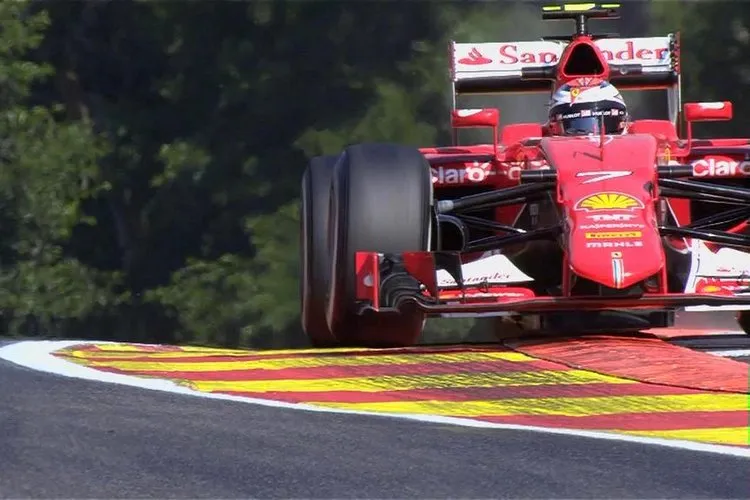
Once upon a time race circuits only had grass, dust, gravel and trees etc. at the edge of track. In order to highlight where the grip finished and these various hazards started, the enlightened painted white lines at the edges of the tarmac and, in some instances, installed kerbs on the inside of corners.
Unsurprisingly the drivers made every endeavor to stay within the white lines and away from the ‘red and whites’ as they new that they were precursors to bad news. At best time would be lost, at worst… well no need to state the obvious.
Time and progress marched inexorably forward; kerbing became more prolific, wider and was added to the outside of the track on the grounds of safety. Drivers, where it made sense, started to use this extra kerbing - effectively widening the circuit at key points and pinching a few tenths to boot.
However, the grass remained and still had to be avoided. To prevent kerb usage on the inside of the corner their design became more aggressive and apart from the odd unplanned excursion, they were avoided.

However, the clever lads back in the garage new that if you could design a car (suspension) to ‘run’ these kerbs in a stable manner, the track could be shortened and lap times reduced and so it was done. But the grass still remained and had to be avoided and the limits of the racetrack remained relatively well defined by the drivers’ unwillingness to purposely take the car on surfaces that delivered less grip than the tarmac.
And then it all changed again: New Grand Prix venues and countries brought new “Tilkcuits” ushering in a new era of safety – tarmac runoff areas. The under managers for circuit design at the FiA, after years of contemplation, concluded that along with mortality being fatal, a car would come to a halt quicker if it was spinning on tarmac rather than grass.
No one would deny the merits of this approach in safety terms, and arguably the savings in costs from vehicle damage. Grass/gravel was pretty much out and the older circuits were modified accordingly where it was deemed vehicles were most likely to travel if things went wrong. Nothing wrong with that……or is there?

Motor racing (notice I use the term ‘racing’ rather than ‘sport’) is a business activity where men and vehicles compete against each other over predefined course (within the white lines). There has never has been a level playing field in terms of machinery and probably never will be: Innovation is part and parcel of the game either in design or interpretation of the regulations.
Pushing the limits in all directions is motor racing. Every team member does it - from the awning erector (trying to pinch two cm’s of the competitor next doors’ allocated space) to the Team Principal (a number of which have had to “jog on” after being caught pushing the limits too far) and last but certainly not least, the driver.
Tarmac run-off areas have changed one of the few immutable elements of motor racing - the “predefined course.” The current regulation regarding what is and is not the track is clear in the opening sentence, but then undermined by subsequent explanations. The Capital Italics inserted into the regulation below illustrate the mindset of the competitor.

20.2 Drivers must use the track at all times. (
OK FINE , UNDERSTAND THAT) For the avoidance of doubt (OH YES…, HERE WE GO) the white lines defining the track edges are considered to be part of the track but the kerbs are not (HA HA HA HAS ANY ONE WATCHED F1 FOR THE PAST 40 YEARS!!???).
A driver will be judged to have left the track if no part of the car remains in contact with the track. (SO WE DON’T HAVE TO STAY COMPLETELY ON THE TRACK THEN?)
Should a car leave the track the driver may re-join (IGNORE THE PREVIOUS STATEMENT THEN IT”S OK TO LEAVE THE TRACK ENTIRELY !!?), however, this may only be done when it is safe (ANYTHING THAT DOESN’T RESULT IN A STUFFING IS SAFE……) to do so and without gaining any lasting advantage (HOW LONG IS A LASTING ADVANTAGE THEN 1 LAP, 2 LAPS, AFTER I PIT?).
At the absolute discretion of the race director a driver may be given the opportunity to give back the whole of any advantage he gained by leaving the track. (HAPPY DAYS!!! A “MAY BE” WE CAN REALLY FILL OUR BOOTS ON THIS ONE!!!)

We’ve seen drivers widening the course at every given opportunity, whether at entry, apex, and/or exit since the advent of tarmac run-off areas. Last seasons F1 resulted in a very public culmination of the problem, with a driver taking pole after he had clearly left the track (all four wheels outside the white lines). With no penalty issued, everyone else soon got in on the act.
When questioned a leading official announced that an advantage had not been gained and therefore no penalty given (remember that discretional bit…). Really……? You widen the track and it’s not quicker? The rationale for this conclusion was “the distanced traveled was longer…” This seems to gloss over the fact that the entry, corner, and exit speed were faster.
If the shortest route through a corner is the primary arbiter of a lap time, the drivers would be glued to the inside of the track. Additionally, the teams have some of the most sophisticated computing power known to man that produce reams of data. If it were slower in the simulations, you can be assured they would tell the drivers. QED They didn’t, so it isn’t .
This leaves us with two key issues here. The first is safety. At great cost, the old and new circuits have had to spend large sums of money creating greater run off areas etc. These are worked out on vehicles cornering within the track limits (white lines).

If the drivers regularly navigate outside of these, increasing the speed of the corners – the benefit of the run off areas (and calculations) are academic. Chicanes in many instances no longer do the job of slowing the cars down but have become a launch pad to be risked in order to compete.
Secondly, officials have to now try and identify whether a driver gained an advantage or not and make a judgment. Good luck on that one, drivers have honed the skill of knocking someone off and making it look like a racing incident for years, and they’re catching up fast on confounding them on purposely crossing the white lines.
It is generally accepted that if you pass a competitor with all four wheels across the line, you will be penalized, but what about the driver who maintains his position in this manner. Did he make a “mistake?” Or did he choose a critical moment to do this, and maintain his position? I suspect the latter goes on in qualifying, camouflaged by a lock up first….
I don’t blame the drivers here; it is the nature of the beast to push the limits. They would probably prefer to reserve their risk taking to racing rather than wondering what they can get away with where track limits are concerned. But the proliferation of tarmac either side of the track forces them to do this because…
Well, there is grip there, and it’s quicker. It’s interesting to note that on circuits where the grass is still left at the edges, drivers make very few “mistakes.”

So what needs to happen? Probably the most frustrating aspect of all of this is the stunningly simple solution. Create a two-meter wide surface either side of the white lines that has the grip coefficient of grass. Beyond this the tarmac remains along with the safety.
A driver goes over the white lines, he looses traction and time (possibly even control) and hence is penalized for driving outside of the track limits (just like the bad old days) rather than by an official who is doing his best but cannot be expected to get this kind of decision right.
This approach will permit kerbs to be lowered and the officials, they’re left with the rule- book and “contacts” to adjudicate. We’re left with the spectacle of drivers battling out on a predefined course once again…
Opinion piece by Sean Stevens (Dubai based race driver and racing instructor)
Latest News






Loading