To quote the great motorsport commentator supreme Murray Walker, the 2016 Formula 1 season is “Go, Go, Go!”
The winter world championship has come and gone and now the real thing has started - the longest season ever with a total of 21 races across the globe.
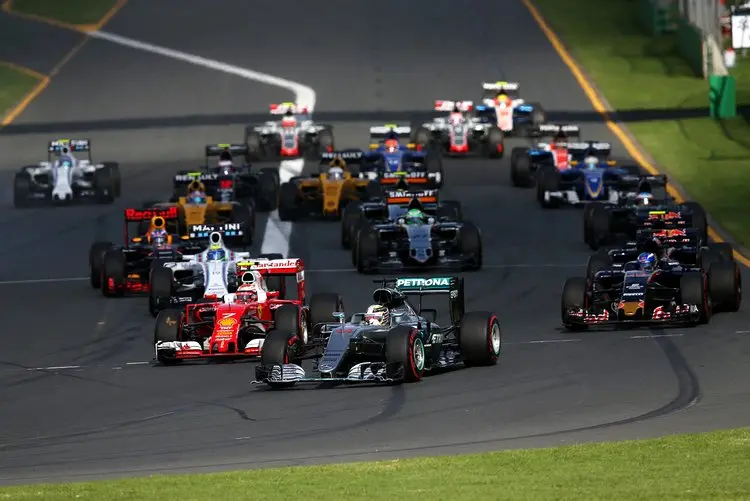
So what have we learnt after the first race in Australia? On paper the results say the same old, same old, with Mercedes domination and Nico Rosberg taking his fourth successive victory.
However, if you watched the race, you will know that it wasn’t as clear cut as the results show and if it wasn’t for the red flag to stop the race after Fernando Alonso’s horrific accident, it could well have been a red overalled driver on the top step of the podium. That maybe pure conjecture, but both Ferrari’s made demon aggressive starts, whilst the Mercedes were almost caught napping, with Lewis Hamilton getting particularly bogged down.
However it does bode well potentially for some interesting racing - fingers crossed.

But it is the Alonso accident which really focusses the mind. The initial impact was thought to be 46G and apparently the crash was so violent that it broke his seat! There is no doubt that the McLaren driver is lucky to be alive and it doesn’t bear thinking about what would have happened if this type of accident had taken place a few years ago without the many safety features currently built into the cars these days. So all credit goes to the FIA for the valuable and extensive work they have done on driver safety.
Which leads on neatly to the debate regarding the driver head protection which is being developed for 2017 and beyond. After Alonso’s accident, concerns were raised that if the ‘halo’ head protection had been on Alonso’s McLaren, it may have dug into the gravel, or made it more difficult for the two-time champion to get out of the car after the crash.
However Jenson Button, who is a director of the Grand Prix Drivers’ Association, said the design may have actually have helped in this accident.
“He was upside when he landed and if he had the halo it would have helped him. With the halo he would have had less impact on his helmet. The halo is the right direction and we need it. I think it's better to have a halo system. They would tip the car over of course to get him out, so it takes a bit longer, but he was OK so it doesn't matter.”

Whilst the current focus is on F1, this is going to eventually have a huge impact on all single seater racing. Whatever appears on an F1 car will eventually be replicated in the other formulas, on the basis if it is good enough for them, then it must be good enough for us!
As a purist I can’t say that I am enamoured by the thought as it will change the look of the cars and people may even argue that it takes something away from the very essence of single seater racing.
However the stable door has been well and truly opened. Now that the research and designs have been sanctioned, it would be unthinkable not to proceed on the grounds of safety. You can just imagine the huge implications should a fatal frontal head accident occur without the head protection, but in the knowledge that such protection had been developed. Like it or not, in these modern times we live in, which many believe is to politically correct, society is geared to be risk averse.
The one concern I have is driver extraction. Under the regulations the driver must be able to evacuate from the car in no longer than 5 seconds. The worry for a number of people is whether that would be possible, if for example the car is upside down, as in Alonso’s case.
Maybe I have seen to many World War Two movies, with pilots being trapped in their aircraft and being engulfed by fire. I know that there is now considerable safety in the modern design of the bag tank and self sealing fuel lines, but there is always a risk of being trapped in fire.

The cars and safety have evolved tremendously over the decades, but for motorsport enthusiasts who follow the history of the sport, there is the tragic example of the hugely talented Roger Williamson being trapped in an upturned car and killed through fire in the 1973 Dutch Grand Prix.
However I am sure all of the associated factors will be taken into consideration by the FIA.
That only now leaves the question of the aesthetics. I must admit I am not a fan of the halo designed by Mercedes and demonstrated by Ferrari at the Barcelona test. To me it just looks to me like a “flip flop” (or “thong” to the Australasian region) that has been plonked on an F1 car, which in the case of the test happened to be on one of the most aesthetically pleasing F1 cars.
The design which has been produced by Red Bull looks far more complimentary. This is more like a wind shield and thinking about it, maybe Red Bull have already considered that it would have aerodynamic advantages!
There is the concern that as effectively it is a windscreen, it could cause visibility problems through oil or rain. However maybe this could be overcome by having something similar to a helmet visor strip which can be ripped off during a pitstop.

Whatever happens, this will in many ways be the start of new era for single seaters. It would be nice to think that this would encourage a few more radical looking designs. However as Adrian Newey has recently claimed, under the regulations as they are, the cars are virtually designed by themselves! However this a topic for another article!
Looking back to the Australian Grand Prix, worthy of a mention is Romain Grosjean and the Haas F1 team. For a new team to score points on its F1 debut is a remarkable achievement and I can understand Romain’s comments that to the team it felt like winning the race.
Romain was also the inaugural winner of F1’s official Driver of the Day, which is voted for by fans on the official F1 website, introduced this year with the aim of increasing fan engagement in the sport.
The results was actually announced well after the race on Monday. The official website did not say how many votes were cast for each driver, but noted “in the interests of fairness, multiple votes identified as originating from the same source were not counted.”
Unofficial statistics posted by Twitter users claim that in fact it was the Indonesian rookie
Rio Haryanto who attracted the most votes with more than 22,000 in comparison to Grosjean’s with less than 14,000.
Rio Haryanto who attracted the most votes with more than 22,000 in comparison to Grosjean’s with less than 14,000.

Haryanto, who was making his F1 debut with Manor F1, actually had a troubled debut weekend. Having started the race last after being penalised for his awkward pit lane crash in practice, he retired with a technical problem.
However he created considerable interest in his native Indonesia, which is the fourth most populous country in the world, with a population of 250 million. Regardless of whether the voting system can be influenced by factors other than voting for the best performance, the interest that Rio is generating is great news for Asia Motorsport.
Another driver making his Grand Prix debut was Jolyon Palmer, who in the revived Renault F1 team, finished 11th ahead of his team mate Kevin Magnussen. Interestingly both are sons of F1 racing fathers, joining the families of Rosberg and Verstappen, plus Sainz if you also include a World Rally Champion, which means that nearly a quarter of the F1 grid are sons of racing fathers!
Jolyon, a former GP2 Champion, served his F1 apprenticeship as third and reserve driver for the team, as then was as Lotus F1. He is the son of Dr Jonathan Palmer, who has the distinction of winning the most Formula championships, as it then was, including Formula Ford, Formula 3, Formula 2 and even in Formula 1!
That was in 1988, when he won the Jim Clark Trophy as the best-placed driver of a non-turbocharged car competing in the World Championship.

JP, as he is more often known signed for McLaren at the end of 1989 as the team's test driver, alongside Ayrton Senna and Gerhard Berger. Palmer's work for McLaren also included development of the McLaren F1 road car, which included a then record-breaking 231 mph run at the Nardo test track.
I first met JP when he joined McLaren and for a number of years I was his “warm up” man when he gave talks to the VIP guests in the hospitality at the races. He later went onto commentate with Murray Walker for the BBC own F1 after the sad demise of James Hunt. In the Murray and James days they shared a microphone, which sometimes proved feisty, but as I understand, it was JP who secured the second microphone.
As test driver JP was usually one of the last team members to arrive at the Grands Prix. Due to the speed of development, invariably he was given the latest parts by the factory to hand carry out to the team at the track, so he usually arrived laden down with heavy taped up suitcases. However on the odd occasion when there weren’t parts, so as to not disappoint his usefulness, sometimes the factory would still give him taped up suitcases, but this time laden with bricks!
JP was trained as a doctor, and whilst he never practiced, apart from racing, he applied his formidable brain to building a motorsport business empire and now is the CEO of Motorsport Vision, which owns a number of race tracks in the UK including Brands Hatch.
Whilst Jolyon has clearly got talent, it is also about being in the right place at the right time, and I am sure that his father's business skills have been significantly useful.
As I conclude I realise that we haven’t talked about qualifying. However, I think that as so much has been already written on GrandPrix247, lets wait and see what happens in Bahrain!
Latest News

Loading