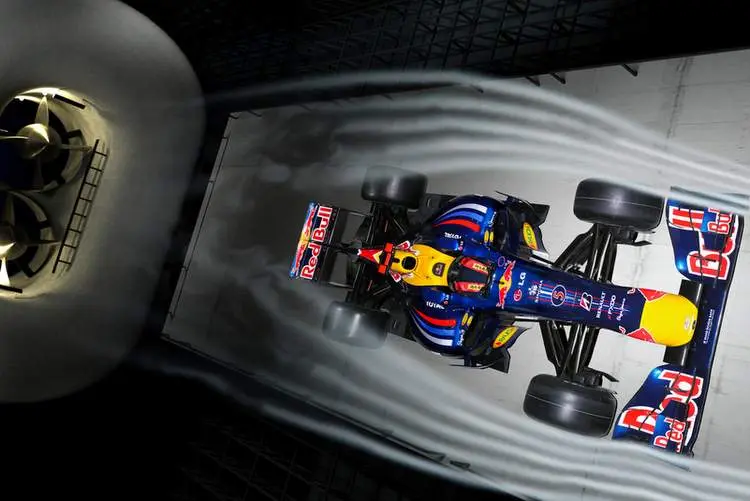
Formula 1 cars employ sleek contours to cut through airflow more efficiently, reducing drag and enabling high speeds.
Engineers also employ downforce as a safety feature during cornering and braking to keep their cars on the ground. Aerodynamics are the backbone of modern F1 design.
Wind tunnels ushered in a new era of aerodynamic research as teams sought an advantage over their competition. DRS and KERS technology was pioneered with this advancement to reduce air resistance while increasing maximum velocity on specific track segments.
Aerofoils and Wings

In 1968, Formula 1 witnessed its most significant evolution since its birth: high-winged cars with increased downforce and greater cornering speeds were first introduced with high wing wings. These vehicles forever altered how racers approached cornering speeds.
However, they also created considerable drag. Drag is defined as the force produced when fluid or air passes by an object at different speeds; its magnitude depends on factors like shape, frontal area, material stiffness and air density.
As per current F1 rules, most aerodynamic devices in F1 are fixed and cannot move (with exception to DRS). To ensure no parts are moving without being detected by load/deflection tests.
FIA ensures that moving parts do not increase drag by subjecting them to CFD testing. Any updates then undergo real car wind tunnel testing in order to confirm their efficiency; this allows teams on tight budgets to still produce significant aerodynamic advances.
Mobile betting platforms have further revolutionized the betting landscape. These apps provide users with the convenience of placing bets in real-time, accessing live match updates, and engaging in interactive betting formats from anywhere in the world for example betting cricket. Features like in-play betting, where bets can be placed while the match is ongoing, add an exciting dimension to the betting experience.
Ground effect aerodynamics

As an airplane nears a flat surface, such as the ground or snow cover, its wings experience something known as the ground effect, which reduces drag while increasing lift. This phenomenon is due to air nearer the ground not being able to shear or lose velocity like in free space; consequently, this forces any vortices at its wings-tip to dissipate faster.
Colin Chapman's Lotus 79 was the first car to effectively utilize this idea and rapidly dominate F1 races. The Lotus design used inverted wing shapes inside of its sidepods to form large venturi tunnels; these were supplemented by sliding skirts which ran along both sides of the car to generate additional downforce.
Although early ground effect cars were dominant, they weren't without issues. Setup errors would quickly render them dangerously unstable and difficult to drive; keeping ground clearances extremely low necessitated stiffly sprung cars that struggled to handle bumps or curbs.
Monocoque chassis

Monocoque chassis design relies on its outer skin (mono = single and coque = shell) to absorb stresses and loads, creating an extremely efficient structure. The rigid shell helps absorb both stress and loads for greater performance and greater stiffness when bent compared with more traditional forms.
Monocoque chassis cars tend to be quieter due to lack of fastening points that rub together and transmit vibration, and also reduce weight, leading to improved acceleration and handling capabilities.
Monocoque structures tend to be more expensive and take more time than tubular spaceframes to produce, plus repairs tend to be more complex and costly, and modifications can only go so far.
Recent developments in composite technology and FEA simulation software have been instrumental in mitigating these difficulties. For instance, one new software program can accurately predict 3 point bend failure loads for composite panels with less than 5% error.
"This significantly shortens analysis times and negates physical testing requirements. Furthermore, this same software program calculates stress distribution across monocoque thickness to help engineers optimise structures for maximum safety and performance.
Active aerodynamics

Formula 1 teams will begin using active aerodynamics during the 2026 season. This technology enables teams to dynamically modify a car's aerodynamic features in order to enhance performance under various driving conditions.
Aerodynamic performance optimization aims at reducing drag on straightaways while simultaneously increasing downforce in corners, as well as improving braking and stability - it is the Holy Grail of racing aerodynamics!
These systems can be found on many modern race cars. These systems typically include moving air ducts, rear spoilers and bodywork flaps that open or close.
But they're often not used to their fullest potential. For example, dual-element wings may not be as aerodynamically efficient than single ones but can still generate downforce to help drivers overtake.
This strategy adds an exciting new twist to Formula 1 races while encouraging fair competition among teams by keeping leading teams from dominating every step of the race and giving trailing ones time and energy conservation before waiting for their chance to make passes.
Follow melbet india for more interesting news.
Latest News








Loading