Canada Is Quietly Becoming One of F1's Most Important Markets and the Numbers Prove It
F1 HistoryMonday, 16 March 2026 at 06:23
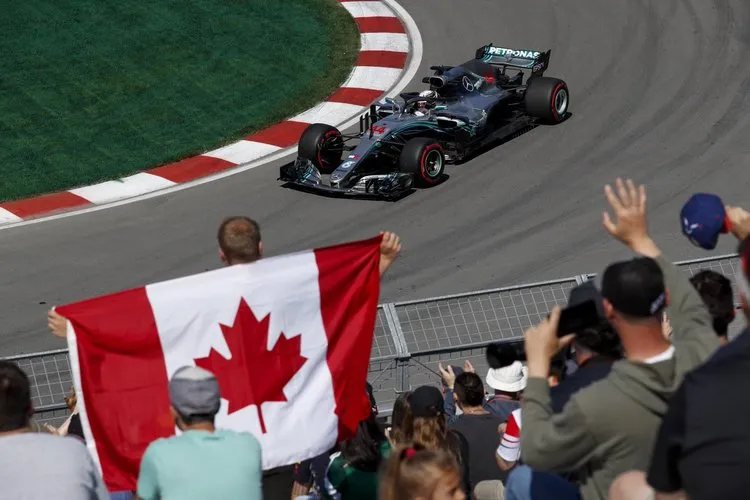
Thirteen drivers. 408 Grands Prix. Seventeen wins. That is Canada's entire Formula 1 record book, accumulated over seven decades, across three generations of racing families, and built almost entirely on the backs of two men who share a surname.
By the cold arithmetic of driver output, Canada is a minor player. And
yet something strange has been happening to the country's relationship with
this sport. Something that the data, when you actually look at it, makes it
quite difficult to ignore.
According to Nielsen Sports'
global fan survey, Canada's F1 fanbase grew by 31.5 percent in 2024 alone. That
is the third fastest rate of growth of any country in the world, behind only
China and Argentina. Bell Media extended its broadcast deal with Formula 1
through the following year. And 352,000 people turned up at the Circuit Gilles
Villeneuve for the 2025 Canadian Grand Prix — making Montreal one of the five
biggest race attendances on the entire calendar.
So the question worth asking
is: why? What is it about this country, with its thin driver history and its
one functioning F1 circuit and its current grid representative who has never
won a race, that keeps producing some of the most passionate and rapidly
growing fandom in the sport?
The answer, if you dig into it
properly, turns out to be more interesting than the headline number suggests.
The Weight of Gilles

You cannot understand Canadian
F1 fandom without understanding what Gilles Villeneuve did to this country. Not
just what he achieved, six wins, 13 podiums, the 1979 title challenge that
fell four points short, but how he drove. The how is the thing.
Villeneuve was not the
fastest driver of his era in a strictly technical sense. He missed the 1979
championship despite Jody Scheckter winning it in an identical car. He never
won the title he probably deserved. What he did instead was something harder to
quantify and easier to remember: he made an unwatchable car watchable.
At
Jarama in 1981, he kept five faster machines behind him for 20 laps in a
Ferrari that had no business being competitive, crossing the line 0.22 seconds
ahead of the car in second place after an hour and 46 minutes of what can only
be described as organised defiance. Enzo Ferrari reportedly compared him to
Tazio Nuvolari. Nuvolari. The greatest racing driver who ever lived.
And then Zolder 1982 happened.
And the circuit in Montreal was renamed after him. And forty years later,
352,000 people are still making the pilgrimage every June.
That is not normal fandom
behaviour. That is something closer to mythology. Canada lost Gilles before
most of its current F1 fans were born, and his name is still on the circuit
that hosts the race. His shadow is genuinely enormous.
The Son, The Stats, and The Uncomfortable Gap

Jacques Villeneuve won the 1997
World Championship. It remains the only F1 title Canada has ever produced. The
numbers around that season are worth sitting with for a moment: seven wins, ten
podiums, and a final race in Jerez where Michael Schumacher drove into him
deliberately and was disqualified from the championship for it, while
Jacques limped his damaged Williams across the line in third to take the title.
That championship was won with
the elegance of someone who had also won Indianapolis and the CART series. It
made Jacques one of only four drivers in history to win both the Formula 1
World Championship and the IndyCar title. Mario Andretti, Nigel Mansell, and
Emerson Fittipaldi are the others. That is the company.
But after 1997, the Williams
became uncompetitive, and Jacques made a series of increasingly unfortunate
team choices, and by 2006 it was over. Canada went eleven years without a
driver on the Formula 1 grid.
Eleven years. That gap matters
more than it might seem. An entire generation of Canadian motorsport fans grew
up watching a sport that had no Canadian in it. And then Lance Stroll arrived
in 2017, became the youngest rookie to achieve a podium finish at 18 years
and 239 days, in Baku and the question of what Canadian F1 fandom actually
looks like in the modern era became genuinely interesting again.
Lance Stroll: The Complicated One

No Canadian driver in F1
history has attracted quite the same split of opinion as Lance Stroll. And the
split tends to fall roughly along the lines of people who think inherited
wealth disqualifies sporting achievement and people who think results are results.
The results, stripped of
context, are these: three podiums, one pole position at Istanbul in 2020 in
genuinely wet and treacherous conditions where he put a Racing Point on the
front row ahead of everyone, and over 200 Grands Prix worth of consistent midfield
competitiveness in machinery that has ranged from genuinely good to quietly
terrible.
He scored points at the 2017 Canadian Grand Prix, the 50th
anniversary of the race, in what was his first home race. That is a fact that
gets lost in the broader discourse.
The broader discourse tends to
focus on his father Lawrence buying Aston Martin and the awkward optics of
that. And the awkward optics are real. But the idea that Lance is simply buying
his way around the grid does not quite survive contact with the reality of what
it takes to finish in the points week after week at the highest level of
motorsport. The grid has 20 seats. He has been in one of them since he was 18.
Canadian fans are complicated
about Lance in a way that is actually quite endearing. They are proud of him
and uncomfortable about the circumstances and unsure what to do with both
feelings at once. That ambivalence is its own kind of engagement.
The Numbers Behind the Boom

The 31.5 percent fanbase growth
figure from Nielsen Sports deserves more attention than it got. Canada did not
experience some seismic domestic event in 2024 that would explain a sudden
surge of F1 interest. There was no Canadian driver winning races, no new Grand
Prix announcement, nothing that would obviously move the needle that
dramatically in a single year.
What there was, instead, was
the cumulative effect of a decade of Formula 1 becoming a different kind of
cultural product. Drive to Survive. The Las Vegas Grand Prix. The sport's
aggressive push into social media and younger demographics. Globally, 43 percent
of F1's fanbase is now under 35, and 51 million fans in that age bracket joined
in the single year of 2025 alone.
Canada was not immune to any of
this. But the growth rate, 31.5 percent, faster than the United States, faster
than Brazil, faster than almost every established motorsport market, suggests
something else is happening too. And that something is probably the Circuit
Gilles Villeneuve.
Montreal's race is, by
measurable attendance and by reputation, one of the genuinely great Grands Prix
on the calendar. The streets are narrow, the walls are close, the championship
fight has been decided there multiple times, and the crowd is loud in a way
that very few F1 venues manage. It is the kind of race that converts casual
observers into people who actually care. The city treats it like a festival. If
you attend it once, you tend to come back.
352,000 people at a single race
weekend is roughly one percent of Canada's total population. That is not a
statistic you see often in F1 attendance figures.
What the Data Tells Us About Canadian F1 Fans Specifically

Research by onlinecasinolabs.com
looking at Canadian sports fans found that F1's growth in Canada tracks closely
with broader trends in entertainment consumption at the top end of engagement, sports betting, streaming, and live event attendance are all rising together.
The F1 audience in Canada skews younger and more digitally native than the
traditional motorsport demographic, which aligns with Nielsen's global finding
that the sport's fastest-growing segments are overwhelmingly under 35.
What
makes the Canadian case interesting is that this growth is happening without a
homegrown driver in genuine contention. The fanbase is expanding on the
strength of the sport itself and the emotional legacy of the Villeneuve era,
rather than live championship hope.
That is actually a more durable
foundation than a spike built around a single driver. When a local hero
retires, the fans built around them often don't stay. Fans built around a
genuine love of the sport and a deep cultural connection to the circuit tend to
compound.
The Circuit That Carries Everything

The Circuit Gilles Villeneuve
is named after a man who drove a Ferrari on three wheels around Zandvoort at
race speed because the alternative was stopping and he did not consider
stopping an option.
It is located on an island in the middle of the St Lawrence
River, between the city and the south shore, accessible mostly by metro and
foot traffic, with the atmosphere of a street circuit even though it is not
technically one.
The Wall of Champions is the
section of concrete at the final chicane where Damon Hill, Michael Schumacher,
Jacques Villeneuve, and numerous others have all ended their weekends in a
cloud of carbon fibre and wounded pride. It has claimed champions and backmarkers
without discrimination. It is one of the few corners in modern F1 where the
consequences of a small error are genuinely immediate and genuinely expensive.
The circuit rewards aggression
and punishes complacency, which means it tends to produce races that are
remembered rather than processed and forgotten. The 2011 Canadian Grand Prix
lasted four hours due to a rain delay and ended with Jenson Button winning from
last place after five pit stops. That is the kind of race that gets people
interested in the sport. Not polished, not smooth, not the result the computer
predicted, just four hours of genuine chaos resolved by someone who kept their
nerve.
Canada's relationship with
Formula 1 is, in the end, a circuit story as much as a driver story. The
circuit exists because of Gilles. But the fanbase that shows up to it now is
there because the circuit itself is worth the journey. That is a distinction that
matters. The mythology brought them in. The racing keeps them there.
What Comes Next

The obvious question is whether
Canada produces another driver. The pipeline is thin, North American single-seater development has historically funnelled talent through IndyCar rather
than the European ladder that leads to F1, and that structural issue has not
changed much.
There is no obvious Canadian teenager currently tearing through
Formula 3 with the kind of numbers that get Helmut Marko's attention.
But the fandom does not need a
driver to sustain itself, and the data suggests it is not waiting for one. The
2025 Canadian Grand Prix drew 352,000 people. Bell Media has locked in
broadcast rights.
The fanbase grew faster than almost any country on earth in
2024. And every June, the city of Montreal still turns itself over to a sport
that it adopted in 1967 and never really let go of.
Thirteen drivers. 408 Grands
Prix. Seventeen wins. And one circuit that still carries more emotional weight
per square metre than almost anywhere else in Formula 1.
The numbers are thin. The
passion is not.
Latest News


Loading