McLaren have produced the best car on the 2025 Formula 1 grid, and their form in the recent Miami Grand Prix revealed the extent of their dominance.
McLaren bosses Andrea Stella and Zak Brown have been at pains trying to deny their car advantage, but in Miami, where conditions were hot, there was no way to hide that.
The MCL39 has an advantage over its rivals in race trim in the region of 0.7-1s, as Oscar Piastri led Lando Norris home in a one-two finish for the Papaya team, over 30s clear of George Russell, who was third for Mercedes.
And while McLaren rivals have run them close in qualifying, Max Verstappen taking the most pole positions this season, there was no contest during the races, as the Woking squad have enjoyed a huge advantage.
And that advantage, according to McLaren rivals and F1 pundits, comes down to the way the MCL39 takes care of its tyres over a race distance while other cars suffer from degradation.
Indeed, Verstappen won in Japan, where temperatures did not play a role, while he was close to the McLarens in Jeddah as well, where degradation was not high.
But once the temperatures go up and the track surfaces become more abrasive, the MCL39 is in its element, its advantage over rival cars multiplied.
Back in 2024, Red Bull suspected that McLaren were using water to keep their tyres cool, something the FIA looked into, clearing the latter and setting up procedures to ensure such a trick is not repeated.
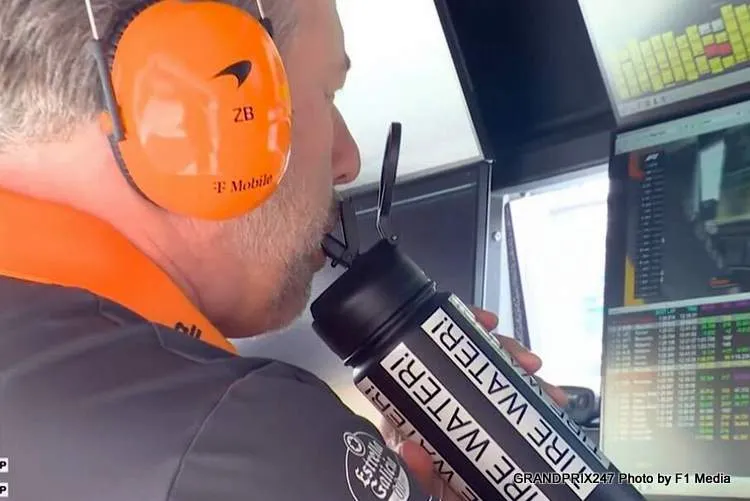
But the consensus that McLaren have a trick up their sleeves has remained while Brown cheekily drank from a bottle in Miami with a label "Tire Water" on it and went on claiming that teams who lodge protests against their rivals and end up being false should pay money for that.
McLaren trick finally revealed?

But now, the trick McLaren have been using may have been uncovered, as reports are claiming that they are using what are called "Phase Change Materials" (PCM).
To explain this, PCMs absorb a certain amount of heat while changing phase—from solid to liquid, for example—and they do that by maintaining a constant temperature.
A quick Google search on PCM will yield the following definition: "A phase-change material (PCM) is a substance that releases/absorbs sufficient energy at phase transition to provide useful heat or cooling."
Each material requires a certain amount of energy to change phases at a certain temperature. This is called Latent Heat.
For example, 1 g of ice requires 334 Joules to melt at zero degrees Celsius, which is its latent heat.
Based on the temperature you need to maintain, the PCM can be selected to make sure it absorbs the required heat, and that is the trick McLaren are suspected to be using.
F1 pundit Scott Mansell, also known as Driver61, produced a video on his YouTube channel explaining this trick and explained that McLaren are using some sort of PCM, probably placed in their brake drum cover, to make sure heat dissipated by the brakes does not overheat the rims and subsequently the tyres.
Mercedes previously used rims with grooves to keep the rims cooled and avoid heat transfer to the tyres.
This trick is a passive system that doesn't require any control or electronic connections and therefore is legal, which would be potentially credited to Rob Marshall, McLaren's chief designer, an engineer known for his mastery of the gray zones in the regulations.
Check out Driver61's video below
Latest News



Loading