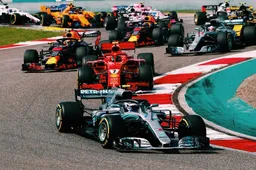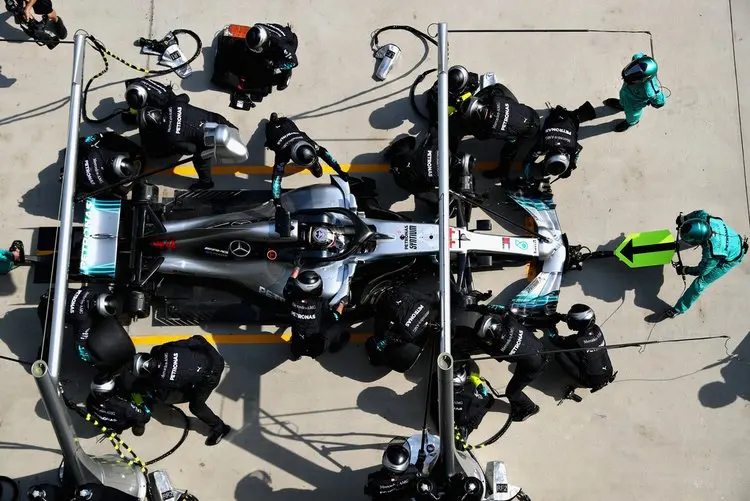
Red Bull's Daniel Ricciardo won the Chinese Grand Prix thanks to a shrewdly timed pitstop during a safety car period in the race, which their rivals did not take advantage of and were left to rue the missed opportunity to bolt on fresh rubber.
Had Max Verstappen not had a couple of moments of madness, it might well have been a 1-2 for the Blues which begs the question: why did Mercedes not pit Valtteri Bottas and Lewis Hamilton at that crucial point in the race?
In his Shanghai debrief, Mercedes chief strategist James Vowles explained, "Valtteri had just crossed the safety car one line, he was ten metres ahead of the safety car one line and the significance of that is he couldn't get into the pitlane."
"He physically past the last point on a track where he could actually cross into the pitlane entry and the reality behind that was it meant he had no other option to continue around on the start-finish straight, catch the safety car and exit the pitlane."
When the safety car was deployed, Hamilton did have a chance to pit for fresh rubber but the team opted not to do so and, as a result, paid the price and had to settle for fourth place.
Asked if the team had time to pit the reigning World Champion, who at that point was sandwiched between the Red Bulls, Vowles replied, "Yes, we absolutely did. In fact more so proven by the fact that Verstappen was just ahead and Ricciardo just behind them, both of those cars made it into the pitlane."
"The question is: why didn't we do it? The situation across the race at that point was that cars weren't really overtaking even when there was different in compound between them. On stint one in the race, you had a mixture of cars on soft and medium, but no one was overtaking each other."
"We had, for us, Kimi in front on the soft tyre with no difference between the two cars, we couldn't even get close. Same with Valtteri at the front with Vettel, but those were obviously on the same tyres.
"Verstappen was on that Ultrasoft tyre, a tyre that was very sensitive and very difficult, neither Kimi or Lewis could really make any inroads into him whatsoever at all, so on a track like that the performance difference between compounds wasn't working out."
"More so with Lewis, if under that safety car condition we always review how many positions we could potentially gain and how many positions we may lose."
"First of all, what would we have gained? Verstappen ahead we new there was a chance they would come in for the safety car and if that were to happen it would put Lewis back up into a podium position if we can take that medium to the end of the race and defend against those cars behind us."
"Now the Medium on our car was working very, very well and indeed we knew we could do 40 laps on it which is what you saw at the end of the race with Valtteri, that trye was working still at the end of the race."
"So the first question is: was a 10 lap old medium going to suffer? The next question is how many positions are we going to lose behind us?"
"We knew Ricciardo was in our window so if he didn't stop we would drop out behind him, but furthermore we had Kimi who stayed out very, very long and he was back into what we call the safety car window for Lewis which would have meant it would be very, very marginal if Lewis was going to come out behind Kimi."
"Now what you saw happened is both Red Bulls took that opportunity and in fact, Ricciardo did end up behind Kimi and Verstappen ended up ahead. With Lewis, we also know if we stopped under the safety car we would always be behind Verstappen through the race and then onwards."
"It was a decision that when we laid out all the facts on the table we didn't believe, based on the earlier evidence, that there will be enough performance differential for a Soft to overtake a Medium even one that's ten laps old."
"The reality of the situation is everyone saw what happened, both Red Bulls were extraordinarily quick on that tyre and were able to just scythe through the field making their way up to the front," concluded Vowles.
Big Question: Did Mercedes slip-up with their strategy in China?
loading
Latest News
Loading