Tech Insight: Storm brews over Mercedes steering innovation
F1 NewsThursday, 20 February 2020 at 22:28
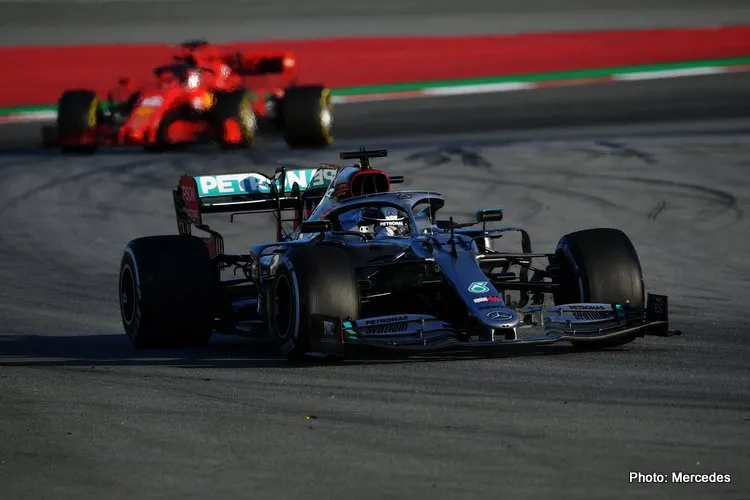
A huge hullabaloo has hit Barcelona’s second day of Formula 1 testing after live in car television images of Lewis Hamilton's Mercedes suggested that the toe of the world champion's car’s front wheel appeared to change in unison with the steering wheel moving towards him on the straights and reverting to its normal position, as the Mercedes turned into corners.
The observations thanks to live television for the first time in testing, immediately led to wild speculation that steering hydraulics are being used to alter the toe in the corners and then revert on the straights to allow the Mercedes a double-edged sword of better turn in the bends and less drag on the straights.
That tied into Mercedes’ incredible pace yesterday has already prompted cries of an unfair advantage, while the team has admitted to testing a 'steering mode' at Barcelona.
Formula 1 suspension and steering rules, however, forbid any adjustment to the suspension system, clearly stating that changes can only be made when the car is stationary and further elaborated by the clause” "No adjustment may be made to any suspension system while the car is in motion," it states.
A further rule clarifies that: "Any powered device which is capable of altering the configuration or affecting the performance of any part of any suspension system is forbidden," while the power steering law is also patent in its clarity: "Power-assisted steering systems may not be electronically controlled or electrically powered.”
It, however, remains unclear how Mercedes ‘Steering Mode’ works, or if it in fact breaches any of the above regulations at all.
Reuters report that technical director James Allison was coy about the details of a system he said was known within the team as DAS (Dual-Axis Steering).
“It’s a novel idea,” he told reporters. “It just introduces an extra dimension to the steering for the driver that we hope will be useful during the year. Precisely how we use it, and why we use it, that’s something we prefer to keep to ourselves."
Testing is not bound by the same regulations as grand prix weekends, with teams sometimes trying out developments they may never race.
Asked whether Mercedes were worried the governing FIA might rule the device illegal, Allison said they had been talking about it for some time, safety was not an issue and it was within the rules.
“This isn’t news to the FIA,” he said. “The rules are pretty clear about what is permitted on steering systems and I’m pretty confident that it matches all of those requirements. I’m just pleased we’ve got it on the car, it seems to be useable and we’ll find out over the coming days how much benefit it brings us.”
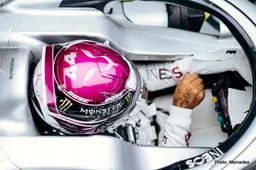
Hamilton said he had only one morning using it, did not find it distracting and was encouraged to see his team were continuing to innovate to stay ahead of the game.
Allison said the steering wheel represented “only the tip of the iceberg of similar stuff” hidden out of sight across the car, “Each of the new cars we bring to the track are festooned with innovation. It’s just they are not always as obvious to you as a stand-alone system like this where you can see it with your own eyes.
“One of the things that give me massive pride from working at Mercedes is to be part of a team that doesn’t just turn the sausage (machine) handle each year," added Hamilton.
On considering the conundrum at play here, the trick appears that because the driver is operating the system via the steering wheel, it is likely perfectly acceptable through the rules.
This is a very interesting loophole - there seems nothing in the rules that prevents the driver from pushing or pulling the steering wheel forward or backwards, or that the steering cannot move in a linear way on top of its rotary function to turn the wheels.
The FIA will need to now consider the situation and decide whether to amend the ruled to prevent any additional movement to the steering wheel, or just leave it.
loading
Latest News

Loading