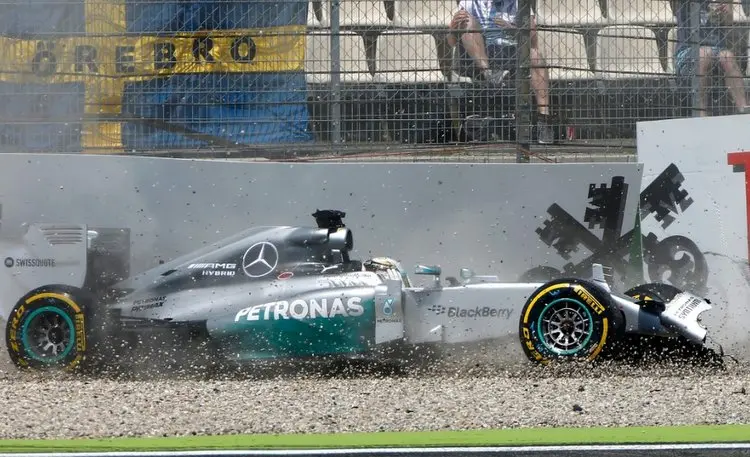
The gravel trap versus tarmac runoff area debate tends to always end in a virtual stalemate.
They are intermediary steps on the way to a primitive way of stopping the car. Some sort of barrier "technology" incorporating engineered containers of water, or a more crusty, time worn traditional wall of old tires, is the final stopping point for the racing car.
Part of me is always somewhat dismayed upon seeing a garishly painted assemblage of tires. A very, very humble sight in Formula One: a safety device culled from a junk yard.
That does not seem to be the best solution in the 21st century in my opinion. There are many examples, but I'll limit my attention to one in particular that immediately comes to mind: the outside of Eau Rouge at Spa.
One knows there is likely to be a shunt there. One also knows it's not going to be just any kind of accident, but likely a bad one. Yet, the answer to that inevitability is the ubiquitous wall of tires. A step up from hay bales.
There is a little bit of a run off area there, but Spa being built in an age when that wasn't even a passing thought, it's minuscule relative to a Tilke runoff. Of course, that is part of it's classic charm.

I propose that FOM, in conjunction with the teams, maintain a system of portable proximity-triggered air bags that could be carried to each race event, temporarily install-able where there are special presentations of impact danger.
While too costly to ask every circuit to implement, the nature of such a singular solution would not incur tremendous cost, relative to asking each circuit to upgrade to such a system themselves.
When taken into account as being an expenditure divided by use throughout multiple races and seasons, I think such a thing would be relatively cost effective and easy to implement.
There would be a straightforward multiple-bag arrangement that would pack flat, and install vertically flat at said locations at each track. Anchored against the tires, or a wall, the modular system could be placed along a long stretch of track like at Eau Rouge, or used judiciously at known "targets" like the outside of Mirabeau.

IR and other sensor technologies are very cheap today thanks to features put into cell phones. It would be of insignificant expense to layout a "pad" of sensors in front of the bags, with simple logic to determine when an object is on a terminal trajectory with a bag.
Appropriate timing would be programmed into the system to allow for the optimal deployment timing of the air bag for maximal effect. Micro controllers that could run such a thing are so inexpensive today a clever electrical engineer could cobble together such a system from less than $10 worth of parts.
At some tracks, the compact nature of having a thin profile would allow additional safety at locations where it is not possible to use conventional barriers. Places at Monaco come to mind.
As an adjunct to this system I would also propose a portable-installation of a series of catch nets, similar to what is used on aircraft carriers for emergency landings.
Situated behind existing barriers, these could be arranged with poles that when a proximity sensor is triggered, would elevate the catch net to a level above existing fencing.
We haven't had a crowd-incursion by a car or wheel yet, but the Dario Franchitti accident in Indycar is an example where such a system would be warranted.

Said catch net would be made in such a way that one would not want such a thing blocking a spectator's field of view, but in an emergency the dense netting would prevent small debris from entering the spectator area, as well as larger objects such as the car or wheels.
The additional measure of Race Control having a switch to remotely activate said net system when appropriate, could possibly save a life. Now and then we see tire tethers fail In high speed straight line accident zones, the additional protection afforded by such a system would help insure Formula One maintains it's spectator safety record.
What does this have to do with gravel traps and run off areas specifically?
If properly designed and adequately tested, such a system could allow Formula One to visit existing tracks that do not meet FIA safety standards due to a lack of run off area.
The air bag system, combined with the emergency net-shield arrangement, would mean that a car could be expected to safely decelerate within engineered limits, while the net-shield would add the equivalent projectile protection afforded now by great distances.

Seeing cars spear into a wall of tires, a makeshift safety measure, seems to be an antiquated solution to the problem of impact safety. The cars are highly engineered to be safe on impact, but a wall of tires is not very progressive relative to all of the other advances F1 has made.
It might also be argued that such a system could have actual "road car relevance". The FIA could pioneer a system that could be installed at locations on everyday roadways known to be prone to impact accidents. The net-shield system, employed between the divider of a freeway, could prevent opposing lane incursions.
Certainly improving the last line of defense in the event of a crash is a worthwhile thing to look into, and if properly done maybe one day an idealized safe track could be designed without the need for the crowd to be 100 meters away, and walls could again be close without the added danger. Formula One engineering can overcome the necessity of long run off areas or gravel traps.
Report by GrandPrix247.com reader Chip McDonald
Latest News







Loading