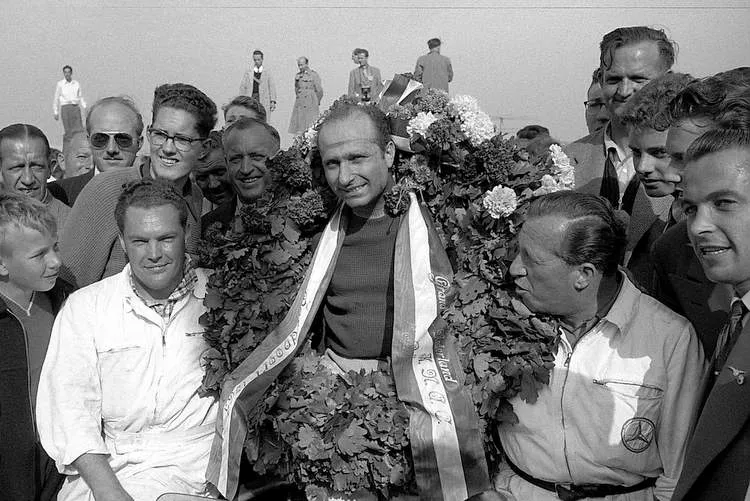
“Fangio, in my opinion, was the greatest driver of all time.” The assessment comes from his own Mercedes teammate, and fellow Formula 1 legend, none other than Sir Stirling Moss.
Many racing aficionados and pundits may not include the likes of Senna, Schumacher, and Hamilton in their top three greatest drivers of all time, but one name will always be in their - and everybody’s - top three list: Juan Manuel Fangio.
“The Maestro” - was born in Balcarce, about four hundred kilometres south of Buenos Aires. Fangoio's grandparents had moved from Italy to Argentina when his father was seven years old. His early racing exploits were at the wheel of Ford and Chevrolet vehicles. He was already in his mid-twenties by this time.
Fangio arrived on the European theatre with the support of the Automobile Club of Argentina and El Presidente Juan Perón. In 1949, he scored his first major international victory in the San Remo Grand Prix and in the same month (April) won the famous Pau Grand Prix, both at the wheel of Maserati 4CLT/48.
The Championship Years

Fangio was part of the conquering Alfa Romeo racing team in the inaugural season of the Formula 1 World Championship in 1950. His first victory came in Round 2 in Monte Carlo when he avoided mayhem with a keen and sharp observation, after the opening lap several cars ahead of him crashed.
He explained to Nigel Roebuck of Motorsport magazine: “There had been a similar accident in 1936, and I happened to see a photograph of it the day before the race. On the second lap, as I came out of the chicane before Tabac, I was aware of something different with the crowd – a different colour.
"And I realised that, instead of seeing their faces, I was seeing the backs of their heads. I was leading the race, but they weren’t watching me – so something down the road was more interesting," said Fangio.
Alfa Romeo dominated the 1950 season. The Milanese team won all six grands prix, equally split between Fangio and Farina. Both skipped the Indy 500 which was part of the Formula 1 championship in the fifties. Farina had famously won the first-ever championship grand prix at Silverstone in May and triumphed in Switzerland before the season finale at Monza in September.
Fangio won Monaco, Spa and Reims

It was his DNF at Monza, and in races, he did not win, that cost him the world title. Farina, in winning his home race, entered the history books as the first-ever Formula 1 World Champion.
Fangio started the 1951 season with victory in the season opener in Switzerland at the Bremgarten street circuit. Two other wins were scored in France and the season finale in Spain. Plus, back-to-back second places in Britain and Germany gave Fangio his first title, and Alfa Romeo their second championship-winning driver in two seasons.
Fangio cherished his time at Alfa Romeo and considered the 158 in sentimental terms his favourite car as it took him to his first title. He was 40 years old at the time of his first championship.
The 1952 & ‘53 seasons were run under Formula 2 regulations. Alberto Ascari was Enzo’s first and Formula 1’s first double-world champion. In a 1952 pre-season race at Monza Fangio crashed his Maserati, he was lucky to survive as the accident broke his neck, and he was sidelined for the rest of the season.
Alberto, whose father Antonio was killed while leading the 1925 French Grand Prix at Montlhery, successfully defended his title in 1953 with five wins.
The Argentine, still driving for Maserati, suffered a DNF in the first four races of the 1953 season, then three consecutive second-place finishes in France, Britain and Germany helped him to second place in the championship. Fangio’s only victory came in the season finale at Monza.
From Maserati to Mercedes

The 1954 season began with victories for Fangio at the wheel of his Maserati in the first two grands prix in his home country and Belgium. Victory in the next round in France at Reims was achieved in a Mercedes upon the Star of Stuttgart’s return to Grand Prix racing.
This turned out to be an uber-dominating season for Fangio. In eight races, Silverstone was his only non-podium finish. Three other consecutive wins would follow in Germany, Switzerland, and Italy. He was third in season finale in Spain, and easily took his second championship with 42 points. In second place was his compadre and Ferrari driver Jose Froilan Gonzalez with 25 points.
Four wins from six races in 1955 gave Fangio his third championship. He won the season opener in his home country and considered this as his hardest race. In the heat of Buenos Aires, he and fellow Argentine Roberto Mieres were the only two drivers who completed the three-hour race without a relief driver.
Fangio was second in the British Grand Prix at Aintree on a historic day for his teammate Stirling Moss who took his maiden Formula 1 championship victory driving for Mercedes.
Return to Modena

The 1955 Le Mans tragedy resulted in Mercedes pulling out of motorsports. This led to Fangio mounting a prancing horse and galloping to his fourth world championship in 1956. Race wins were recorded in his home country (shared drive with Luigi Musso), Britain and Germany.
Fangio would later say he never felt comfortable at Ferrari. While he was on good terms with his teammates which included Eugenio Castellotti, Musso and Peter Collins, the same cannot be said about Scuderia’s team manager Nello Ugolini.
It was back to cross-town rival Maserati for the 1957 season. This would be his final full season in Formula 1 and would witness not only his fifth and final championship but also one of the greatest victories in the history of Grand Prix racing.
The “Maestro” led a Maserati sweep of the top four places in the opening race of the season to take his fourth successive victory at his home grand prix. He won from pole position in Monaco and scored a hat trick by winning the French Grand Prix at Rouen. In the next round at Aintree, the British Grand Prix was his only DNF of the season.
The race was won by his ex-Mercedes teammate Moss (shared drive with Tony Brooks) in a Colin Chapman-designed Vanwall. This was the first F1 championship victory for a British constructor. From seven races, apart from the Aintree DNF, Fangio had four wins and two second-place finishes.
The Pursuit of Prancing Horses

The 1957 German Grand Prix took place at the legendary Nürburgring on August 4. Fangio’s Maserati team realized their soft Pirelli tyres would not last the distance without losing pace compared to the Englebert tyres on their Modena rivals.
They opted for a Gordon Murray strategy of the future; mid-race pit stop for re-fuelling and fresh tyres to give the driver the unfair advantage.
Leading from pole position Fangio came into the pits after a dozen laps. The team did what Niki Lauda would call “spaghetti culture,” extending what should have been less than a thirty-second pit stop to over 56 seconds.
The Ferraris of Mike Hawthorn and Peter Collins were long gone by the time Fangio returned to the track, over fifty seconds behind. Once he got the tyres heated and up to speed, the pursuit was relentless.
He would set new track record lap after lap. On Lap 20 of 22 he set the fastest lap of the race which was over eight seconds faster than his own pole position time. He passed Collins for second and was now within striking distance of race leader Hawthorn.
On the following lap Fangio took the lead with two wheels on the grass. The margin of victory of the epic drive was three seconds.
At age 46, Fangio was a five-time F1 world champion with 24 Grand Prix victories.
The Final Analysis

In 1958, Fangio took part in two races. First was his home Grand Prix where he finished fourth. His final Formula 1 drive came in the French Grand Prix where he again finished fourth. The race took place at the Reims street circuit which featured long straights.
It was while driving his Maserati on these long straights the “Maestro” made mental notes of his racing life. The Triumphs. The tragedies.
The death of his compatriot Onofre Marimon at the Nürburgring in 1954 had affected him deeply. Even before he came to Europe, Fangio had experienced the price one must pay for success in racing. His co-driver and friend Daniel Urrutia was killed in Peru when Fangio crashed the car in a long-distance race in 1948.
Then there were teammates Castellotti, Musso and Collins. All were killed between March 1957 and August 1958.
His own words from Motorsport magazine. “I thought about my career, how I’d come to Europe originally for just one year, and never thought I’d win a race – and in the end stayed 10 years and won five World Championships! But now I was wondering what I was doing here, and I knew then it was over, and time for the rest of my life.”
Fangio decided to wave the chequered flag on his illustrious career before the chequered flag was waved on the race.
Latin American legend for life

Five F1 world championships, 24 Grand Prix wins, 29 pole positions, 23 fastest laps, and 35 podiums from 51 starts made Fangio the undisputed “Maestro” of Formula 1.
During the 1957 season, Fangio also won the sports car Havana Grand Prix in a Maserati 300S. He was invited again in 1958 and took pole position in his Maserati 450S.
Fidel Castro’s supporters kidnapped him the night before the race at Lincoln Hotel. Luckily, he was released the following day after the race without any harm.
In life after racing Fangio, like Moss, was an ambassador for Mercedes, and he - “a lad from a small town” - was made President of Mercedes-Benz Argentina. On July 17, 1995, this great Champion from the first decade of Formula 1 passed away at the age of 84 from a heart attack.
The legend lives on. Born. June 24, 1911. Died. July 17, 1995.
Latest News
Loading