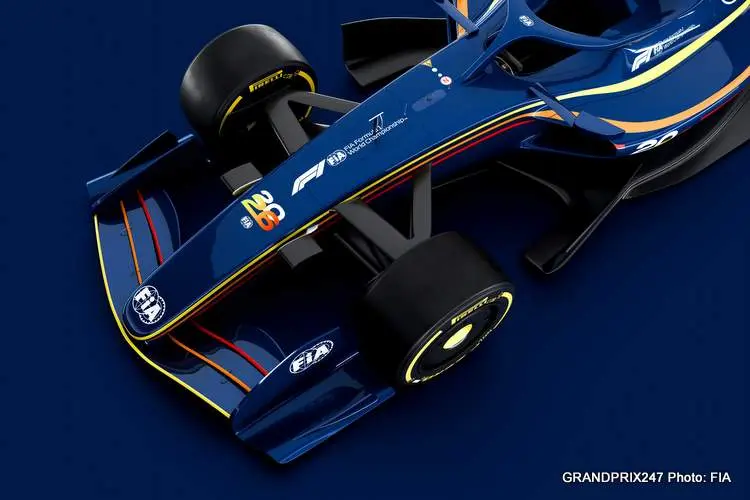
The countdown for the 2026 Formula 1 regulation changes is on with three races remaining in the 2025 season, with teams already focusing on their challengers for next year.
Pirelli are also racing to finalize their tyre compounds for 2026 with the dimensions of the rubber changing. While the rims will remain at 18" diameter, the tyres will be narrower, 25 mm less at the front and 30 mm less at the rear.
And one of the aspects Pirelli have to deal with is the amount of load their 2026 tyres will have to deal with based on the aero loads the 2026 F1 cars will produce, keeping in mind that they will be totally new, both on the chassis and power unit side, in what is considered the most drastic regulation change in the history of the sport.
As such, and with the teams now considerably advanced in their 2026 designs, they have provided Pirelli with load figures from the early simulations.
Pirelli motorsport boss Mario Isola revealed: "That is our request, yes. All teams must give us a prediction of their expected loads for the end of next season."
Are early simulations reliable?

But with the Italian tyre manufacturer having all the load data from the teams, will they be able to predict the pecking order that will emerge in 2026, or at least identify which outfit has an advantage?
That is not the case, according to Isola, who added: "I don’t believe that those simulations are telling us what the competitive order for next year will be.
"The numbers are far from that, to be honest. They are just simulations showing the expectations of the teams, not the real performance that we see on track.
"I’ve already read articles saying, ‘with this in mind we already know who will be fastest’," the Italian noted. "No, reality is completely different.
"Even if you have a higher load at the front or at the rear, that still doesn’t mean you will be quicker. That also depends on drag levels and on many other factors, so it's not that those simulations define the competitive order.
"So basically, I can already tell you who is going to be the winner next year! But unfortunately, it’s not like that, or maybe I should say: luckily, it’s not like that," he quipped.
With ten different sets of data available, Isola explained the methodology Pirelli have pursued while developing their 2026 tyre designs.
Tyre integrity comes first

He said: "In the first part of the development, it was not a big issue because we targeted the integrity of the tyre based on the highest simulations.
"The difficult part of the job is when you're in the process of defining the compounds, because that also depends on the energy and load.
"It's difficult for teams to come with reliable simulations, but we need those numbers," he went on. "We cannot start with a tyre that is okay for loads at the beginning of the season, but not for the end of the season.
"In that case we have to increase the tyre pressure by a huge amount, because we need to support the construction. We prefer to design a tyre that’s in line with the expectations for the end of the season."
However, Isola predicted that the teams' data sets will converge as their designs get more developed; he said: "That has happened in the past as well.
"For example, when we introduced the 18-inch tyre. At that point, we have already homologated the tyres for 2026, but we can still use that information to make our compound selection for all races.”
As to how Pirelli decided on the hardness of each compound and the offset across the range, Isola revealed: "We started the development with the C3 as our baseline, as that one is in the middle of the range.
"We started to design a C3 with the same hardness as the current C3, and then moved to the others. We tried to enlarge the gaps with the other compounds.”
"If for any reason the cars are not as fast at the beginning of the season as predicted, then the range of compounds is probably a bit on the hard side.
"But in that scenario we can still select softer compounds for specific races," the Pirelli boss concluded.
Latest News

Loading