From Monaco to Monza: Iconic races that shaped betting culture
F1 HistoryThursday, 22 January 2026 at 05:58
There are Grand Prix that feel less like sporting events and more like public lessons in uncertainty. The cars arrive wrapped in engineering certainty, namely simulation, wind tunnels, and tyres counted to the lap, yet the weekend ends with people arguing about fate.
That argument, repeated across decades, is one reason betting culture attached itself so naturally to Formula 1: the sport offers a clean laboratory for messy human instincts.
Monaco and Monza sit at opposite ends of that laboratory. One is a slow, glittering corridor where a mistake has no room to become “a moment.” The other is a cathedral of speed where a small misjudgment multiplies in the slipstream. Between them, fans learned how to price risk.
Monaco’s glamour hides a ruthless math problem
Formula 1’s own Monaco race guide captures the essentials: racing began there in 1929, Monaco was on the calendar in the first World Championship season in 1950, and it has been an ever-present since 1955. The circuit itself is the real storyteller. Narrow streets, barriers close enough to feel personal, and a race in which track position often matters more than raw pace.
That’s why Monaco has always nudged betting habits toward “who owns Saturday?” rather than “who looks quickest on Friday long-runs.” Pole position, qualifying duels, and first-lap lead markets make intuitive sense here, because passing is so hard that clean air becomes a form of wealth.
The day survival became the sharpest weapon

If Monaco teaches the value of centimetres, 1996 taught the value of patience. Formula 1 has repeatedly highlighted how abnormal that race was: Olivier Panis won from 14th on the grid, and only a handful of cars were still running when the chequered flag fell. It wasn’t luck in the cartoon sense. Panis still had to drive a street circuit in treacherous conditions without making the mistake that swallowed almost everyone else.
This is the kind of historical outlier that lives on in betting culture. It doesn’t prove that favourites are meaningless; it proves that certain venues make the tail of the probability curve fat. On street circuits, attrition is not a footnote; it’s a variable.
Monza turns speed into a referendum on nerve
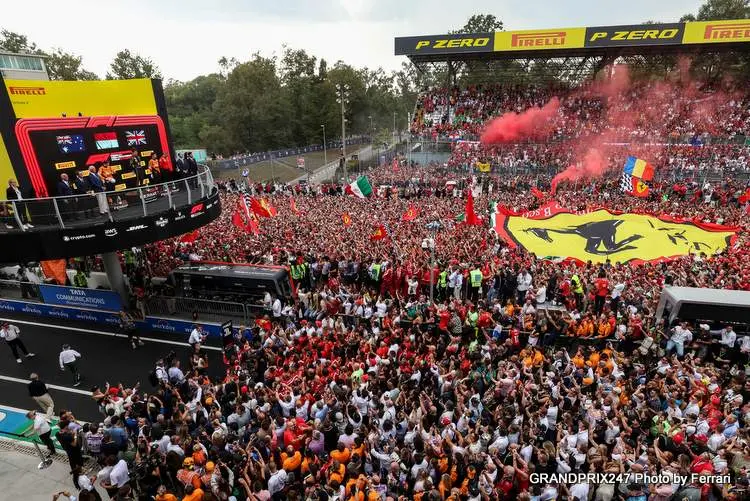
Monza is different: it looks simple until you realise the “simple” parts are taken at astonishing velocity. The place earns its nickname through feeling, not branding. Long straights and heavy braking zones compress the field into decisions: who dares to defend into Turn 1, who risks tyre life for track position, who commits to a strategy early enough to avoid being trapped behind slower cars.
Betting culture at Monza tends to reward those who think in scenarios. Instead of one neat prediction, you build branches: safety car timing, first-stop windows, and the way a team behaves when its two cars are nose-to-tail, and the pit wall starts speaking in riddles.
The new language of sport

Formula 1 didn’t invent betting, but it did help modernise how betting markets are fed. In 2018, F1 announced a partnership with Interregional Sports Group (ISG) and Sportradar to enable new in-play betting markets using data taken directly from the track on race weekends. That shift matters because it mirrors how fans already watch: with timing screens, radio messages, and probabilities updating in real time.
The second-screen habit is now part of the ritual, and it’s common to see fans keep odds open while monitoring laps and sectors. On race weekends, a second screen on the melbet app (Arabic: melbet تطبيق) can sit beside live timing, turning those strategy swings into numbers you can compare with your own instincts. Used responsibly, live markets can sharpen attention: you stop saying “something’s coming” and start asking what, exactly, would have to happen? That’s the beginning of better prediction—and, often, fewer impulsive decisions.
The rare crack in a dominant season
Some races shape betting culture by challenging the most comfortable assumption of all: inevitability. Formula 1’s own features about the 1988 Italian Grand Prix describe the moment with clarity. Ayrton Senna led late, closed in on backmarker Jean-Louis Schlesser, and the clash at the first chicane ended Senna’s race, gifting Ferrari an emotional 1-2 finish with Gerhard Berger ahead of Michele Alboreto.
For bettors, the lesson isn’t sentimentality; it’s structural. Even a dominant car has failure modes: traffic, reliability, the split-second judgment of a lapped driver, the thin line between “routine” and “ruined.” Monza, more than most circuits, has a habit of putting those failure modes under a microscope.
Recent seasons still echo the old teachings
The past stays relevant when the present keeps rhyming with it. In 2025, Lando Norris won the Monaco Grand Prix from pole, ahead of Charles Leclerc and Oscar Piastri. This outcome underlined how Monaco rewards control of track position and strategy. At Monza later that year, Max Verstappen won the Italian Grand Prix, with Norris and Piastri behind him, which is another reminder that at high speed, execution and clean air are priceless.
If you want a practical way to think about these venues without turning the weekend into spreadsheets, keep it simple:
- At Monaco, ask who is most likely to own a qualifying and avoid traffic.
- At Monza, ask who can convert pace into strategy without blinking under pressure.
- Everywhere, remember that the “obvious” outcome usually has a hidden price—tyres, timing, or temperament.
Monaco and Monza shaped betting culture by shaping how fans narrate risk. One teaches you to respect the wall. The other teaches you to respect speed. Together they teach the hardest lesson of all: prediction is not certainty; it’s discipline, practiced in public, one lap at a time.
Latest News
Loading