Ford: Not just making powertrains here; we're making F1 history
F1 NewsSunday, 02 February 2025 at 15:45

One year ago, Red Bull Racing and Ford announced their partnership for the 2026 Formula 1 season. Now, as the countdown to their debut power unit installation continues, the American automotive giant has made it clear that they are very, very serious about the project.
After initially exploring a partnership with Porsche and continuing to race with Honda-powered Red Bull Powertrains units until the end of 2025, Red Bull stunned the paddock by confirming Ford as its long-term power unit supplier on this day last year.
With just over a year to go before a Ford-badged power unit is fitted to the 2026 Red Bull RB22, the U.S. manufacturer has underlined its commitment. In a recently released video titled Making History | Red Bull Powertrains, Ford showcased its determination to compete at the highest level.
Mark Rushbrook, Ford Performance Global Director, emphasised the intensity of the competition, he said: "Formula 1, it's the ultimate challenge. It's not a marathon; it's a sprint race.
"Whenever you take on a big project, there are the early days, the excitement, and then when you get into it, there are moments of, 'What have we gotten ourselves into?'"
Red Bull team principal Christian Horner highlighted the scale of the challenge Ford and Red Bull Powertrains face, saying: "It's the fear of failure that drives us all in Formula 1.
"We do not underestimate the scale of the challenge of coming in as a new power unit manufacturer. This is the biggest change that Formula 1 has had, I think, probably in 70 years, where chassis and engine have all changed at the same time," he explained.
Horner: What better partner than Ford to help us in that journey?

"Bringing the electrical world and the combustion world together—what better partner than Ford to help us in that journey? To see that famous Ford logo coming back into Formula 1, emblazoned on our cars—it will be a big moment of pride, I think, for everyone in the organization," Horner added.
Jake Powers, Powertrain Electrification Supervisor, underlined the timeline pressures ahead of 2026, he commented: "We're in a race to 2026—it is very close. For a race car to work in F1, it has to be light; it has to be fast. In 2026, the battery becomes more important—it's generating and producing 350 kW, so you get more power out of the battery, and you still have to make it light."
Test Engineer Colton Lorenz reflected on a key technical milestone: "This was the first time they had run the turbo, so when we finally installed it on our test bench, there was a little bit of nervousness. Are the clearances internally okay? Is the bearing system right? Is the oil system working?"
Christian Hertrich, Powertrain Engineering Manager, described the level of precision required, he said: "Everything is aerospace level; you're treating each part like life or death. In motorsports, we think of timelines in months to a year. In the Red Bull world, we're talking hours to days.
Hertrich: There are a lot of sleepless nights

"A lot of our responsibility has become the manufacturing of additively produced parts," Hertrich continued. "They're very complicated—the geometry is very complicated. We make estimates for how long it's going to take to deliver something, but you hit challenges that you don't expect, and you have to react.
"There are a lot of sleepless nights where I worry about my parts, my designs, and everything. But at the same time, I think we have a great team, and I think we have the right tools to be successful," he ventured.
Ford’s commitment extends beyond Red Bull Racing, with Beverly Minicilli Chudo, Senior Engineer, reinforcing the company’s focus on excellence: "We want to make sure that we have a high-performing car with 100% confidence that all those parts in that car were built to the highest quality."
Chudo added: "To see that famous Ford logo coming back into Formula 1, emblazoned on our cars—it will be a big moment of pride, I think, for everyone in the organization."
As Red Bull and Ford gear up for their competitive debut in 2026, the ambition is clear: they are not here to simply participate but to set new benchmarks in F1’s hybrid era. It's also worth looking back at history, where F1 Stats show that Ford-badged engines powered legendary drivers to 10 Formula 1 World Championship titles, as well as 176 GP victories only bettered by Ferrari and Mercedes.
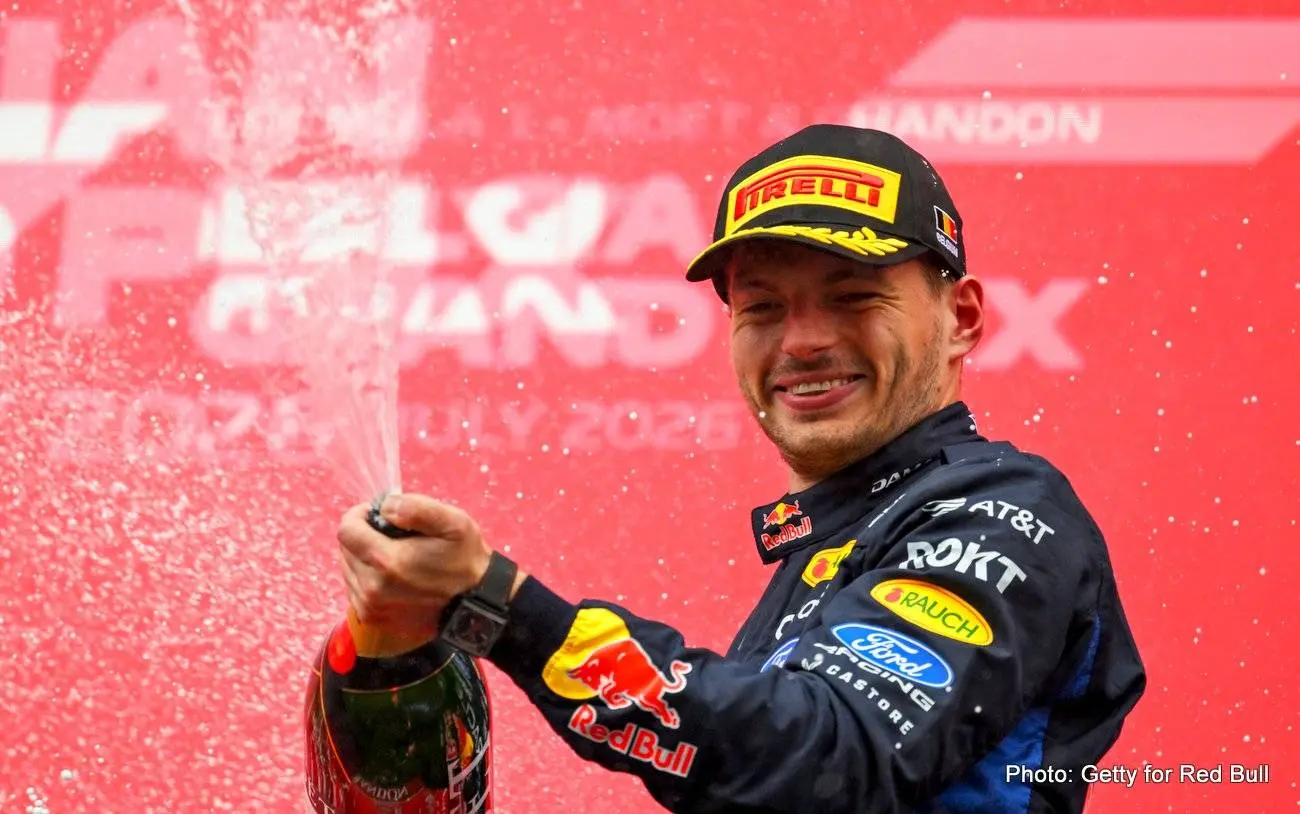
Notably, clearly fired up by the union and wasting little time, the switched-on Ford Performance marketing department is already using the immense talents of Max Verstappen, in the instance below driving a Mustang and they are yet to really get started in F1:
Latest News
Loading