Having rested the troops for almost a month, combat in the Formula 1 arena resumes at Zandvoort this weekend. Since this is Max Verstappen’s home Grand Prix, we could expect that he and Red Bull Racing will reassert their authority on the F1 World Championship.
Unfortunately, this is unlikely to happen. While everyone in the Paddock has been theoretically taking a breather, the FIA got busy clarifying a few technical points. One of which will almost certainly have a big impact on the Red Bull RB20, and of course Verstappen.
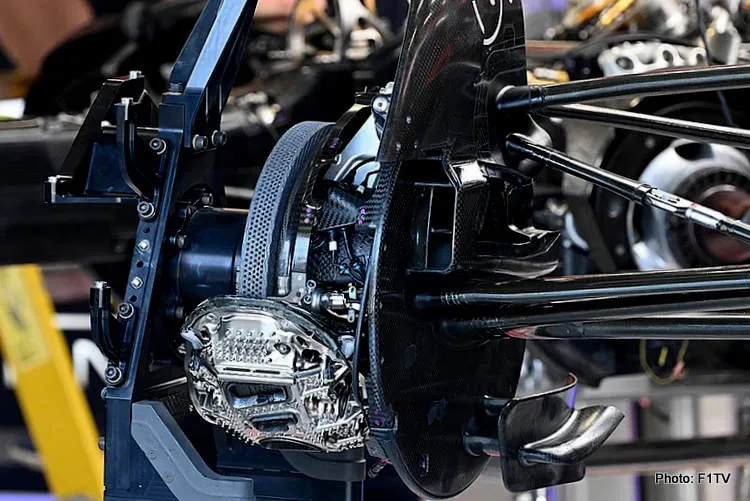
I’m talking about Red Bull’s “Magic Brake” of course. A torque vectoring system that helps counteract the slow-speed corner understeer inherent in today’s heavy ground effect-reliant cars.
The prestige revealed
The idea that the RB20 had such a system was indicated earlier in the season at Albert Park in Australia. Throughout Free Practice and Qualifying, Verstappen enjoyed a comfortable two-tenths advantage over the rest of the top runners. However, on race day, this seemed to evaporate.
During the opening laps, his left-hand rear brake suddenly started smoking, eventually catching fire as he entered the pitlane. The suggestion was that it had locked onto the calliper due to a malfunction in the bias system. Bias left and right? The trick was revealed: the RB20 had brake-activated torque vectoring!
Simple
For those unfamiliar with the concept, the easiest way to explain its impact is to imagine you’re in a canoe. If you’re moving along in a straight line and stick the blunt part of the paddle in the water, you experience a braking effect. You will also find the canoe abruptly changes direction at the same time! This is torque vectoring.
Nothing new here

Many road cars use it, normally as part of their electronic stability system. In other sportier versions, it is leveraged to improve cornering. This is clearly a “driver aid” and is, of course, banned in F1.
However, the concept is already being used to a lesser degree by the drivers when they manually “close” or “open” the diff, depending on grip levels and the stability of the car’s rear.
Abracadabra, it’s gone
I'm not sure how this left-right brake bias is initiated. There have been suggestions of a “T” section in the brake line with a left-right inertia-activated valve inside. Hmm, not sure I buy that completely. A system engaged by steering wheel angle input would make more sense as it could be easily calibrated.
I suspect the FIA scrutineers aren’t sure either. However, the regulation's wording is fit for purpose, referring only to: “any system that can produce systematic or intentionally asymmetric (different bias) braking torque in a given axle is forbidden.”
But why make the Magic Brake disappear now?
Given that F1 is all about innovation an’all, it’s strange the FIA has decided to close this off mid-season. In the past, when a team has found a gap in the regs, they have been told up front it will be closed the following year, e.g. Mercedes’ DAS system. Shutting down the “Magic Brake" halfway through the Championship just doesn’t seem like cricket.
For the record, I looked at the slow-speed corner data for `Silverstone and `Hungaroring. Not that it is definitive, but guess who was quickest in every slow-speed corner… yep, Red Bull by at least a tenth! No one else was that consistent. Someone somewhere doesn’t want a “bullish” second half!
Latest News

Loading