Mercedes Trackside Engineering Director, Andrew Shovlin, addressed the topic of George Russell's disqualification from the 2024 Belgian Grand Prix revealing the Briton himself might have been a factor.
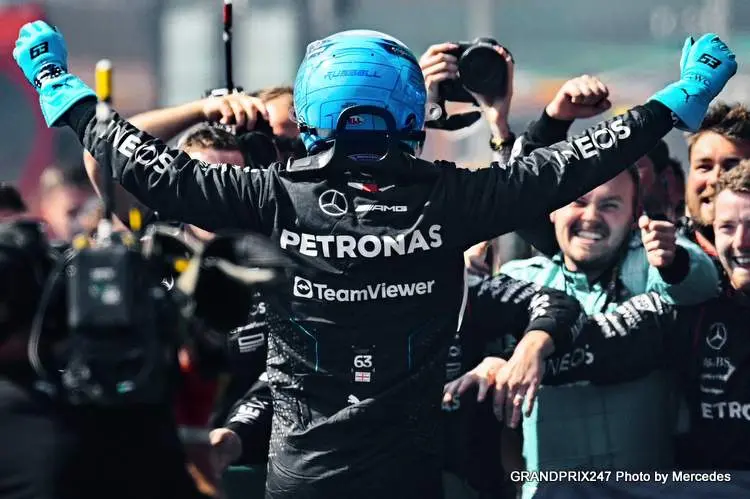
Russell delivered an impressive performance to cross the finish line at the Belgian GP first, making an improvised one-stop strategy work, but was later stripped of the win after his car was found 1.5Kg underweight during post-race scrutineering.
The Mercedes (including Russell's weight) was 796.5Kg as opposed to the mandated 798Kg.
Mercedes accepted the stewards' judgement and admitted they have erred, and while the reason for the #63 W15 being underweight was not clear at the time, Russell's one-stopper was tipped as the reason since it caused his tyres to lose more rubber, hence making the car lighter, as it seems Mercedes did not account for that pre-race.
In Mercedes' post race debrief video, Shovlin gave some credibility to the tyre-theory, being the reason behind Russell's disqualification, but admitted the result of the team's analysis is yet to be conclusive.
He said: "[It was] obviously very disappointing and unfortunate, particularly after he'd driven such a strong race to win from so far back.
"Right now, we're trying to understand exactly what happened. A lot of that involves us getting the weights of all the different components.
"The car can lose quite a lot of weight during the race. You get tyre wear, plank wear, brake wear, oil consumption. The driver themselves can lose a lot.
"And in this particular race, George lost quite a bit of weight," the Mercedes engineer revealed.
Both cars had the same weight before the race

Shovlin insisted both W15's went through the same procedure with Lewis Hamilton's car didn't face any issues - the seven-time Formula 1 Champion inherited the win.
He said: "The cars started the race the same weight. Lewis and George were both weighed after qualifying. The cars were within 500 grams.
"George's was the only one that had the problem, and it's because things like the tyre wear was much higher. It looks like we lost more material on the plank. We'll collect all that data, though, and look at how we can refine our processes, because clearly we don't want that to happen in the future," he explained.
A lighter F1 car is naturally a faster F1 car, but Shovlin was adamant Russell did not gain an advantage with his car being lighter towards the end of the race.
He said: "In terms of pace at the start of the race, it's nil because George's car and Lewis's car start the race at the same weight.
"Now, obviously, as George's car was losing weight faster than Lewis's throughout the race, there is an associated gain with that, but you're into the hundredths of a second per lap.
"It will be very small, because when you're talking about amounts, like one or two kilos, they don't amount to a lot of lap time," Shovlin insisted.
Despite Russell not gaining much of an advantage, the rules are the rules, and Mercedes messed up this time.
Latest News
Loading