Formula 1’s American era has arrived. What began as a cautious experiment has transformed into one of the sport’s most important regional expansions.
With three races spread across the U.S., Formula 1 has tapped into a market that blends entertainment, technology and sporting culture unlike anywhere else in the world. This shift has not only strengthened the global calendar but reshaped how the sport presents itself to fans.
Three American cities now host Formula 1 races, each transforming how fans experience the world’s fastest sport. From Miami’s flash to Austin’s fight and Las Vegas’s theatre, the trio defines Formula 1’s U.S. identity.
Formula 1 has gone from testing U.S. curiosity to igniting full-scale obsession. Once a European showcase, the sport now has a foothold in America that feels permanent. Fans don’t just tune in; they travel, bet and celebrate the spectacle, reshaping global racing culture.
A decade ago, Formula 1 was only knocking on America's door. The only event waving the flag of the USA was the Austin Grand Prix at the Circuit of the Americas (COTA). Today, it has become a three-city spectacular that no other country can boast.
However, this increase was not an accident. Liberty Media, the US firm that owns F1, was quick to realize this. As reported by Reuters in May 2024, viewership of F1 in the US has increased by more than 40% since 2018. The clear indication was that Americans did not merely want Formula 1 every year. The event should become an integral part of their sports calendar.
Why America Became the New Formula 1 Powerhouse

The rise of Formula 1 in the United States didn’t happen by accident. The single biggest catalyst was Netflix’s Drive to Survive, which introduced the personalities, drama and rivalries of the paddock to millions of new viewers. Younger audiences, in particular, embraced the series and transformed curiosity into lifelong interest. Social media amplified the effect, giving fans a constant stream of highlights, data, and behind-the-scenes access.
Another factor was the willingness of U.S. brands to invest. American companies now sponsor teams, races and fan events at a scale not seen before, creating a financial foundation that encourages further expansion. The U.S. also offers something unique: cities that can host races combining motorsport with cultural identity, nightlife and large-scale tourism.
Miami entered the Formula 1 grid in 2022, wrapping the Hard Rock Stadium in 19 corners of adrenaline. It’s the race that feels like a festival, part fashion show, part motorsport. You don’t just watch the race; you live it.
From yachts floating in man-made marinas to the roar of cars echoing off palm-lined streets, Miami’s vibe is unmistakable. Its track may be temporary, but the memories stick. Fans pour in from Latin America, Europe and the U.S., turning the city into a week-long carnival of sound and spectacle.
Miami represents Formula 1’s modern pulse, vibrant, inclusive and built for entertainment.
The Heart of U.S. Formula 1

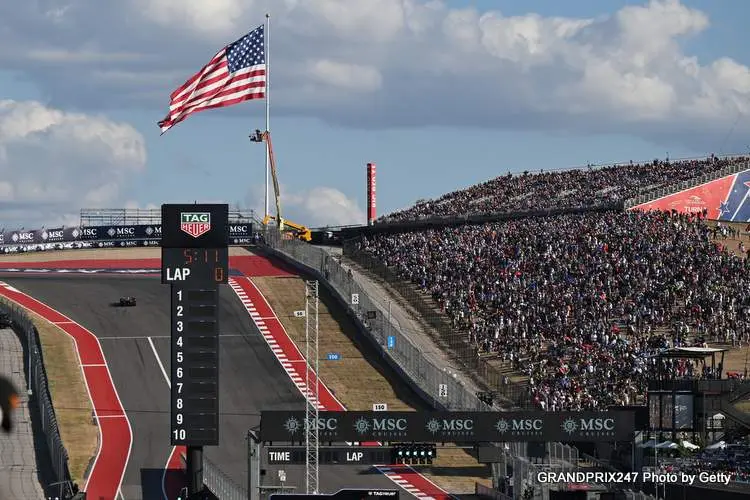
Austin deserves credit for keeping Formula 1 alive in the States long before Netflix or neon lights got involved. Since 2012, COTA has been the sport’s American anchor, a technical masterpiece that mixes European precision with Texas attitude.
The uphill Turn 1 is still one of the most famous starts in modern motor racing. It’s aggressive, unpredictable and definitely unforgettable. The attendance level of the 2023 United States Grand Prix broke all previous records, with more than 440,000 spectators (Formula1.com, Oct. 2023).
While Miami is all about show, Austin is all about tradition. It’s all motorsport, complex, honest and proud of its heritage.
When Formula 1 announced its return to Las Vegas for 2023, skeptics called it a gimmick. Then the lights went down. The Strip shut down traffic. Between hotels and casinos, cars hit 212 mph (341 km/h). Suddenly, everyone understood.
The Las Vegas Grand Prix isn’t just another stop; it’s a statement. The sport’s organisers built a permanent pit building off Koval Lane and re-paved the Strip for race night. Bloomberg (Dec. 2023) estimated the event generated $1.2 billion in economic impact for the city.
Las Vegas brought Formula 1 full circle, combining sport and spectacle into a modern entertainment empire.
Three Tracks, One Nation

Miami, Austin, or Las Vegas highlight the diversity of this sports event. Miami celebrates celebrity and energy. Austin celebrates racing expertise and history. Las Vegas turned competition into theater. This diversity is why the F1 experience in the US is so strong. It reaches every fan from the traditionalist to the adventure-seeking enthusiast.
How the Three U.S. Races Compare
- Miami thrives on celebrity culture, festival energy and vibrant trackside entertainment.
- Austin remains the purist’s choice, offering the most technical racing and the strongest motorsport heritage.
- Las Vegas is pure spectacle — night racing, neon visuals, and unmatched economic impact.
Together, they form a complete package: tradition, entertainment and theatre.
Unlike traditional European markets that grew with the sport, U.S. fans discovered Formula 1 through storytelling, data and entertainment. Many treat the race weekend like a festival — concerts, fan zones, celebrity appearances and hospitality events shape the experience. Others engage through analytics, tracking live telemetry, tyre strategy and pit stop timings. This mix of entertainment and data-driven fandom has become a defining characteristic of the American audience.
Formula 1 US Betting and Broadcasts

Racing and wagering have always been related. The difference now is transparency and access. As sports betting becomes mainstream, fans can legally engage with Formula 1 odds across regulated platforms.
The most popular betting markets in the U.S. include race winners, podium finishers, fastest laps and qualifying head-to-heads. Live betting has expanded quickly as data becomes more accessible, letting fans react to tyre changes, safety cars or sudden shifts in pace. Because each race develops in real time, bettors get a uniquely interactive experience that supports strategic thinking instead of blind guessing.
That’s where Covers enters the conversation. Known for its sportsbook reviews and verified bonus guides, the platform helps bettors find safe, licensed operators. It lists up-to-date welcome offers from trusted names in U.S. sports betting, making the process simpler and more secure for casual fans entering F1 markets.
For viewers, the connection between sportsbooks and racing has changed how races are consumed. Tracking tyre wear, pit stops, or fastest laps becomes more thrilling when every second has data-driven context. Betting responsibly can turn race watching from passive to participatory, a way to read the strategy, not just the scoreboard.
The three American Grand Prix now serve as Formula 1’s commercial backbone. Teams rely on the U.S. leg for sponsorship exposure and logistical balance. Fans, meanwhile, gain proximity to the world’s top racing spectacle without crossing oceans.
How Formula 1 Boosts Local Economies

Forbes (Nov. 2023) noted that F1’s North American revenue share increased by 17% year-on-year, mainly due to expanded U.S. engagement. Cities compete to host fan zones, while local economies enjoy record hotel occupancy rates. This growth proves the U.S. isn’t just a venue, it’s vital to Formula 1’s future stability.
Whether streaming at home or standing trackside, the experience feels global yet local, fast cars meet familiar skies.
Each U.S. race weekend generates enormous economic value. Hotels report record-high occupancy, small businesses see spikes in sales, and airports operate at maximum capacity. Beyond tourism, Formula 1 brings job opportunities in event management, logistics, media production and hospitality.
Cities like Miami, Austin and Las Vegas use the race to promote themselves globally, turning each Grand Prix into a marketing campaign seen by hundreds of millions of viewers worldwide.
What Teams and Drivers Think About the Triple-Header in America

Drivers regularly highlight Austin’s layout as one of the most enjoyable on the calendar, especially the dramatic climb into Turn 1. Miami’s atmosphere has earned praise for its energy, while Las Vegas divides opinion — some love the showmanship, others find the conditions challenging.
Teams, however, agree on one thing: the U.S. offers unmatched commercial potential. American sponsors, fan engagement and global broadcast reach make the trio of races a financial and promotional asset for the entire paddock.
Could another U.S. race be on the horizon? Rumours persist. New York has flirted with waterfront circuit ideas and Los Angeles has the audience. However, Formula 1’s leadership remains cautious about overextending. The focus, for now, is perfecting what’s already working.
Expect refinements instead of new additions:
- Miami plans layout tweaks to improve overtaking.
- Austin continues facility upgrades to sustain its record attendance.
- Las Vegas aims to streamline logistics after its chaotic debut year.
Formula 1 recognizes it has found itself ‘gold' in the United States, but the challenge is maintaining this quality level.
Looking Ahead The Final Lap

Three races, one message: America is no longer Formula 1’s guest; it’s a full-time resident. Each circuit, from Texas to Florida to Nevada, captures a unique rhythm of the same passion: speed. For longtime fans, this feels overdue.
For newcomers, it’s the perfect time to dive in and discover why millions worldwide follow the calendar like scripture.
The U.S. chapter of Formula 1 isn’t just about geography. It’s about energy, ambition and connection. The engines may quieten between weekends, but the momentum is unmistakable and only accelerates.
If the current momentum continues, the U.S. could influence the direction of Formula 1 for the next decade — from technical partnerships to sponsorship trends and new fan experiences. Manufacturers may deepen their involvement, and more American talent could rise through the junior ranks.
What’s certain is that the American chapter is no longer optional for Formula 1; it’s essential. The sport’s future will be written as much under U.S. lights as on historic European circuits.
Latest News
Loading