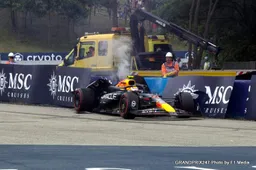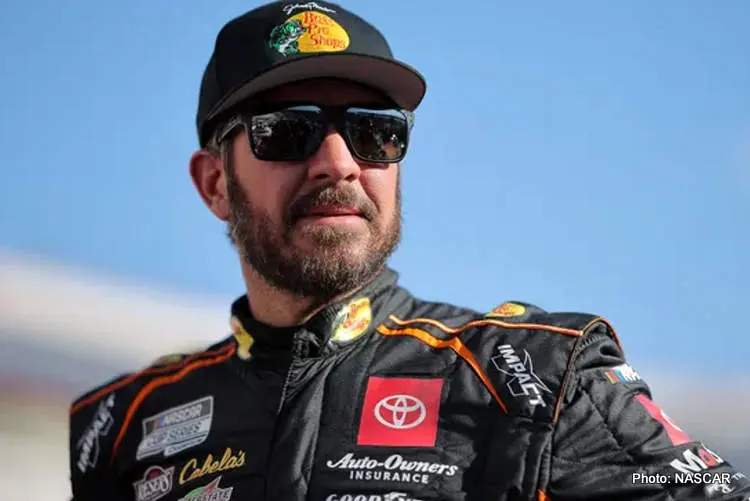
Martin Truex Jr. is a name synonymous with success in NASCAR with a decorated career in stock car racing, some fans speculate whether the American race driver could have made the same mark in Formula 1.
Notably, Formula 1 is a world vastly different from NASCAR. While his legacy in NASCAR is cemented, this article delves into the factors that contributed to his decision to stay in NASCAR and why he never crossed over to F1, despite rumors and talks.
Martin Truex Jr.’s NASCAR Dominance
Truex Jr.’s career in NASCAR has been nothing short of stellar. He claimed the NASCAR Cup Series championship in 2017, displaying his ability to dominate on the track. With over 30 wins and 20 poles in his Cup Series career, Truex Jr. has consistently shown why he belongs among NASCAR’s elite drivers.
The 2017 season was a career-defining moment for Truex Jr. He won 8 races, leading over 2,200 laps throughout the year. This performance not only secured him the championship but also cemented his place as one of the sport's all-time greats.
The Challenge of Formula 1
While NASCAR focuses on oval and road course racing, Formula 1 emphasizes precision on tracks filled with tight corners, high-speed straights, and sharp braking zones. The technical demands in F1 often require drivers to have different skill sets, making it difficult for stock car drivers to transition seamlessly.
Despite his skill in NASCAR, Truex Jr. never seriously pursued a career in F1. The financial dynamics of NASCAR, combined with Truex’s personal preference, kept him from exploring F1, even though drivers like Juan Pablo Montoya made the switch. His focus was always on NASCAR, where he had already built a solid foundation.
Financial Considerations in NASCAR vs. F1
Truex Jr. has earned millions throughout his career in NASCAR. In 2023 alone, his net worth was estimated to be over $40 million, much of which comes from winnings, endorsements, and sponsorships. His deals with Bass Pro Shops and Toyota have been particularly lucrative, allowing him to remain one of the highest-paid drivers in NASCAR.
Formula 1 also offers immense financial rewards, but the structure is different. F1 drivers often sign contracts worth tens of millions of dollars, with Lewis Hamilton’s contract with Mercedes worth $40 million annually. While Truex Jr. could have earned big in F1, his secure position in NASCAR allowed him to continue thriving without taking the risk of transitioning to a new sport.
Talent Development and Transition Between Sports
Transitioning from NASCAR to F1 is not an easy task. Drivers like Kimi Räikkönen and Fernando Alonso, who competed in both NASCAR and F1, experienced the differences firsthand. The skill set required in F1 includes sharper cornering techniques and adaptability to more technical tracks, areas where Truex Jr. was less experienced.
Truex Jr.’s success in NASCAR comes from his consistency on a variety of track types, including short tracks, road courses, and superspeedways. His experience in stock cars, which are heavier and less agile than F1 cars, was well-suited to the demands of NASCAR but would not necessarily translate to F1 racing.
Other NASCAR Drivers Who Transitioned
Juan Pablo Montoya is one of the few drivers who transitioned between F1 and NASCAR. While Montoya found moderate success in both, his career in F1 was not as dominant as some had hoped. He managed 7 wins in F1 before moving to NASCAR, where he found success on oval tracks.
Montoya’s move to NASCAR proved that while crossover between the two sports is possible, it is challenging to master both. Montoya’s path might have deterred Truex Jr. from pursuing a similar journey, knowing the difficulties involved in competing at the highest levels in two vastly different motorsports.
The idea of crossover success between NASCAR and F1 has always sparked interest, not just in the racing community but also among betting enthusiasts. Many New Jersey betting promos speculated on Truex Jr.’s potential if he had made the leap to F1 as he is a hometown hero of “The Garden State”. Fans often debated whether the shift would have been profitable for Truex Jr., both in terms of career success and financial gains.
NASCAR’s Unique Racing Culture
Truex Jr. has long been a fan favorite in NASCAR. The community-centric nature of NASCAR, where drivers build strong personal connections with their fans, has kept Truex Jr. engaged. This type of relationship is less prevalent in F1, where the global scale of the sport creates a different dynamic.
Sponsorship deals in NASCAR are key to a driver’s financial success. Truex Jr.’s relationship with Bass Pro Shops, a company based in the U.S., was a perfect fit for his brand and style of racing. F1 sponsorship deals, on the other hand, tend to have a more global focus, which might not have aligned as well with Truex Jr.’s values and fan base.
Racing Styles and Preferences
Truex Jr.’s racing style—marked by patience, strategy, and adaptability—was well-suited for the demanding nature of NASCAR. NASCAR requires a driver to be comfortable with high-speed drafting, particularly on superspeedways, a style of racing that does not exist in F1.
F1 requires a more aggressive approach to cornering and overtaking. The cars’ superior aerodynamics allow for high-speed cornering, but they also demand more precision. Truex Jr.’s stock car experience, while impressive, may not have lent itself as easily to F1’s more aggressive racing tactics.
Conclusion
Martin Truex Jr. did not pursue a career in F1, choosing instead to continue his legendary career in NASCAR. His impact on the sport is undeniable, and his decision to stay has paid off both professionally and financially. His legacy in NASCAR is solidified as one of the greatest, leaving fans to speculate about what could have been had he attempted to conquer the world of F1.
Had Truex Jr. moved to F1, it is uncertain whether he would have found the same level of success. While the idea is tantalizing, his established dominance in NASCAR made staying in the sport a more lucrative and fitting option.
Latest News




Loading