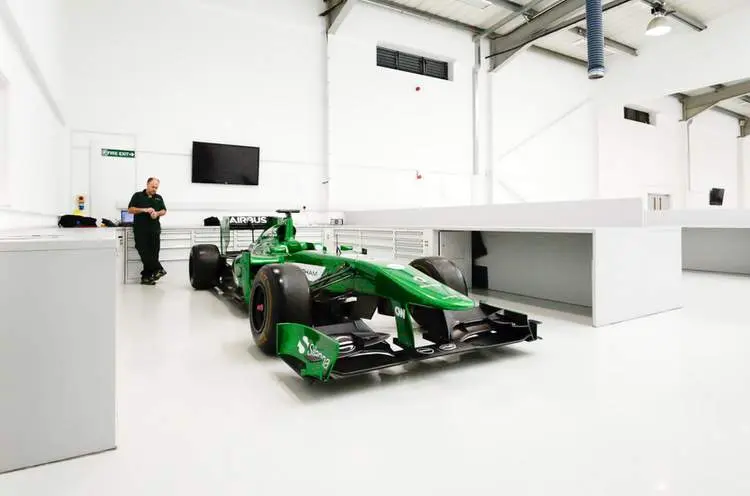
Amid reports that Caterham wants to rejoin Formula 1, the FIA should be careful about the idea of welcoming this historic brand back to the grid.
On the face of it, Caterham seems like an ideal candidate for a new F1 team. Famed for the Caterham 7, a kit car built around Colin Chapman’s Lotus 7 (which was driven by the likes of Graham Hill), the company has bags of motorsport prestige and expertise.
Caterham also competed in F1 as recently as 2014. However, this is where the positivity around the team’s prospects ends. Like Virgin & Hispania Racing, who also joined the sport in the early 2010s, the outfit struggled badly, failing to score a single point in five full seasons.
Off the track, things were even more turbulent. Having initially entered under another historic name—Lotus—a legal squabble quickly followed with Lotus Renault. After rebranding as Caterham, funding issues led to bankruptcy, forcing the team to shut up shop and leave (seemingly) for good.
However, amid a surge in popularity, F1 is now seeing a push for more teams on the grid. With Audi taking over Sauber and Cadillac entering next year, the door has been left ajar for new joiners. While this could offer Caterham a way back, are there better brands out there for the job?
Caterham: History tainted by the 2010s

Automotive fans will no doubt be familiar with the Caterham 7. The open-seater’s iconic design continues to inspire Caterham’s current showroom—and it’s not just a car for modern day enthusiasts. It dominated 1950s racing to such an extent that the US banned it from competing in the 1960s.
Though its F1 team originally joined under the Lotus moniker, the Caterham name was seen as similarly historic when adopted in 2012. The outfit's problems had less to do with naming and more to do with performance. Under neither guise did they ever look competitive, managing a best finish of 11th.
To be fair to Caterham, fellow new joiners Virgin Racing and Hispania didn’t do much better. The latter turned up at its first pre-season test with no on-track running whatsoever. At one point or another, all three also failed to pass the 107% rule, disqualifying them from several F1 events.
Virgin’s successor team Marussia lasted longest, before eventually folding in 2015, underlining the challenges facing new outfits in F1. Caterham’s own exit also involved significant legal wrangling, which damaged the brand’s (and arguably the sport’s) reputation. With so much work having gone into building up F1’s image, Liberty Media will be keen to avoid a repeat episode.
Investors are keen, OEMs a better option?

Earlier this week, investor Saad Kassis-Mohamed revealed plans to revive Caterham’s defunct F1 team through his group SKM Capital investment. Competing under the SKM Racing brand, the proposal would see the Silverstone-based outfit return by 2027.
However, Caterham’s F1 revival faces several roadblocks. First of all, it’d need to be approved by the FIA and Liberty Media. As we’ve seen with Cadillac’s protracted bid to join the grid, gaining their approval is no easy task. Other teams will also need convincing.
One of the major sticking points to adding an eleventh team was prize money. Simply put, F1’s existing teams didn’t see the need to split their earnings eleven ways. In fact, Cadillac will have to pay $450-Million in entry fees to justify its inclusion—and this is viewed as low by many of the teams—there’s a desire to ask further new joiners for up to $600-Million.
In this context, the €280-Million earmarked for the venture by SKM Capital won't be enough to foot the bill. When you factor in the controversy around Caterham’s previous entry, it may not be the most attractive proposition either. Given that OEMs are better equipped to absorb these kinds of costs, could minor stakeholders like Ford or Toyota be better options?
With the likes of Renault, Honda, Mercedes, and Ferrari all sticking around, F1 has arguably never been in ruder health, manufacturer-wise. It’ll be fascinating to see who joins next.
Should Caterham be allowed to rejoin Formula 1?
loading
Latest News








Loading