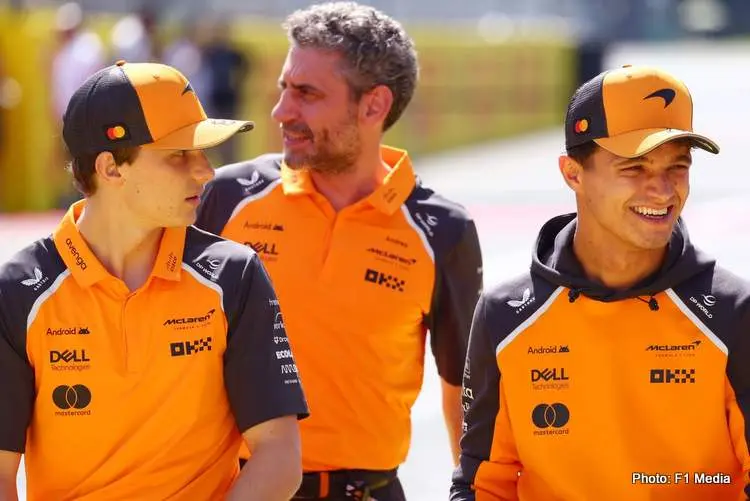
McLaren’s title fight with Max Verstappen has intensified after the Qatar Grand Prix, where the team’s commitment to treating Lando Norris and Oscar Piastri with absolute equality backfired at a critical moment.
With Verstappen closing to 12 points behind Norris and Piastri only 16 adrift, Jacques Villeneuve believes McLaren’s philosophy has become a liability rather than a virtue, warning that the so-called Papaya rules are now actively harming their championship bid.
Villeneuve said: “McLaren can’t take gambles because they’re treating their drivers fairly. Red Bull can take advantage of it.” He explained that Verstappen’s late pit stop worked because Red Bull could afford to gamble on the Dutchman alone while McLaren felt obliged to mirror decisions between their drivers.
“McLaren didn’t have the best strategy. But Max and Red Bull took a gamble because if no one else pitted, they would have been at the back. It was a gamble, and it paid off because everyone else pitted." The Canadian argued that the fairness-first approach has boxed McLaren into predictable decision-making.
“Once the decision was made with Piastri, they made a similar one with Norris instead of reacting. From the beginning of the season, they’ve always said they want to be 100 percent fair with both drivers. That might well cost them.” He noted that Norris could have been left out to slow Verstappen and protect Piastri’s race, but McLaren refused to break parity.
Strategy mistakes now under the microscope

Villeneuve stressed that teams make strategic errors every season, but the timing of this one has magnified its consequences: “McLaren isn’t the first team to get the strategy wrong. It’s happened to teams over and over. When the championship is on the line, you notice it much more. In a critical moment it is compounded.
"It might be costly because that gave Max a lot of points on a weekend where they were definitely the quickest car out there. The balance had turned around because in Qatar it was Piastri controlling the weekend. This was a big change compared to the last few races. But overall, it’s just making the championship more exciting for everyone.”
With all three contenders still theoretically in play, Villeneuve emphasised that McLaren cannot rely on team orders because Piastri is still mathematically alive: “Max is just 12 points behind and Piastri is 16 points behind. That means Piastri is not in a position to help Norris or the team cannot ask him to because he can still win it himself. So it’s an open battle between three drivers.”
He drew a historical parallel to the 2010 finale: “The last time we had more than two drivers in the last race was Vettel’s first championship when he, Lewis, Webber and Alonso fought it out in Abu Dhabi. It’s the one race where Alonso got stuck behind Petrov, which is why they introduced the DRS.”
Pappaya Rules are detrimental to McLaren’s success

Villeneuve rejected the idea that Verstappen carries momentum into the Yas Marina finale: “It’s not about momentum now, it’s about how you react under pressure. And that’s new to the McLaren drivers. I guess it’s a good thing it happened to them in Qatar with a race to go, because they can digest it and come back from it. After Qatar, they should have been first and second in the championship.”
Here, Villeneuve believes McLaren’s philosophy becomes a weakness: “Papaya rules have never worked and they’re detrimental to McLaren’s success. If you want to win at all costs, if you want to be a winner, you cannot have Papaya rules.”
He compared McLaren’s stance unfavourably with iconic pairings. “I don’t think Prost and Senna had that when they were teammates, nor when Hamilton and Alonso were teammates. It didn’t work. Vettel and Webber? It didn’t work. It’s the first time I see that kind of rule.”
Villeneuve warned that such enforced equality has a track record of losing titles: “Some championships were lost because there weren’t any rules. That’s happened. The Papaya rules might well have a negative effect on the Drivers’ Championship.”
He cautioned that the team may have contractually tied its own hands: “We keep talking about the Papaya rules, but we don’t know what’s in the drivers’ contracts. If in their contracts it has to be 100 percent balanced, well the team has to cope with that. I don’t think they expected to be in this position where they would have to stick to it until the last race.”
As the grid heads for a three-way showdown in Abu Dhabi, Villeneuve believes McLaren must now confront the consequences of the ethos they embraced: “When you sign a contract, you can’t imagine every scenario. You do what you think is best and at some point one will be the clear leader. But that is not what happened and they’re stuck with it.”
(Source: CoinPoker)
Latest News
Loading