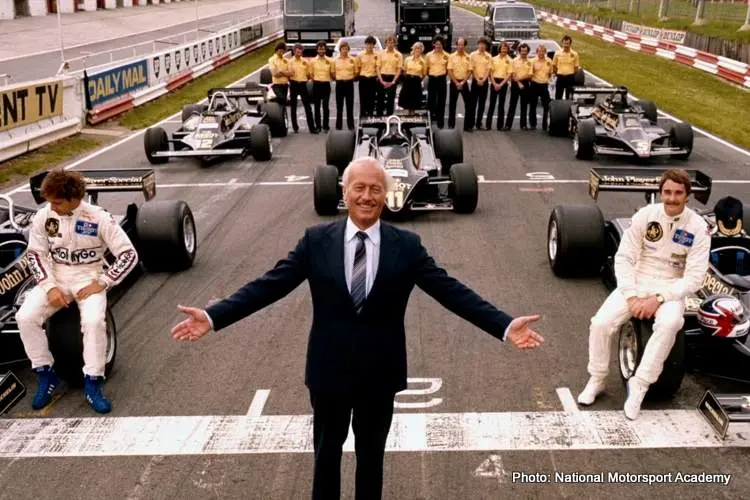
The motor racing heavyweight who added his brand of genius to his championship-winning Lotus Formula 1 cars, greatly admired by this era's greatest designer Adrian Newey.
ACBC, Anthony Bruce Colin Chapman was the genius behind Lotus, the marque that took legends of Grand Prix motor racing like Clark, Hill, Rindt, Fittipaldi, and Andretti to world championship glory. After Enzo Ferrari, Chapman is the most influential and charismatic character the world of Formula 1 has ever seen.
Early Days. His story began in Surrey, England, where he was born on May 19, 1928. Chapman's father operated the Railway Hotel in London. After earning his engineering degree and learning to fly, Chapman’s adult life was in high gear and fast forward. Royal Air Force. Then working at the British Aluminium Company and indulging in his passion of tinkering with cars. Lotus Engineering was established in 1952.
Chapman, the race driver. Like Enzo and Ecclestone, Chapman had driving ambition. He entered his Lotus in the 1955 Le Mans with him as the number one driver. He and co-driver Ron Flockhart were disqualified for reversing on the track.
The following year at the Sarthe circuit, Chapman and American co-driver Herbert MacKay-Fraser retired three hours before the finish. The sister car of Reg Bicknell and Peter Jopp took class victory and finished seventh overall.
Chapman's racing career and dream came to a halt when he crashed into his Vanwall teammate Mike Hawthorn in practice for the 1956 French Grand Prix at Reims.
Chapman. The Constructor

Team Lotus first appeared in Formula One at the 1958 Monaco Grand Prix. Graham Hill retired with engine problems, and Cliff Allison finished sixth; he would score the team’s only points of the season from his fourth-place finish in the Belgian Grand Prix.
Stirling Moss gave the first podium and F1 victory to Lotus in his Rob Walker-privately-entered Lotus 18 in Round 2 of the 1960 Formula 1 season. The team’s own maiden victory was at Watkins Glen in the 1961 season finale, the US Grand Prix. The winner, Scottish racer Innes Ireland, was told by Chapman at the Earl’s Court Motor Show he will not be driving for the team next season.
It was with another racer from the north of England that Chapman and Team Lotus would reach new heights and championship glory—Jim Clark. The Scottish farmer would race only for Chapman in his glittering Grand Prix career.
Among the many of Chapman's innovations was the car he introduced in 1962, the Lotus 25, Formula 1’s first monocoque chassis design. Clark took his and the car’s maiden win with an impressive performance at Spa-Francorchamps.
My Best Friend

In 1963, in which there were no non-British Grand Prix winners, Clark took seven wins from ten races to be crowned world champion. Team Lotus won the Constructors’ Championship for the first time.
Chapman and Clark again dominated the 1965 season; the combination took six victories from ten races and won the Greatest Spectacle in Racing—the Indianapolis 500. On New Year’s Day in 1968, Clark broke Fangio’s record of 24 Grand Prix wins by taking victory in the South African Grand Prix at Kyalami.
This was not only his final victory but also his final F1 race. In April, Lotus entered him in a race where young English driver Max Mosley was making his Formula 2 debut—Hockenheimring. Chapman was deeply affected by the death of his best friend and star driver, Clark was dead.
Chapman did not even come to the race shop for three weeks. The season was salvaged by his other driver, Hill, who won the second round in Spain and captured his second title at the end of the racing year.
The 1968 World Champion Hill described his employer: “The standard he sets for himself and his own mechanics more or less sets the tone, and of course you've got to come up to that anyway.”
Hill, known as the life of the party, was in no joking mood when he said, "When you're overtaken by your own rear wheel, you know you're sitting in a Lotus."
On a positive note, the season saw Chapman securing sponsorship from Gold Leaf tobacco; the era of big corporate spending in Formula 1 had arrived.
Edge with Wedge

The Lotus 72 was another clever innovation from Chapman and Maurice Phillippe. The innovative wedge-shaped design featured radiators mounted on the side of the car. After adding oil, water, and Chapman’s favourite ingredient, lightness, the car weighed 530 kg, the minimum allowed.
Jochen Rindt was another driver who met Chapman’s exacting standards. He gave the Type 72 its first victory in the 1970 Dutch Grand Prix. Like Stirling Moss and Jackie Stewart before him, Rindt was concerned about Chapman’s obsession with ‘adding lightness’ to his racing cars. The German-born Austrian even wrote a letter to him expressing his safety concerns about Lotus cars. Over the years several drivers had been killed or seriously injured in Chapman’s creations.
Unfortunately, Rindt’s name would be added to that list after his crash at Monza in practice for the 1970 Italian Grand Prix. Dr. Marko’s school friend would go on to become Formula 1’s first—and hopefully only—posthumous world champion.
During the season Chapman had discovered another rare talent, Emerson Fittipaldi, the Brazilian who had arrived in England the previous year without speaking a word of English. In 1972, at the age of 25, he would become, at the time, the youngest world champion, driving the Lotus 72 in iconic JPS livery. Only the Gulf and Martini colours come close to the grace and beauty of JPS livery.
The Lotus 72 would score 20 Grand Prix wins, including Ronnie Peterson’s maiden win at Paul Ricard in 1973.
The Chapman-Andretti Years at Lotus

Chapman’s final champion was Mario Andretti; his commitment and dedication were akin to Clark’s. In 1968, the American made a dramatic Grand Prix debut by taking pole position for his home race at Watkins Glen in a Lotus.
A decade later he would become world champion in tragic circumstances at Monza. Chapman’s latest trick up his sleeve with the assistance of Peter Wright was ground effect. The Lotus 79 was class of the field. The opening lap accident led to the death of Andretti’s teammate Peterson.
Ironically, the Super Swede, who had signed to drive for McLaren in 1979, had earlier said to journalist Keith Botsford, “I just don’t intend to be another dead hero for Colin Chapman.”
For the 1981 season, Chapman and his engineering brains—Peter Wright, Tony Rudd, and Martin Ogilvie—came up with the idea of a twin-chassis design, the Lotus 88. The team was not allowed to race the Type 88 in the opening three races. An incensed Chapman did not enter any cars for Round 4 at Imola.
The Type 88 would never race in Formula 1, but soon Chapman had a bigger headache. His main sponsor, the mysterious American oil trader David Thieme, was arrested in Zurich on fraud charges. His sponsorship pipeline ran dry quickly for Team Lotus.
The DeLorean Debacle

John DeLorean received a grant of £35m from the British Government to set up manufacturing in Northern Ireland. He promised production would start in eighteen months but was unable to convince Porsche and BMW to help meet this deadline.
Chapman, eager to get in on the action and always on a fast track, was the answer. The two met in Geneva, and after four days of negotiating, they came to the agreement upon payment of over $17m from DeLorean.
The investigators would later allege this invoice was paid twice. One for design work by Lotus Cars and the other as an ‘introductory fee’ to GPD, a company set up years earlier by Chapman and his finance director Fred Bushell for tax avoidance. According to Chapman, ‘Tax evasion is a crime; tax avoidance is science.’
The second payment was deposited in their personal bank accounts in Switzerland. Bushell later pleaded guilty and was sentenced to three years in prison.
Chapman was a man on a mission in a hurry. Pushing the envelope, stretching the limits, and bending the rules to win at any cost—sadly, without any regard for the safety of his drivers—was fair game.
Rudd, team manager at BRM, who also worked for Chapman, once described an attempt by the Lotus genius to convince officials that the paper from a road map he had painted with aluminium paint and installed between the engine and driver compartment was fireproof! The officials refused to accept it as a fireproof bulkhead.
The Last Lap
On the evening of December 15, 1982, Chapman flew home from a meeting in Paris. He would not see another sunrise. At the age of 54 he passed away from a massive heart attack. Today, his son, Clive, runs Classic Team Lotus from Norfolk.
The Unforgettable Colin Chapman. Born: May 19, 1928. Died: December 16, 1982.
Latest News




Loading