Racing drivers are very similar to fans, in that they tend to stick to one type of driving but a rare few go beyond that
To master more than one motorsport discipline, three in fact is what the Triple Crown of Motorsport is all about.
Rally drivers learn to drive off-road, with paths full of sand and loose gravel. They must be comfortable sharing the cockpit alongside a co-pilot, and be content taking their vehicle into the air when necessary.
NASCAR drivers enjoy smoother surfaces, with higher speeds. Tracks and races are run counter-clockwise to prevent pressure on a driver's heart. Races are long, tiring and extremely fast-paced.
Formula One combines a bit of both of these sports, with sharp turns, rapid acceleration and intense concentration.
Racers very rarely move between driving styles, because of the mental re-tooling required to make the shift. Moving between driving styles and intending to win in a different discipline, is rarer still.
Drivers and teams put a lot at stake to make the jump, not just in terms of finances but also in terms of reputation.
Betting on the outcome of motorsport events has become a popular pastime, with online platforms offering competitions, a 1xbet promo code and bonuses. Read on to improve your general racing knowledge and hopefully your odds.
The Triple Crown Explained

The Triple Crown of Motorsport is associated with the three most important achievements a driver can have in the sport of racing. This unofficial title is inspired by the triple crown of thoroughbred horse racing which originated in England in 1853. A horse named the West Australian won three historic meets:
- The 2000 Guineas Stakes, run over 1609 meters at Newmarket Racecourse in Newmarket, Suffolk
- The Derby, run over 2423 meters at Epsom Downs Racecourse in Epsom, Surrey
- The St. Leger Stakes, run over 2937 meters at Town Moor in Doncaster, Yorkshire
In its earliest version, the Triple Crown of Motorsport consisted of a win in all three of these races:
- The Indianapolis 500, which was first held in 1911
- The 24 Hours of Le Mans, first run in 1923
- And the World Drivers' Championship of Formula One, originating in 1950
More recently, the overall win of the World Drivers' Championship is no longer required and has been substituted with a victory at the Monaco Grand Prix.
Graham Hill

Graham Hill was born in Hampstead, London on the 15th of February 1929. Hill's first race entry came in 1958, at the Monaco Grand Prix with four years of racing required for a first win at the Dutch Grand Prix in 1962. Hill won the World Drivers' Championship that same year, and again in 1968.
Hill and his son Damon were the first father and son pair to win Formula One World Championships.
Despite being a world-class racing driver, Hill did not pass his driving test until he was 24 years old, and described his first personal car as "A wreck. A budding racing driver should own such a car, as it teaches delicacy, poise and anticipation, mostly the latter I think!".
Hill is the only driver to have completed the Motorsport Triple Crown, in both the Monaco Grand Prix and World Drivers' Championship versions. In total, 19 drivers have taken part in all three legs of the current Triple Crown and won at least one of the events. With Fernando Alonso and Juan Pablo Montoya being the only active drivers to have won two of the three events.
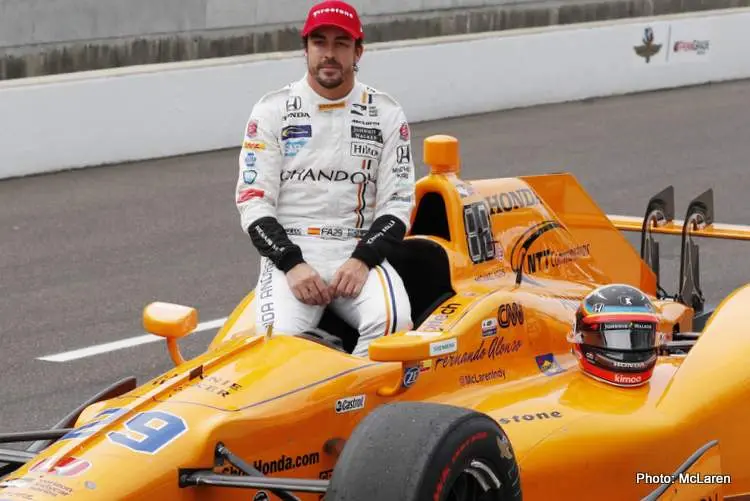
Fernando Alonso

The Spanish racing driver currently racing for Aston Martin in the Formula 1 is probably the closest man to winning the Triple Crown.
His wins of the Formula One World Championships in 2005 and 2006, as well Monaco Grand Prix victories in 2006 and 2007, and Le Mans wins in 2018 and 2019 put him within reach in both versions of the Motorsport Triple Crown.
Born on the 29th of July 1981 in Oviedo, Asturias, Alonso has had a spectacular career, rivaling Hill's two Championship wins.
Alonso still holds the honor, of being the only Spaniard to win a World Championship. Alonso became the first Spanish Grand Prix winner with his victory at the Hungarian Grand Prix in 2003.
Alonso is often referred to as one of the greatest Formula One drivers in the history of the sport. With fellow drivers commenting on his fast and consistent driving style, in all weather conditions and on all tracks. It has been said, that Alonso has an acute sense of the grip in turns and can keep the car on the edge of adhesion.
Juan Pablo Montoya And Jacques Villeneuve

According to the current version, Juan Pablo Montoya is close behind Alonso in attaining the Motorsport Triple Crown. Montoya won the Monaco Grand Prix in 2003 and the Indianapolis 500 twice in 2000 and 2015, missing a win at Le Mans. The Colombian racing driver is five years Alonso's senior at 48 years of age.
The Canadian Jacques Villeneuve is currently 53 years of age. His wins at the 1995 Indianapolis 500 and the 1997 Formula One World Championship, put him one win away from an original version Motorsport Triple Crown, missing a win at Le Mans.
In The End
Motorsports are such an exciting pastime. They have a direct benefit for the drivers and engineers they employee, but also for the race fans that love to watch. The technology that develops through the high level of investment benefits regular car users as well as sports car owners, with innovations being implemented down the line.
Team management, pit stop pace, material development, engine testing and driver commitment are at an all time high. Drivers that push past their own limits and styles of driving, and enter races in different divisions, stay true to what attracted them to the sport in the first place - the unbridled joy of speed and competition.
Racing is not only an adrenaline-pumping competitive activity but also a symbol of culture and passion. Customized embroidered patches have become a unique way for fans to show their support for teams and drivers.
Custom Patches Canada can be designed with favorite team logos, driver numbers, or classic racing patterns. Whether they are sewn on clothing, hats, or backpacks, customized patches allow fans to show their personality and love for racing.
In racing events, fans often wear clothing with these customized patches to cheer for their favorite drivers. This unique cultural phenomenon not only enhances the cohesion among fans but also adds more humanistic colors to racing.
Latest News
Loading