Note to reader: This is not a Formula 1 story, perhaps even the antithesis of the top flight... nevertheless, it is an amazing story of the fascinating people and machines that have made their mark on the history of motorsport, thanks to Porsche we are enlightened by a maverick motor racing hero Otto Mathé and his crazy race car.
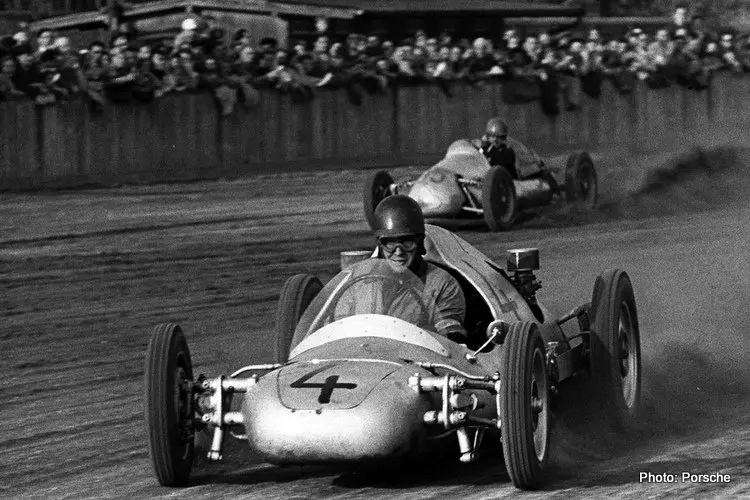
The Fetzenflieger - the Flying Shreds, go figure - an extraordinary nickname for an exceptional vehicle and its incredible owner/driver.
Despite his physical disability, Austrian race driver Otto Mathé celebrated many successes at the wheel of his self-built car that had a Porsche factory racing engine.
Mathé was left with one functional arm after a motorcycle accident during a race in September 1934, resulting in his right-arm being paralysed below the elbow.
Not that it stopped him from continuing to actively participate in motorsport – quite the opposite, Mathé took a “double or nothing” approach to racing and switched to four wheels.
Giving up was never an option and from that point, his passion for cars was wholly committed to Porsche. In the mid-1950s he became increasingly well known for arriving at his favourite racetracks with a rather unusual vehicle: the Fetzenflieger.
Combining Volkswagen components with Porsche engine-performance made the Monoposto, technically, a Formula 2 car. But Mathé also always kept available a set of bolt-on mudguards, lighting, a second seat and a spare wheel, so in next to no time his contraption was ready to compete in other racing series as and where needed.
With the gear lever installed on the left – the side of his still-functional hand – he would lean against the steering wheel to change gear: a technique that made the Austrian world-famous.
And in spite of his physical disability, Mathè regularly outclassed the competition, leaving even the keenest drivers in his dust.
The peculiar Porsche turbocharged Otto Mathé’s career. The self-built racing car, with hand-crafted aluminium skin accommodating a 1.5-litre factory racing engine (Spyder), and later a Fuhrmann engine from the 356 A Carrera GT, is certainly one of the most unusual Porsche racing cars ever seen.
The extremely low centre of gravity, short wheelbase, and engine installed in front of the rear axle result in extraordinary driving characteristics, while a kerb weight of just 395 kilograms and 130 PS enable acceleration to more than 200 km/h.
But it’s not just for those qualities that the bizarre nickname of Fetzenflieger – or “Flying Shreds” – was coined for the car.
The reason being, Mathé would leave the side panelling open in order to facilitate quicker changing of the spark plugs when needed.
All that protected the carburettors from incoming dirt were two overlapping fabric tarpaulins, which also functioned as air filters, while occasionally misfiring and igniting the fabric, the strange car leaving a trail of flaming fabric in its wake.
The Fetzenflieger was primarily used for sand track racing and ice races; an example of the latter is the legendary race commemorating Ferdinand Porsche in Zell-am-See.
Mathé set a record time there in 1956, completing the four-kilometre icy course in just 157 seconds – leaving Porsche PR boss and racing driver Huschke von Hanstein and Richard von Frankenberg trailing.
On that day, around 3,000 motorsport fans were captivated by the Fetzenflieger at the foot of the Großglockner.
Mathé, who Niki Lauda has often described as his childhood hero, passed away in 1995.
Source: Porsche
Latest News



Loading