With the summer break now in full swing, I thought it appropriate to dig into a couple of technical questions I have seen posed in the GrandPrix247 comments section.
In my very first "Tech Draft Explained" column, I will attempt to explore queries related to Formula 1 technical matters that readers might like explored further.
Recently, a user named "Camber” asked the following: “Could you explain to us in an article what the effect was on the Red Bull car with the complete bargeboard missing on the right side and how difficult it is to drive the car?”
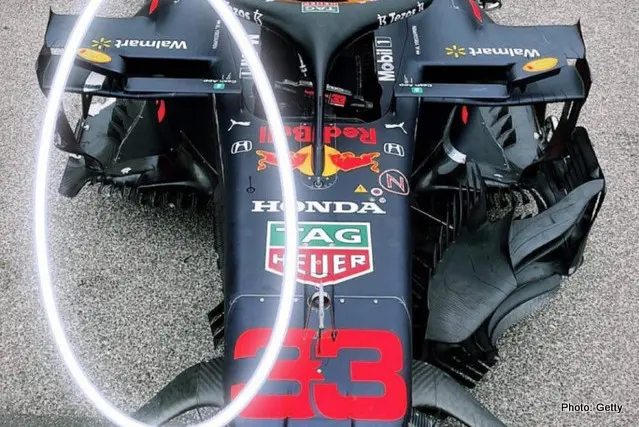
The first corner accident at the recent 2021 Hungarian Grand Prix in which Max Verstappen’s right hand side bargeboard was destroyed had such an impact on the performance of the RB16B that Christian Horner compared the compromised aerodynamic loadings saying: “He probably had less downforce than Mick Schumacher today”
I must confess right now that I feel that statement is probably conservative and upon looking at the damage, the effect may have been even greater.
Before detailing the damage to the RB16B and the impact it had on the cars performance it is important to briefly explain what a bargeboard is and what function it serves.
Bargeboards were introduced into F1 in 1993 by McLaren on the MP4/8 and are the curved group of vertical bodywork pieces located longitudinally between the front wheels and the sidepods and they serve a purely aerodynamic role.
The bargeboard serves two important functions; conditioning the flow of turbulent wake caused by the front wings, front suspension members and rotating front tyres, redirecting it away from the rear aerodynamic devices and around the sidepods, and to energise vortices to help in the sealing of the aerodynamic floor device and help with its flow separation.
In modern times, bargeboards have also become critical in the conditioning and energising of flows associated with tyre squirt, which is the flow that is deflected off the rotating rear tyre laterally into the diffuser path.
A more simplistic explanation would be that bargeboards condition and energise the airflow heading towards the rear wing and the rear diffuser to maximise downforce.
During the red flag period in pit lane during the race Red Bull had only enough time to remove and secure broken and loose parts from the right hand side bargeboard assembly of Verstappen’s car and as a result during the remainder of the race the flow rearwards on his car would have been significantly more turbulent on the right hand side with a profound impact on rear downforce, with associated imbalances between the left and right hand flows at the rear and front to rear aerodynamic imbalance.
The compromised downforce and imbalances would have certainly impacted on tyre loadings resulting in terrible oversteer, excessive lateral scrub, tyre surface overheating, higher tyre compound degradation and potential graining and braking performance would have also been severely compromised.
Not only would the rear aerodynamic devices have been upset, but airflow around the sidepods would have also been impacted, resulting in compromised cooling efficiency and probable compromises in engine performance.
Quantifying the impact of the damage to Verstappen's car in lap time is difficult, but the 80 second delta to the race winner is a fair indication of how important the bargeboard assembly as an aerodynamic device is to a modern F1 car, and that indeed F1 is so reliant and sensitive with its aerodynamic balances.
Now that the first "Tech Draft Explained" is out the way, thanks to "Camber" for the great question.
I would like to highlight again that if you have any questions that you would like me to answer directly in this column, please feel free to email me via the GP247 contact form and I will endeavour to respond as soon as I can.
Latest News

Loading