Since joining the Formula One calendar every Singapore Grand Prix has come to within four minutes of the series’ mandated two-hour time limit.
Last year’s race was the longest, eclipsing the two-hour mark by three minutes and 23 seconds, beating the previous record from the 2015 Singapore Grand Prix, which ended 1 minute and 22 seconds past the two-hour limit.
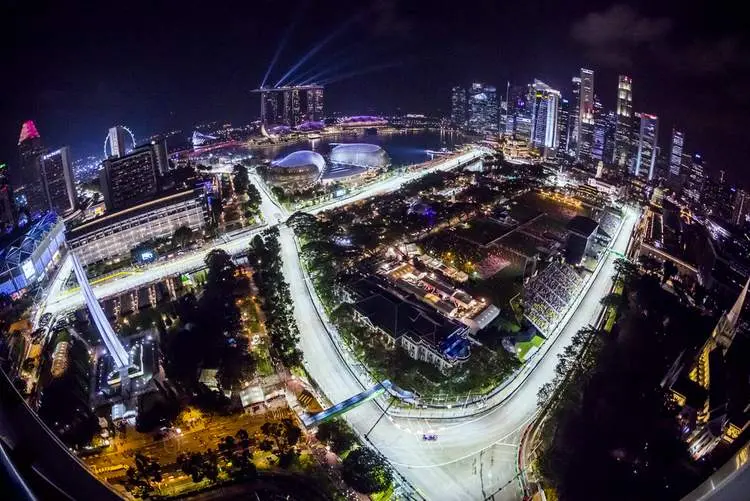
No one complains, however, as Singapore is a destination venue on the Formula One calendar. Its cutting-edge culture and incredible modernization have turned the tropical island located only one degree north of the equator into a global hub for business and tourism, with Formula One’s visit to the world’s only island city-state combining both in glorious fashion.
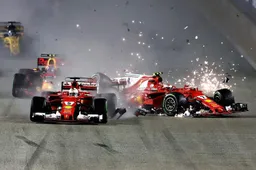
Fans are treated to a sensory assault that can only be found at Marina Bay Street Circuit. A hallmark of the Singapore Grand Prix is the track’s lights shimmering off the cars’ sinewy shapes as they shoot down the straights at 300 kph (186 mph) while sparks fly from their underbodies.
Augmenting the awesomeness of 20 Formula One cars screaming around this elaborate track is the prowess drivers must have to keep their cars in one piece. The walls surrounding Marina Bay Street Circuit are unforgiving, but in order for a driver to wring every ounce of speed from his racecar, he must dance with those walls while navigating the numerous bumps of the track’s surface.
If that’s not enough, Singapore in September is hot. Really hot. And for added measure, really humid. As much as the Singapore Grand Prix is run at night for aesthetic purposes, nighttime is the coolest time for drivers and spectators alike. Nonetheless, temperatures inside the racecar can reach 60 degrees Celsius (140 degrees Fahrenheit).
Despite the tough track and equally tough environs, the Singapore Grand Prix is embraced by drivers. The electric atmosphere of the city and the beauty of Formula One at night, where exhaust flames and glowing brake discs provide a technicolor display that goes unnoticed in daylight hours, are appreciated by the drivers. It’s a modern-day Monaco.
The Essentials
- Focus points Slow-speed grip. Most of the corners are taken in either second or third gear, so getting the power down effectively at slow speeds is crucial to lap-time. This is particularly difficult at the start of the weekend, when the asphalt is very dirty and slippery.
- Unique difficulty The lights. The Singapore Grand Prix begins two hours after sunset and the track is lit up by 1,500 lamps, positioned six metres above the asphalt. The artificial light takes some getting used to by the drivers and, although the start of last year’s race was damp, the impact of a fully wet race on visibility has yet to be established.
- Biggest challenge Heat and humidity. The ambient temperature rarely drops below 30 degrees and with humidity levels of around 85 per cent, this race is now the most physically demanding in F1. It’s also the longest race of the year, regularly exceeding the FIA’s two-hour time limit, and drivers expect to lose up to three kilos in sweat during the race.
Race Engineer's Lowdown
- Braking Heavy. There are 15 braking events per lap, which is more than at any other circuit in F1. The drivers spend, on average, 22s per lap on the brakes and the peak deceleration is 4.7g into Turn Seven.
- Power The cars use 1.9kg of fuel per lap, which is high. Fuel consumption is a consideration for the teams at this race.
- Aero Maximum downforce. The circuit’s average speed is only 8mph (13km/h) higher than at Monaco, so the engineering emphasis is on slow-speed grip, good turn-in and traction.
Statistics for Sunday’s Singapore Grand Prix at the Marina Bay Street Circuit:
- Lap distance: 5.065km. Total distance: 308.828km (61 laps)
- 2017 pole: Sebastian Vettel (Germany) Ferrari One minute 39.491 seconds.
- 2017 winner: Lewis Hamilton (Britain) Mercedes
- Race lap record: Hamilton, Mercedes 2017: 1:45.008
- Start time: 2010 local (1210 GMT)
Singapore Grand Prix
- Sunday’s race is the 11th in Singapore, the first night-time grand prix upon its introduction in 2008.
- Only four drivers have won at the circuit — Fernando Alonso (2008, 2010), Vettel (2011, 2012, 2013 and 2015), Hamilton (2009, 2014, 2017), Nico Rosberg (2016).
- Red Bull and Mercedes have won the race three times, Ferrari twice.
- Red Bull’s Daniel Ricciardo has twice finished second and twice set the fastest lap. He is going for a fifth successive Singapore podium.
- Vettel has been on pole four times in Singapore, more than anyone else, but only in odd years. Hamilton has three poles. The race has been won from pole position on seven occasions.
- The lowest winning grid position was Alonso, who came from 15th in a now-notorious 2008 race where Brazilian teammate Nelson Piquet crashed his Renault deliberately on team orders.
- There has been at least one safety car intervention in every race in Singapore so far. Last year’s had three.
- The race is the longest on the calendar in terms of time taken to complete and runs close to the two-hour limit.
- The winner in Singapore has been champion at the end of the season in six of the last seven years.
- Vettel has been on the podium six times to Hamilton’s five.
Race Victories
- Hamilton has six wins this season to Vettel’s five. Ricciardo has two and Max Verstappen one.
- Hamilton has 68 victories from 222 races and is second in the all-time list behind seven-times world champion Michael Schumacher (91). Vettel, now third on the all-time list, has 52, Ricciardo seven.
- Ferrari’s Kimi Raikkonen has now gone 108 races since his last win, in Australia in 2013.
- Ferrari have won 234 races since 1950, McLaren 182, Williams 114, Mercedes 82 and Red Bull 58. Former champions McLaren and Williams have not won since 2012.
Pole Position
- Hamilton has a record 78 career poles, Vettel 55.
- Verstappen, at 20-years-old, can still become the youngest ever pole sitter this season. The current youngest is Vettel, who did it aged 21 years and 72 days.
- Verstappen’s birthday is on Sept. 30.
Podiums
- Hamilton has 128 career podiums and is second on the all-time list behind Schumacher (155). Vettel has 107, Raikkonen 100.
- Mercedes’ Valtteri Bottas has had five second-place finishes in 14 races.
Milestones
- Renault’s Nico Hulkenberg will be making his 150th start on Sunday. The German holds the record for most races without finishing on the podium.
- Verstappen, Carlos Sainz and Kevin Magnussen will be chalking up 75 starts each.
- Raikkonen took his 100th career podium finish at the previous race in Italy.
- Hamilton set the fastest lap at Monza, taking his career tally to 40. He is only the fourth driver to reach that mark. The others are Schumacher (77), Raikkonen (46) and Alain Prost (41). Vettel is on 34.
Championship Points
- Hamilton leads Vettel by 30 points with seven races left
- Mercedes are 25 points ahead of Ferrari in the constructors’ championship.
- Sergey Sirotkin’s 10th place at Monza meant every driver on the starting grid has now scored this season.

The Marina Bay street circuit in Singapore provides a completely different set of challenges compared to the last two events, with emphasis on performance shifting back towards the chassis, and overall grip, with Aerodynamic efficiency of less importance. The different track nature, together with the presence of upgrades being likely for a number of teams, means that the pecking order may bear no resemblance to Monza.
Downforce vs Drag
- Every team will run their maximum downforce rear wing for Singapore, and use the front wing as a balancing device to optimise performance in slow-speed corners, which dominate the entire lap.
- The only straight of significance that is not DRS assisted is between Turns 13 and 14, so drag levels are not important to overall lap time as was the case in Italy.

Car Strengths Needed
- High downforce partly determines lap time around Singapore, although given that Aerodynamic importance rises with the square of speed, the slow nature of the track rewards mechanical grip highly in addition.
- Being a street circuit, driver confidence is key so a drivable car with a good Aero balance is important to allow use of the entire track width.
- Traction is also vital from the multiple acceleration zones, both for qualifying and the race, the latter requiring thermal management of the rear tyres.
Key Corners
- Turn 5 – this corner requires a strong front end to allow the driver to use full power as early as possible heading on to the following straight, which provides an opportunity to overtake with the use of DRS.
- Turns 13/16 – braking and turning simultaneously is required thanks to kinked, blind entries, making cars prone to front tyre locking.
- Turns 22/23 – these corners are the only high speed turns on the track but will test a car’s outright Aerodynamic performance.
Tyres

- Pirelli is bringing the softest trio of compounds in its range, as was the case last year. Therefore, the HyperSoft makes its third appearance of the year.
- In 2017, the strategy was likely to be a one-stop affair although certainty in this is clouded by the fact that the first part of the race was wet. However, multiple drivers were able to subsequently run for 30 laps on last year’s UltraSoft (this year’s SuperSoft) without trouble. The caveat is that the first few laps of their stints would have been at reduced speed on a drying lap.
- Given the improved tyre management of teams from last year, it would be reasonable to expect around half of the race could be managed on this year’s UltraSoft tyre.
- With the significantly lower durability of the HyperSoft tyre, it may only be possible to do a one-stop strategy using the Soft, which should be able to complete most, if not all of the race distance, together with the HyperSoft (or UltraSoft).
- However, if a late race safety car occurs, as is often the case in this event, then those running long with an old set of a harder compound will be vulnerable to drivers behind who will have pitted for fresh HyperSoft or UltraSoft tyres, and be lapping multiple seconds faster.

Overtaking/DRS
- Overtaking chances are limited, but there are two reasonable DRS zones which making racing possible, unlike in Monaco.
- The most popular overtaking spot is into Turn 7, with the multiple slow corners before the DRS zone out of Turn 5 allowing cars to follow each other closely.
- As mentioned above, late safety cars can result in cars having significantly different tyre performance, thereby creating close racing.
Weather
- As is always the case in Singapore, rain is forecast on all three days.
- The almost daily downpours usually occur prior to F1 session times, thereby being most likely to affect FP1 and FP3. It is possible, however, as was the case in 2017, that the rain can arrive later in the day.
- Given the difficulty of the track, teams and drivers will hope for as much dry running as possible to gather data on set-up options and tyre performance.
Form Guide
- The pecking order should resemble that seen in Monaco and Hungary.
- Therefore, Ferrari and Red Bull could be closely matched, with Mercedes a little further behind, on what is the Champions’ weakest track of the season.
- Behind the top three, a tight battle will take place for best of the rest honours, with Force India bringing a major upgrade package, originally scheduled for before the summer break, but delayed due to financial issues.


loading
Latest News
Loading