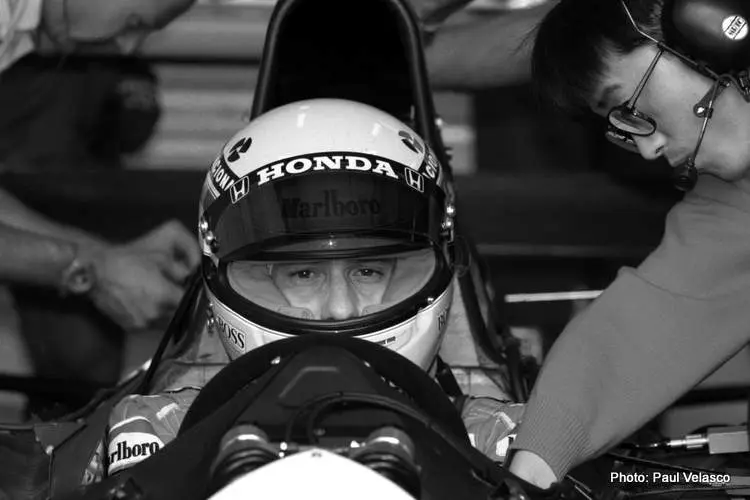
A rare and deeply personal interview with Ayrton Senna, conducted in 1991 by Dr Jacques Dallaire, offers remarkable insight into the mindset of the late Formula 1 legend at the peak of his powers.
Senna, by then a double World Champion with McLaren, sat down with Dallaire after the Canadian Grand Prix for an open and unfiltered discussion about the qualities that define great drivers, the mental and physical demands of racing, and the spiritual dimensions that shaped his life and career.
Below is an overview of the interview conducted by Dr Dallaire, but the real deal, full transcript: a 7,442-word opus is well worthy of a read when time permits you. Link here>>>
Senna believed greatness in racing began with early exposure but was fundamentally rooted in instinct and mindset, he told Dr Dallaire: “If you start really young… it becomes part of you. You always have the basics for doing what you’re doing.”
He warned that experience alone meant little without something innate: “Even if you are 20, 30, 40 years old, with all the experience you have at that time, it almost may not count for very much.”
For Senna, the key was an inner sense of purpose and direction. “It’s really a question of just… because it’s there. It’s been part of you right from your existence.”
Self-confidence, fear, and the danger of ego

Senna placed enormous value on self-confidence—but only when channelled correctly: “There are different ways of being self-confident,” he said. “If you mix it with ego… then you have a negative effect.”
He explained that confidence must always be paired with respect for danger and for others: “I always consider the competition being technically as realistically as possible and sometimes even try to be a little pessimistic… to create the right attitude for yourself.”
That humility extended to fear: “There is certainly the fear factor,” said Senna. “I cope with it and use it most of the time for self-preservation.”
Despite his reputation for spiritual introspection and instinctive driving, Senna spoke extensively about the importance of physical preparation and its effect on mindset. “You can have all the desire, the will… but if your body doesn’t follow it, you’ll not be a total."
He stressed the value of self-monitoring and personal data collection: “You keep all this data… then you can see how much you improved.”
Improvement, he explained, was both physical and mental. “As you improve it, your mind gets stronger too because you know you are better… you can cope with those difficulties much better.”
Senna: Spirituality was central to everything

The most revealing part of the interview came when Senna described how his spiritual growth had helped him cope with the intensity of racing and life.
“It’s something I developed a lot over the past three years… it has helped me immensely,” Sennas said, and explained that a sense of peace and spiritual receptiveness was vital: “Once you are open and you are prepared enough for that… it brings you a feeling that you are total.”
Senna saw racing as a journey to self-mastery: “Through racing I get to know myself better and better… it has become an exercise for me and a way of living.”
When asked about concentration, performance, and flow, Senna described his pursuit of perfection in almost cybernetic terms: “I never reached 100% so far. As much as I try… I always aim for more from myself.”
He described “flow” as a state where “everything flows… the real qualities that you have take over above anything else.” But he also warned of the mental toll: “This personal design to do better and better… it can eventually break you down. You know… damage you.”
Senna saw his eventual retirement not as an escape, but as a necessary rebalancing: “Eventually I’ll have to compensate for the stress… to bring back later some balance to my life.”

Thought-provoking quotes from Ayrton Senna's interview with Dr Jacques Dallaire
- “If you start really young, it becomes part of you—it’s not something you suddenly learn.”
- “At critical moments, it’s really mind work, not body work.”
- “You can be confident, but if it becomes ego, you lose your grounding.”
- “Positive self-confidence is the key to triggering a system that goes stronger, stronger, stronger.”
- “Fear is always there—what matters is how you use it.”
- “If your body doesn’t function, doesn’t follow your mind, you are only part of it.”
- “You must sacrifice comfort now for rewards later—you always know when you’re making that choice.”
- “You need a clear target to cope with the boring, the difficult, the stressful.”
- “Determination is more important than anything else—it’s what pushes you to give without having much.”
- “Even anger or negativity can be fuel if you know how to use it.”
- “I talk to myself during races—it keeps me alert and on the line where I perform best.”
- “You can give too much for what you’re getting—you need to pull yourself back sometimes.”
- “Through repetition and reflection, you learn where you function best—and how to get back there.”
- “All the important memories live in your system—not just your mind, but your body too.”
- “What you see in my behaviour isn’t what is really happening inside of me.”
- “Once you’ve felt spiritual peace, you can’t live without it—it becomes part of you.”
- “When you find your flow, everything works with less effort and more precision.”
- “The challenge is what brings flow—the motivation to meet the target is the trigger.”
- “Through racing, I get to know myself better and better—as a driver and as a man.”
- “Once you win, it becomes harder to stay motivated—you have to search for new meaning.”
Latest News
Loading

