Sainz: I can give a lot of feedback on what this car is missing
F1 NewsFriday, 08 August 2025 at 13:19
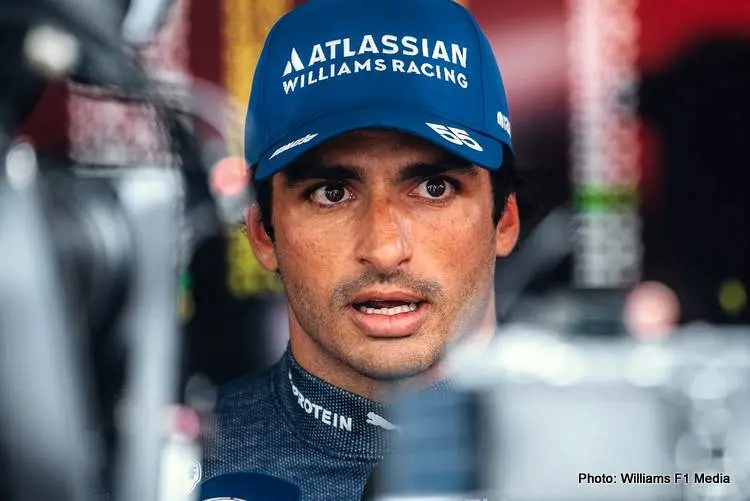
Carlos Sainz says his team must rethink its car philosophy for 2026 after another disappointing result in Hungary exposed the Williams FW47’s persistent aerodynamic flaws, insisting he has valuable feedback to improve the operation at Grove.
Williams driver Sainz, who finished P14 in Budapest, has repeatedly flagged the car’s poor performance in long-radius corners, where Williams continues to fall behind: “We have poorer aerodynamic characteristics in long corners, where you need to maintain downforce from entry to the middle of the corner.
"These things fail us; it's been a long-standing tendency, which is why short corners and straights suit us better,” Sainz explained to AS. “On tracks like Barcelona, Hungary, or Qatar, the car suffers; a change in design philosophy is needed to ensure next year's car performs well on different circuits.”
Williams opted to freeze development of the FW47 early in the year to shift resources toward the 2026 rules overhaul. That left Sainz, who joined from Ferrari, with little room to influence the current car despite giving detailed feedback since pre-season testing.
No upgrades since February as patterns emerge

Sainz’s transition to Williams began with back-to-back runs in the Ferrari and the FW47 at the Abu Dhabi test, giving him a direct comparison between the two cars. While he immediately pointed out key weaknesses, Williams only introduced one upgrade package in February and has not added any new parts since.
The team currently sits P5 in the Constructors’ Championship with 70 points, but performance has been erratic. Excluding the rain-affected Australian Grand Prix, Williams has scored double-digit points at only three venues—Miami, Imola and Spa—and failed to score entirely in Bahrain, Barcelona, Austria, and Hungary.
In Sakhir, Sainz retired after contact with Yuki Tsunoda while fighting for the top ten. But in Spain, Austria and Hungary, the Williams car was simply out of its depth, undone by the same aerodynamic deficit that continues to plague them on longer corners.
Sainz recalled: “At the beginning of the season, this negative quality was accentuated in my case because I tend to enter the corner while braking, placing greater aerodynamic demands on the front end.
“Hungary has always been a difficult track for the team. We had a long meeting after qualifying because I've gone from a team that was on pole to one that's 13th. I can give a lot of feedback on what this car is missing at a circuit like this,” Sainz insisted.
The Williams FW47 is flawed and inconsistent

The FW47 has generally struggled on high-downforce circuits regardless of corner type, but has performed well on straights or at lower drag levels. That makes upcoming rounds in Monza, Baku and Las Vegas critical opportunities for points.
Sainz, however, is clear that with no new parts on the horizon, weekend execution is now everything: “For my part, in the short term, I'm focusing on the execution of the weekends. There's nothing you can do about the aerodynamics or the setup,.
"I tried three or four different ones in Hungary and ended up going back to the car that gave me competitive qualifying runs in Miami and Imola. I'll make sure we have clean weekends. If we had had that at Spa, Miami, or Imola, we would have scored a lot of points.”
Sainz’s frustration is understandable. In 2024, he was winning races for Ferrari. In 2025, he’s in debriefs explaining why P13 in qualifying is the new benchmark. For now, the hard truth remains: unless Williams can deliver a fundamentally different car next year, the only fight Sainz will have is to find another top team.
Latest News




Loading

