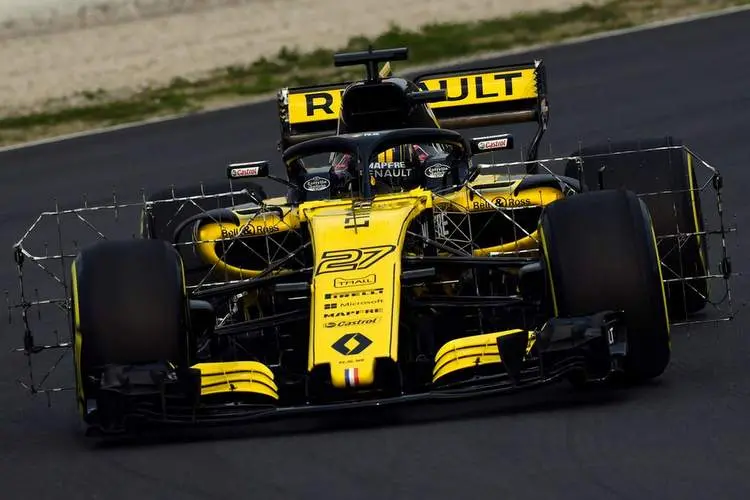
Renault have targeted delivering the same power with their 2018 engine early on in the season as they did at the end of last year, with reliability sorted out and under control for the first race in Melbourne, and thereafter developing the engine as the 2018 Formula 1 season progresses.
Renault F1 managing director Cyril Abiteboul told, "We have decided voluntarily to make some compromises for engine number one in order to make sure that we have got the right platform. If you come to the first race and you start to have reliability problems, then that is not just that race - it compromises the whole season. You cannot afford to do that."
"It is about setting the right baseline, having the right platform and building a plan for the season - trying in particular to synchronise development at the factory with the introduction of new engines because we are very limited."
"The fewer engines you have the more rigid you need to be in the implementation of performance. So the focus is very much on reliability."
Compared to Ferrari and Mercedes, reliability was at times embarrassing for Renault, particularly in the latter third of the season. Addressing these issues has been and continues to be the priority.
Abuteboul explained, "We have covered 11 times the mileage on the dyno that we had covered at the same point last year - and we are aiming to have 70000km on the dyno by race one - which is huge. It is something that we have never done since the introduction of the V6."
"But when we will be on track, we will need to sign off a number of things and this is particularly the plan for T9 [test one] - to make sure that there is no disconnect between track and dyno."
"So don't look at the lap time in T9 because everything will be massively tuned down for obvious reasons, but T10 [test two] we want to run in a more representative mode."
This would mean that Renault will have slipped a notch or two if Mercedes and Ferrari have found some extra horsepower in the winter.
Abiteboul confirmed the conservative call, "Our target is more or less to start in Melbourne with the same performance level as we finished in Abu Dhabi - which is actually quite a decent performance baseline."
"And then we want to make it much more reliable, and make it in a way that we can extract the power in a consistent and sustainable manner - and not have to turn down the engine because of reliability or temperature concerns. That is the baseline."
"Clearly power unit number two will be a step and power unit three will be another step," concluded Abiteboul without mentioning the timeline for the next two steps.
Latest News


Loading